The Floral Oracle by Catherine and Nagasiva Yronwode: Difference between revisions
(edit and save) |
(cosmos) |
||
| (96 intermediate revisions by 2 users not shown) | |||
| Line 2: | Line 2: | ||
[[File:American-Scale-Company-Your-Wate-and-Fate-Logo.jpg|left|150px|thumb]] | [[File:American-Scale-Company-Your-Wate-and-Fate-Logo.jpg|left|150px|thumb]] | ||
[[File:2022-09-07-Tier-1-YWAF-Fortunes-in-Flowers.jpg|right| | [[File:2022-09-07-Tier-1-YWAF-Fortunes-in-Flowers.jpg|right|200px|thumb|The Floral Oracle, Part One]] | ||
[[File:2023-09-14-Release-YWAF-Fortunes-in-Flowers.jpg|right| | [[File:2023-09-14-Release-YWAF-Fortunes-in-Flowers.jpg|right|200px|thumb|The Floral Oracle, Part Two]] | ||
[[File:2023-11-07-Release-YWAF-Prophetic-Petals.jpg|right| | [[File:2023-11-07-Release-YWAF-Prophetic-Petals.jpg|right|200px|thumb|The Floral Oracle, Part Three]] | ||
[[File:2023-11-14-Release-YWAF-Oracular-Posies.jpg|right| | [[File:2023-11-14-Release-YWAF-Oracular-Posies.jpg|right|200px|thumb|The Floral Oracle, Part Four]] | ||
The Floral Oracle began as four installments of "Your Wate and Fate," My Patreon supporters had access to the work a year before the public. | The Floral Oracle began as four installments of "Your Wate and Fate," My Patreon supporters had access to the work a year before the public. | ||
| Line 27: | Line 27: | ||
(Wait. Stop. If you don't know about '''[http://hoodoopsychics.com HoodooPsychics.com]''', it is the coolest psychic line on the internet. Go to '''[http://hoodoopsychics.com HoodooPsychics.com]''' right now and check it out. If you go to the '''[http://facebook.com/hoodoopsychics Hoodoo Psychics Facebook page at facebook.com/hoodoopsychics]''' and like it, you can sign up for a FREE PSYCHIC READING GIVEAWAY every Monday, and if you win, you can pick any '''[http://hoodoopsychics.com HoodooPsychics.com]''' reader you want, including me!) | (Wait. Stop. If you don't know about '''[http://hoodoopsychics.com HoodooPsychics.com]''', it is the coolest psychic line on the internet. Go to '''[http://hoodoopsychics.com HoodooPsychics.com]''' right now and check it out. If you go to the '''[http://facebook.com/hoodoopsychics Hoodoo Psychics Facebook page at facebook.com/hoodoopsychics]''' and like it, you can sign up for a FREE PSYCHIC READING GIVEAWAY every Monday, and if you win, you can pick any '''[http://hoodoopsychics.com HoodooPsychics.com]''' reader you want, including me!) | ||
Okay, so starting in October 2020, i made a commitment to go live on '''[http://hoodoopsychics.com HoodooPsychics.com]''' once a week. To let people know when i was available, i wrote, and siva photoshopped, one entry of [[:Category:Floriography|floral symbolism]] each week, to fit the Facebook | Okay, so starting in October 2020, i made a commitment to go live on '''[http://hoodoopsychics.com HoodooPsychics.com]''' once a week. To let people know when i was available, i wrote, and siva photoshopped, one entry of [[:Category:Floriography|floral symbolism]] each week, to fit the '''[http://facebook.com/luckymojocurio Lucky Mojo Facebook]''' and '''[http://forum.luckymojo.com Lucky Mojo Forum]''' formats. For research, i consulted my collection of antique 19th century [[:Category:Floriography|floriography]] books and early 20th century postcards on [[:Category:Floriography|the Language of Flowers]]. This is an unusual project for us, since i am doing the writing and he is producing the art. Through these ads we were able to give folks a taste of floriography and to promote my reading career at the same time. | ||
[[File:2023-04-02-LMHR-Oracle-Hour-Ad.jpg|center|300px|thumb|[https://tolmcrn.com/HRH686 The Floral Oracle, April 2, 2023]]] | |||
In April 2023, i introduced my ongoing work on '''[[:Category:Floriography|Floriography]]''' to the public with a tutorial on the Lucky Mojo Hoodoo Rootwork Hour. '''Tune in online to listen: [https://tolmcrn.com/HRH686 Floriography with Catherine Yronwode]''' | In April 2023, i introduced my ongoing work on '''[[:Category:Floriography|Floriography]]''' to the public with a tutorial on the Lucky Mojo Hoodoo Rootwork Hour. '''Tune in online to listen: [https://tolmcrn.com/HRH686 Floriography with Catherine Yronwode]''' | ||
Skip to the bottom of this page if you want the back-story of how The Floral Oracle came to be, and how its popularity has grown. | |||
= A Symbolic Bouquet of Meaningful Blossoms = | = A Symbolic Bouquet of Meaningful Blossoms = | ||
| Line 58: | Line 42: | ||
so it will come up | so it will come up | ||
- | - | ||
spirea, pink has been written and she doesn't | |||
know if we got a picture | know if we got a picture | ||
- | - | ||
love lies bleeding we need to do it | love lies bleeding we need to do it | ||
- | - | ||
rice we need to do it pair with wheat? | rice we need to do it pair with wheat? | ||
| Line 73: | Line 55: | ||
<gallery widths="400px" heights="450px" perrow="3" align="center; cellspacing=8px; cellpadding: 5px 5px 5px 5px;"> | <gallery widths="400px" heights="450px" perrow="3" align="center; cellspacing=8px; cellpadding: 5px 5px 5px 5px;"> | ||
File:Acacia.jpg|The Acacia is a symbol the afterlife and of the persistence of the spirit after death. In Freemasonry it symbolizes the | File:Acacia.jpg|The Acacia is a symbol the afterlife and of the persistence of the spirit after death. In Freemasonry it symbolizes the Immortality of the Soul and is employed in funerary services, and in traditional Judaism it is the custom to plant an Acacia on the grave of a loved one. Acacia wood, which is quite resistant to decay, is also mentioned in the Bible as the wood from which both Aaron's rod and the Ark of the Covenant were made. Branches of blooming Acacia make a sturdy bouquet for the bereaved; but some people sneeze when Acacia is in bloom. | ||
File:Acanthus.jpg|Acanthus, also called Bear's Breeches, is a Mediterranean genus whose best-known species is ''Acanthus mollis,'' a large evergreen perennial with shiny leaves that sends up conspicuous flower spikes bearing dozens of purple-hooded white blossoms. Acanthus gained fame as the model for the leafy scroll-work on the capitals of ancient Greek Corinthian columns and it has persisted as a motif in art, architecture, and furniture ever since. Due to its multi-millennia-long use in decoration, the | File:Acanthus.jpg|Acanthus, also called Bear's Breeches, is a Mediterranean genus whose best-known species is ''Acanthus mollis,'' a large evergreen perennial with shiny leaves that sends up conspicuous flower spikes bearing dozens of purple-hooded white blossoms. Acanthus gained fame as the model for the leafy scroll-work on the capitals of ancient Greek Corinthian columns and it has persisted as a motif in art, architecture, and furniture ever since. Due to its multi-millennia-long use in decoration, the Acanthus symbolizes Fine Art, Craftsmanship, and Good Taste. | ||
File:Aloe.jpg|Aloe Vera is a member of the Lily family. The thick gelatinous juice found within its succulent green leaves has a long history of use in natural medicine, particularly for treating sunburn, skin irritations, and superficial scrapes. Because it supports the repair of damaged skin, it is associated with Health and Beauty, and its gracefully arrayed leaves symbolize Spiritual Well-Being and Resilience. Aloe is considered a lucky house plant in Chinese Feng Shui, and is said to eliminate negative energies if grown in the East or North of your home or work space. | File:Aloe.jpg|Aloe Vera is a member of the Lily family. The thick gelatinous juice found within its succulent green leaves has a long history of use in natural medicine, particularly for treating sunburn, skin irritations, and superficial scrapes. Because it supports the repair of damaged skin, it is associated with Health and Beauty, and its gracefully arrayed leaves symbolize Spiritual Well-Being and Resilience. Aloe is considered a lucky house plant in Chinese Feng Shui, and is said to eliminate negative energies if grown in the East or North of your home or work space. | ||
File:Althaea.jpg|The Althaea is a symbol of spiritual and therapeutic healing, and of emotional compassion. A member of the Mallow and Hibiscus family, its name means "The Healer" and its mucilaginous root has a long history of medical use in the making of poultices for wounds and decoctions for easing sore throat. In trying times, the Althaea calls in beneficial spirits and helpers who soothe tense thoughts and smooth rough speech. When Althaeas are presented in a bouquet, the meaning is one of caring and amelioration of difficulties, for help is at hand. | File:Althaea.jpg|The Althaea is a symbol of spiritual and therapeutic healing, and of emotional compassion. A member of the Mallow and Hibiscus family, its name means "The Healer" and its mucilaginous root has a long history of medical use in the making of poultices for wounds and decoctions for easing sore throat. In trying times, the Althaea calls in beneficial spirits and helpers who soothe tense thoughts and smooth rough speech. When Althaeas are presented in a bouquet, the meaning is one of caring and amelioration of difficulties, for help is at hand. | ||
File:Alyssum-Basket-of-Gold.jpg|Basket of Gold Alyssum, also known as Yellow Alyssum, Golden Alyssum, Gold-Dust Alyssum, Golden-Tuft Alyssum, Golden-Tuft Madwort, Rock Madwort, and <i>Aurinia saxatilis</i>, is a low-growing evergreen perennial in the Mustard family, native to Europe, Asia, and North Africa. In Greek, Alyssum means "Without Madness," and the plant was once prescribed to treat mental illness, hence the name "Madwort." The flowers are worked into nosegays and tussy-mussies, where they symbolize A Positive Disposition and Happy Thoughts. | |||
File:Amaryllis.jpg|The Amaryllis is a sturdy member of the Lily family. As a symbol of strength, determination, and success it may be given to commemorate a hard-won achievement. It also carries the meanings of beauty and love. Its name is Greek and means "to shine or sparkle." The ancient Greeks said Amaryllis was a young woman who loved a shepherd named Alteo. The Oracle of Delphi told her to stand in front of Alteo’s house for thirty nights piercing her bosom with a golden arrow. On the thirtieth night, a beautiful flower grew from her blood and Alteo gave her his love. | File:Amaryllis.jpg|The Amaryllis is a sturdy member of the Lily family. As a symbol of strength, determination, and success it may be given to commemorate a hard-won achievement. It also carries the meanings of beauty and love. Its name is Greek and means "to shine or sparkle." The ancient Greeks said Amaryllis was a young woman who loved a shepherd named Alteo. The Oracle of Delphi told her to stand in front of Alteo’s house for thirty nights piercing her bosom with a golden arrow. On the thirtieth night, a beautiful flower grew from her blood and Alteo gave her his love. | ||
| Line 88: | Line 72: | ||
File:Apple.jpg|The Apple Blossom symbolizes anticipation, for it is a Spring-time harbinger of coming harvests. Like other members of the Rose family, it has five petals, so the flowers look like tiny Roses. It is an English custom to go into the Apple orchard on January 6th and sing to the oldest bearing tree, encouraging it to flower and bring in a bountiful crop: "Hats full! Caps full! Bushel, bushel, sacks full! And my pockets full too! Hurrah!" Christians relate the Apple to the temptation of Adam and Eve in the Garden of Eden; it thus appears in The Lovers tarot card. | File:Apple.jpg|The Apple Blossom symbolizes anticipation, for it is a Spring-time harbinger of coming harvests. Like other members of the Rose family, it has five petals, so the flowers look like tiny Roses. It is an English custom to go into the Apple orchard on January 6th and sing to the oldest bearing tree, encouraging it to flower and bring in a bountiful crop: "Hats full! Caps full! Bushel, bushel, sacks full! And my pockets full too! Hurrah!" Christians relate the Apple to the temptation of Adam and Eve in the Garden of Eden; it thus appears in The Lovers tarot card. | ||
File:Arborvitae.jpg|Arborvitae or Thuja is a genus of evergreen coniferous trees with flattened branches in the Cypress family, native to Asia and North America. Confusingly, Arborvitae in our Eastern states is called Whitecedar, and Arborvitae in our Western states is called Redcedar, but neither is a member of the Cedar genus of the Pine family, so collectively they are also known as New World False Cedars. Arborvitae is a Latin name meaning "Tree of Life." When added to a floral bouquet or grown near a home, Arborvitae represents Unchanging Friendship. | |||
File:Arbutus.jpg|The Arbutus is a shrub or small tree native to the Mediterranean, Europe, the Canary Islands, and North America, where it is also known as Madrone or Strawberry Tree. It flowers with a bunch of inconspicuous white, Heather-like cups, which identify it as a member of the Heath family. Because its edible berries take so long to ripen, the fruits of the previous season always accompany the current season's flowers. This brings to mind thoughts of fidelity and constancy, and thus a sprig of flowering and fruiting Arbutus proclaims, "Thee Only Do I Love." | File:Arbutus.jpg|The Arbutus is a shrub or small tree native to the Mediterranean, Europe, the Canary Islands, and North America, where it is also known as Madrone or Strawberry Tree. It flowers with a bunch of inconspicuous white, Heather-like cups, which identify it as a member of the Heath family. Because its edible berries take so long to ripen, the fruits of the previous season always accompany the current season's flowers. This brings to mind thoughts of fidelity and constancy, and thus a sprig of flowering and fruiting Arbutus proclaims, "Thee Only Do I Love." | ||
| Line 111: | Line 97: | ||
File:Black-Eyed-Susan.jpg|The Black-Eyed Susan, a member of the large Daisy family, is a symbol of justice, and also represents encouragement and motivation to persist in what is right. It is a hardy native of North America that adapts well to many regions and is the state flower of Maryland. Like other members of its family, the Black-Eyed Susan has a place in herbal medicine, where it provides support to the immune system and is used to treat sores and mild infections. When a bouquet of Black-Eyed Susan is presented as a gift, the message conveyed is one of social and political support. | File:Black-Eyed-Susan.jpg|The Black-Eyed Susan, a member of the large Daisy family, is a symbol of justice, and also represents encouragement and motivation to persist in what is right. It is a hardy native of North America that adapts well to many regions and is the state flower of Maryland. Like other members of its family, the Black-Eyed Susan has a place in herbal medicine, where it provides support to the immune system and is used to treat sores and mild infections. When a bouquet of Black-Eyed Susan is presented as a gift, the message conveyed is one of social and political support. | ||
File:Bleeding-Heart.jpg|The Bleeding Heart, also known as Lady's Locket and Lady's Heart, symbolizes passionate love so deep that its loss would be tragic, the pain of unrequited or lost love, and a compassionate love so strong that one's heart figuratively bleeds for the sorrows of another. Its gracefully arched, 3-foot stems are festooned with dangling pink, red, or white flower hearts, but despite its delicate, exotic appearance, it is actually a hardy plant that endures for decades if its basic needs are met. Perhaps there is a lesson to be learned there about the true nature of love. | File:Black-Locust.jpg| The Black Locust, a deciduous tree that bears cascades of attractive white flowers, is a member of the Fabaceae or Leguminosae family, and thus a relative of Peas, Beans, Clover, Acacia, and Wistaria. Although its leaves and bark are toxic, the flowers are not, and they are used in medicinal teas and fried in fritters. The Black Locust's taxonomic name, ''Robinia pseudoacacia,'' and its alternative common name, False Acacia, point out its affinity to the Acacia, a funerary tree symbolizing immortality, and thus its meaning is, unsurprisingly, Affection Beyond the Grave. | ||
File:Bleeding-Heart.jpg|The Bleeding Heart, also known as Lady's Locket and Lady's Heart, symbolizes passionate love so deep that its loss would be tragic, the pain of unrequited or lost love, and a compassionate love so strong that one's heart figuratively bleeds for the sorrows of another. Its gracefully arched, 3-foot stems are festooned with dangling pink, red, or white flower hearts, but despite its delicate, exotic appearance, it is actually a hardy plant that endures for decades if its basic needs are met. Perhaps there is a lesson to be learned there about the true nature of love. | |||
File:Borage.jpg|Borage, sometimes called Star Flower is an annual Mediterranean plant, now naturalized throughout Europe and North America. Its bright blue flowers are used to decorate salads and deserts, or are frozen in ice cubes to add colour to drinks. The hairy leaves have the scent of cucumber and can be cooked, although excess consumption is a liver toxin. Greeks and Romans steeped Borage in wine for Forgetfulness; in England, Borage honey and flower syrup brought Joy and cured melancholy. Borage flowers also represent Bluntness and Direct Speech. | |||
File: Broom.jpg|Broom is a common name that refers to three related species, Scotch Broom ''(Cytisus scoparius),'' French Broom ''(Genista monspessulana)'', and Dyer's Broom ''(Genista tinctoria).'' All three are shrubby, yellow-flowered members of the Pea and Bean family, native to Europe. Introduced to North America as ornamentals, they soon naturalized and are now considered invasive species. Despite the name "Broom," they are not related to Broom Corn, which belongs to the Grass family. In the Language of Flowers, a sprig of Broom means Modestry and Humility. | |||
File:Buttercup.jpg|The Buttercup, also known as the King Cup or Water Crow-Foot, is in the Ranunculus genus, which contains a phenomenal 1,750 species, most of which bear crowns of golden-yellow or white five-petalled flowers. Buttercups are toxic to most animals, but are a food source for the Hebrew Character Moth. This moth has a mark like the Hebrew letter "nun" ("fish") on each wing; both the letter and the word protect against the evil eye. The meaning of the Buttercup in old books is "I Wish I Was Rich," but modern writers say it means, "You are Radiant with Charm." | |||
File:Butterfly-Bush.jpg|Butterfly Bush, also known as Buddleia, is a genus of 140 species, most of them perennial shrubs with long spires of small four-petaled flowers in shades of blue, lavender, pink, and white. Its habit of growth and bloom-time has led to it being dubbed Summer Lilac, but the two plants are not related. Not only do Buddleias attract Butterflies, they provide nectar for Moths and Bees, making them a great garden choice. Because they readily come back from severe damage and need little care, they symbolize Regeneration and Transformation in Difficult Places. | File:Butterfly-Bush.jpg|Butterfly Bush, also known as Buddleia, is a genus of 140 species, most of them perennial shrubs with long spires of small four-petaled flowers in shades of blue, lavender, pink, and white. Its habit of growth and bloom-time has led to it being dubbed Summer Lilac, but the two plants are not related. Not only do Buddleias attract Butterflies, they provide nectar for Moths and Bees, making them a great garden choice. Because they readily come back from severe damage and need little care, they symbolize Regeneration and Transformation in Difficult Places. | ||
| Line 133: | Line 127: | ||
File:Carnation-Rose-Peach.jpg|The Carnation is also known as Clove-Pink or Clove-Gillyflower; the word "Clove" alludes to its fragrance, resembling Clove spice. The Carnation symbolizes Love and Fascination, but each of its many colours and tints has a subtly different meaning. Pink Carnations signify friendship and romance, Red Carnations indicate deep heart-felt love, and striped, variegated, and multi-hued Carnations warn of fickle love. These rosy-peach Carnations carry all of these ideas and convey a desire for Naked, Carnal Sexuality with a romantic and loving tinge. | File:Carnation-Rose-Peach.jpg|The Carnation is also known as Clove-Pink or Clove-Gillyflower; the word "Clove" alludes to its fragrance, resembling Clove spice. The Carnation symbolizes Love and Fascination, but each of its many colours and tints has a subtly different meaning. Pink Carnations signify friendship and romance, Red Carnations indicate deep heart-felt love, and striped, variegated, and multi-hued Carnations warn of fickle love. These rosy-peach Carnations carry all of these ideas and convey a desire for Naked, Carnal Sexuality with a romantic and loving tinge. | ||
File:Carnation-White.jpg|The Carnation is a symbol of love and fascination, but each of its many colours carries a slightly different message. White Carnations signify new and hopeful love. In the Language of Flowers, when given in bouquet, they symbolize the thought that the recipient is Sweet and Lovely. Like most white flowers, they are representative of Innocence or Pure Love, without sexual connotations. When given by one woman to another they convey the meaning of "A Women’s Good Luck Gift," a wish to cheer the receiving woman on to fortune and success. | File:Carnation-White.jpg|The Carnation is a symbol of love and fascination, but each of its many colours carries a slightly different message. White Carnations signify new and hopeful love. In the Language of Flowers, when given in bouquet, they symbolize the thought that the recipient is Sweet and Lovely. Like most white flowers, they are representative of Innocence or Pure Love, without sexual connotations. When given by one woman to another they convey the meaning of "A Women’s Good Luck Gift," a wish to cheer the receiving woman on to fortune and success. | ||
File:Cattail.jpg|The Cattail or Reed Mace is a symbol of sheltered peace and prosperity ensured by noble patronage. The stalks are tall and thus Cattails are rarely found in small bouquets, but a bunch of these aquatic reeds in a large vase makes a powerful statement when placed on display at the opening of a new shop or business. or in a hotel lobby The messages conveyed are those of financial security and charitable provision for the local community, and of power and strength that supports all those who seek safety and aid under the majesty of a true leader. | File:Catnip.jpg|Catnip has an intoxicating effect on Cats, who react to it as to a love-drug, rolling in it and biting the leaves. It is a member of the Mint family, along with Rosemary, Sage, Lavender, Oregano, Dittany of Crete, and Thyme. It is an aphrodesiac gift bestowed on Cats, and also "Intoxicating in Matters of Love and Sex" for human beings. Seasoning food with Catnip and Dittany of Crete is said to entice a lover, and a well-known nine-day Love Herb Bath is made with a tea blended from Catnip, Rose Buds, Damiana, Lovage, Red Clover, Lavender, and Ginger. | ||
File:Cattail.jpg|The Cattail or Reed Mace is a symbol of sheltered peace and prosperity ensured by noble patronage. The stalks are tall and thus Cattails are rarely found in small bouquets, but a bunch of these aquatic reeds in a large vase makes a powerful statement when placed on display at the opening of a new shop or business. or in a hotel lobby The messages conveyed are those of financial security and charitable provision for the local community, and of power and strength that supports all those who seek safety and aid under the majesty of a true leader. | |||
File:Cedar.jpg|Cedar, also called Cedrus, is a genus of evergreen coniferous trees with aromatic wood, in the Pine family. Some are native to the Himalayas, some to Turkey, Cyprus, Syria, and the Eastern Mediterranean, and some to Morocco and Algeria in North Africa. The Cedar of Lebanon is the national emblem of Lebanon and it has special value to those who grow plants mentioned in the Bible, for the Temple of King Solomon was built from Cedar of Lebanon. When a branch of Cedar is included in a bouquet or grown in a garden, its meaning is "Spiritual Strength." | |||
File:Celosia-Coxcomb.jpg|Coxcomb Celosia, also called Crested or Cristate Celosia, is a tropical flower in the Amaranth family, with culinary and medical uses and colourful unfading flowers when dried. Celosias have remarkably differing flower forms, and until recently botanists were confused about their genetic relatedness. Coxcomb Celosia was formerly ''Celosia cristata'', but is now called ''Celosia argentea, var. cristata''. Its flower heads, which look like rooster combs, symbolize Bravery, Foppery, and Bold Affection. | |||
File:Celosia-Plumera.jpg|Plumed Celosia is, like Coxcomb, a tropical member of the Amaranth family. The two used to be cousins, back when Plumed Celosia was ''Celosia plumosa'' and Coxcomb was ''Celosia cristata,'' but modern genetic testing has revealed them to be siblings, and both are now ''Celosia argentea,'' with Plumed Celosaia known as ''var. plumosa.'' The brilliant, feathery flowers preserve their hues, so either fresh or dried, Plumed Celosia represents Unfading Love, Immortality, and Enduring Beauty. | |||
File:Chamomile.jpg|The Chamomile is a small white flower with with a strong, sweet fragrance. It is a medical remedy that brings restful sleep and good health for children. Magically, because of the flower's golden-yellow centers, Chamomile is also found in spells of money-luck. Finally, like several members of the Daisy or Aster family, Chamomile is widely used to predict love futures by young women, who pull the white petals off one by one, while reciting, "He loves me ... he loves me not," and hoping for a truthful outcome when the final petal is plucked. | File:Chamomile.jpg|The Chamomile is a small white flower with with a strong, sweet fragrance. It is a medical remedy that brings restful sleep and good health for children. Magically, because of the flower's golden-yellow centers, Chamomile is also found in spells of money-luck. Finally, like several members of the Daisy or Aster family, Chamomile is widely used to predict love futures by young women, who pull the white petals off one by one, while reciting, "He loves me ... he loves me not," and hoping for a truthful outcome when the final petal is plucked. | ||
| Line 171: | Line 173: | ||
File:Corn.jpg|Corn, also known as Maize, native to the Americas, is now a food crop grown world-wide. A member of the Grass family, it bears starchy seeds, called kernels, on stout stalks called cobs. It can be cooked fresh, as Corn on the cob or cut Corn. When dried, the kernels can be ground to cornmeal or powdered into cornstarch. The germ of the kernel contains oil, which can be extracted and used in cooking. With all of these uses, Corn symbolizes Abundance, Prosperity, and Riches, and Cornbread is eaten on New Year's Eve for Wealth in the coming year. | File:Corn.jpg|Corn, also known as Maize, native to the Americas, is now a food crop grown world-wide. A member of the Grass family, it bears starchy seeds, called kernels, on stout stalks called cobs. It can be cooked fresh, as Corn on the cob or cut Corn. When dried, the kernels can be ground to cornmeal or powdered into cornstarch. The germ of the kernel contains oil, which can be extracted and used in cooking. With all of these uses, Corn symbolizes Abundance, Prosperity, and Riches, and Cornbread is eaten on New Year's Eve for Wealth in the coming year. | ||
File:Cornflower.jpg|The blue Cornflower or Bachelor's Button looks upward to see the blue sky, and thus it symbolizes anticipation and hope for the future. It is a member of the large Daisy or Aster family, and it lends a charming rustic quality to a bouquet of wildflowers given by an unmarried man to the one he favours in romance. As a blue flower, the Bachelor's Button is also one of many similarly-hued blossoms that represent a peaceful and modest home where contentment reigns — which is exactly what the bachelor wants when it comes time to marry and settle down. | File:Cornflower.jpg|The blue Cornflower or Bachelor's Button looks upward to see the blue sky, and thus it symbolizes anticipation and hope for the future. It is a member of the large Daisy or Aster family, and it lends a charming rustic quality to a bouquet of wildflowers given by an unmarried man to the one he favours in romance. As a blue flower, the Bachelor's Button is also one of many similarly-hued blossoms that represent a peaceful and modest home where contentment reigns — which is exactly what the bachelor wants when it comes time to marry and settle down. | ||
File:Cosmos.jpg|The word "Cosmos" does not mean, as many think, "the universe." Rather it is the ancient Greek word for "order" or "arrangement." Therefore, to refer to our solar system, galaxy, or the universe as a "cosmos" is to imply strongly that it not a chaotic array of objects, but an inherently orderly one. Thus it is with the Cosmos flower, a member of the large Aster or Daisy Family, known for its strong, wiry, upward-thrusting stems, each topped with eight perfect petals arrayed around a central yellow disk, symbolizing Order, Peace, Harmony, and Love. | |||
File:Cowslip.jpg|The Cowslip is a yellow-flowered perennial Primrose that blooms in the fields, meadows, and coastal dunes of Europe. The leaves are edible in salads or as cooked greens and the flowers are used to make Cowslip wine. The ancient Celts believed that Cowslips point the way to hidden fairy gold. The plant's drooping flower-heads resemble a bunch of keys, so in the Middle Ages the Cowslip became known as Saint Peter's Herb, after the Christian Keeper of the Keys. In Floriography, the Cowslip symbolizes Native Grace, Fairy Gifts, and Youthful Joy. | |||
File:Crabapple.jpg|Crabapples are small, stiffly-branched members of the Apple genus in the Rose family, and thus cousins to the Peaches, Apricots, Cherries, Plums, and Almonds. They bloom lavishly in Spring, with pink or white flowers, but although they produce large crops of apples, their small or crabbed fruits, less than 2 inches in diameter, are disappointingly sour. Crabapples are great for making preserves and cider, but they can't be eaten out of hand, so while Apple blossoms symbolize anticipation, Crabapple flowers represent Crabby, Irritable, or Fretful Thoughts. | File:Crabapple.jpg|Crabapples are small, stiffly-branched members of the Apple genus in the Rose family, and thus cousins to the Peaches, Apricots, Cherries, Plums, and Almonds. They bloom lavishly in Spring, with pink or white flowers, but although they produce large crops of apples, their small or crabbed fruits, less than 2 inches in diameter, are disappointingly sour. Crabapples are great for making preserves and cider, but they can't be eaten out of hand, so while Apple blossoms symbolize anticipation, Crabapple flowers represent Crabby, Irritable, or Fretful Thoughts. | ||
| Line 183: | Line 189: | ||
File:Dahlia.jpg|The Dahlia, a tuberous perennial native to Central America, was named to honour the Swedish botanist Anders Dahl (1751-1789). There are forty-nine species in the genus, and their forms and colourations are so varied that Dahlia breeeders sort them into appearance groups such as single, ball, pom-pom, collarette, Anemone-flowered, Waterlily-flowered, Cactus-flowered, and so forth. Presenting a bouquet of Dahlias pays a compliment, for it signifies that the gift-giver considers the recipient to be a person of good taste, aesthetic refinement, and elegant culture. | File:Dahlia.jpg|The Dahlia, a tuberous perennial native to Central America, was named to honour the Swedish botanist Anders Dahl (1751-1789). There are forty-nine species in the genus, and their forms and colourations are so varied that Dahlia breeeders sort them into appearance groups such as single, ball, pom-pom, collarette, Anemone-flowered, Waterlily-flowered, Cactus-flowered, and so forth. Presenting a bouquet of Dahlias pays a compliment, for it signifies that the gift-giver considers the recipient to be a person of good taste, aesthetic refinement, and elegant culture. | ||
File:Daisy.jpg|The White Daisy is a symbol of Innocence, Purity, and Loyal Love. When it is presented in a bouquet, it assures the recipient of the giver's circumspection, discretion, and willingness to keep a secret, for its meaning in the Victorian Language of Flowers is "I'll never tell." The White Daisy is also famous as one of the flowers used in a folkloric divination called "He loves me, he loves me not," in which petals are pulled off the flower one at a time, and the final petal gives the answer to the question of whether a person of interest loves or does not love you. | File:Daisy-White.jpg|The White Daisy is a symbol of Innocence, Purity, and Loyal Love. When it is presented in a bouquet, it assures the recipient of the giver's circumspection, discretion, and willingness to keep a secret, for its meaning in the Victorian Language of Flowers is "I'll never tell." The White Daisy is also famous as one of the flowers used in a folkloric divination called "He loves me, he loves me not," in which petals are pulled off the flower one at a time, and the final petal gives the answer to the question of whether a person of interest loves or does not love you. | ||
File:Daisy-Yellow.jpg|The Yellow Daisy, like the White Daisy, is used in the folkloric fortune-telling ritual that young girls and women employ to find out if their beloved truly loves them in return. They pull the Daisy petals one by one, alternating between "He loves me" and "He loves me not." The last petal pulled tells the truth of the matter. Yellow Daisies are symbolic of a surreptitious affair, for as the saying goes, "Daisies Don't Tell." However, unlike the circumspect White Daisy, the Yellow Daisy expresses the cheerful belief that "A Secret Love Will Be Declared at Last." | File:Daisy-Yellow.jpg|The Yellow Daisy, like the White Daisy, is used in the folkloric fortune-telling ritual that young girls and women employ to find out if their beloved truly loves them in return. They pull the Daisy petals one by one, alternating between "He loves me" and "He loves me not." The last petal pulled tells the truth of the matter. Yellow Daisies are symbolic of a surreptitious affair, for as the saying goes, "Daisies Don't Tell." However, unlike the circumspect White Daisy, the Yellow Daisy expresses the cheerful belief that "A Secret Love Will Be Declared at Last." | ||
| Line 205: | Line 211: | ||
File:Elder.jpg|The Elder, also known as Elderflower, is a shrub with pithy stems, heavy clusters of small white blossoms, and bountiful crops of black fruit called Elderberries. Its stems are used to make Elder whistles, its flowers and berries to make magical wines. Sitting beneath an Elder on Halloween is said to bring visions of the Fairy realms, for good or ill. In a vase, its flowers symbolize Endings, Rebirth, and Compassion. In magic spells, the dried flowers, berries, leaves, or roots of Elder are used for Protection and to ward off both natural and unnatural illness. | File:Elder.jpg|The Elder, also known as Elderflower, is a shrub with pithy stems, heavy clusters of small white blossoms, and bountiful crops of black fruit called Elderberries. Its stems are used to make Elder whistles, its flowers and berries to make magical wines. Sitting beneath an Elder on Halloween is said to bring visions of the Fairy realms, for good or ill. In a vase, its flowers symbolize Endings, Rebirth, and Compassion. In magic spells, the dried flowers, berries, leaves, or roots of Elder are used for Protection and to ward off both natural and unnatural illness. | ||
File:Evening-Primrose.jpg|The biennial Evening Primrose or Oenethera is native to the Americas, and is not actually a Primrose or Primula at all. Native Americans prescribed it for skin diseases and it was introduced to Europe under the name King's Cure-All. Its long bloom time makes it a crucial source of nectar and pollen for moths, butterflies, and hummingbirds. Because it blooms at dusk, it is a symbol of silent love and | File:Evening-Primrose.jpg|The biennial Evening Primrose or Oenethera is native to the Americas, and is not actually a Primrose or Primula at all. Native Americans prescribed it for skin diseases and it was introduced to Europe under the name King's Cure-All. Its long bloom time makes it a crucial source of nectar and pollen for moths, butterflies, and hummingbirds. Because it blooms at dusk, it is a symbol of silent love and Love at the Evening of Life. Because so many moths visit it, some say that it represents "Inconstancy," as though its popularity was somehow a fault. | ||
File:Fennel.jpg|Fennel root, known as Finocchio, is a beloved Italian vegetable, and Fennel seeds are used to flavour Finocchiona sausage, but like others in the Apiaceae or Umbelliferae family -- including Angelica, Asafoetida, Anise, Carrot, Celery, Coriander, Cumin, Dill, Lovage, Masterwort, Parsley, Parsnip, and Sea Holly - Fennel also has strong magical associations. Its yellow flowers symbolize Flattery; its seeds are used in spells of Protection from snakes, the police, immigration officers, and tax assessors; and in folk medicine it treats depression and headaches. | |||
File: | File:Fern.jpg|Although the Fern is not a flower, it appears in many bouquets as a symbol of Magical Fascination, Humility, Modest Confidence, Safe Shelter, Sincerity, the Secret Bonds of Love, New Life, and New Beginnings. Because it reproduces by spores and bears neither flowers nor seeds, the Fern is associated with the gender-non-binary planet Mercury and the element of Air. Depending on the species, a living Fern may be planted atop a spell-packet for conjugal love. For protection and safety, dried fern leaves may be scattered about or carried in a mojo bag. | ||
File:Fern.jpg| | File:Fern-Maidenhair.jpg|The Maidenhair Fern, with its wiry hair-like stems and graceful leaves, holds a special place in the realm of magical herbology. It is sacred to the goddess Venus, and has long been used as a test of virginity due to the belief that only a virgin can hold a branch of Maidenhair Fern without causing its leaves to shake. Those leaves have the remarkable power of causing rain drops to bead up and fall off, a trait noted in its taxonomic name, ''Adiantum capillaris-veneris,'' which means "unwettable hair of Venus." In a bouquet it represents the Secret Bonds of Love. | ||
File:Fir.jpg|The Fir is a coniferous evergreen tree in the genus Abies, which is part of the larger Pine family, the Pinaceae. Fir trees tend to be conical, with a single trunk and downward-drooping branches and needles when young, but as they age they may develop flattened crowns and increasing asymmetry due to environmental factors. Firs often grow in mountainous areas, where their shape helps them shed the weight of Winter snow. Their lumber is widely used in construction, and they are said to symbolize Strength, Constancy, Time, and Immortality. | File:Fir.jpg|The Fir is a coniferous evergreen tree in the genus Abies, which is part of the larger Pine family, the Pinaceae. Fir trees tend to be conical, with a single trunk and downward-drooping branches and needles when young, but as they age they may develop flattened crowns and increasing asymmetry due to environmental factors. Firs often grow in mountainous areas, where their shape helps them shed the weight of Winter snow. Their lumber is widely used in construction, and they are said to symbolize Strength, Constancy, Time, and Immortality. | ||
File:Flax.jpg|The Flax flower is a symbol of domesticity, a happy home life, female wisdom, and womanly virtue. This is because the strong fibers derived from Flax | File:Flax.jpg|The Flax flower is a symbol of domesticity, a happy home life, female wisdom, and womanly virtue. This is because the strong fibers derived from Flax stalks are used in spinning and weaving, which was at one time the home occupation of many women. The Flax flower, as well as the act of spinning, is associated with the Norse goddess Freya, who is generally shown spinning Flax fibers into linen threads. Like other blue flowers, Flax carries the connotation of a peaceful home, female dignity, devotion to family, marital commitment, and social maturity. | ||
File:Forget-Me-Not.jpg|The Forget-Me-Not, with its tiny scorpionic racemes of blue flowers and its soft, velcro-like seed-pods, is so symbolic of Remembrance and Fidelity that its very name reflects its magical qualities. The pink buds of romantic and devoted love open to sweet blue blossoms with yellow centers, representing Honesty, Clarity, and Loyalty -- but if you have ever walked through a patch of these darling, shade-loving biennials when the seed-pods are ready to separate from the stems and latch onto your socks or your dog's fur, you truly will never forget them! | File:Forget-Me-Not.jpg|The Forget-Me-Not, with its tiny scorpionic racemes of blue flowers and its soft, velcro-like seed-pods, is so symbolic of Remembrance and Fidelity that its very name reflects its magical qualities. The pink buds of romantic and devoted love open to sweet blue blossoms with yellow centers, representing Honesty, Clarity, and Loyalty -- but if you have ever walked through a patch of these darling, shade-loving biennials when the seed-pods are ready to separate from the stems and latch onto your socks or your dog's fur, you truly will never forget them! | ||
File:Forsythia.jpg|Not only is the Forsythia one of the earliest shrubs to blossom in the Spring, it is so eager to bloom that it covers its bare, woody branches with golden flowers well before its green leaves appear. For this reason the Forsythia symbolizes | File:Forsythia.jpg|Not only is the Forsythia one of the earliest shrubs to blossom in the Spring, it is so eager to bloom that it covers its bare, woody branches with golden flowers well before its green leaves appear. For this reason the Forsythia symbolizes Anticipation, Hope, and Cheerful Expectancy of wonderful future things to come. To give a bouquet of Forsythia branches cut from your own garden is a traditional way to share the joys of Spring, and to bring a living Forsythia plant to new home owners and plant it in their garden is to wish them many years of happiness in that home. | ||
File:Foxglove.jpg|The Foxglove is a tall plant in the Snapdragon family that bears spires of bell-shaped flowers, small enough for foxes to wear as gloves. It is a popular flower, despite the fact that it is highly toxic if eaten. Pharmacists say, "The dose makes the poison," and Foxglove is usually given as an example of this because in small doses its deadly toxin, digitalis, is a valuable heart medicine. Foxglove thus symbolizes both healing and harm. Its meanings are similarly dualistic: Immortality and Insincerity. Foxgloves in a vase mean, "I am not ambitious for myself, but for you." | File:Foxglove.jpg|The Foxglove is a tall plant in the Snapdragon family that bears spires of bell-shaped flowers, small enough for foxes to wear as gloves. It is a popular flower, despite the fact that it is highly toxic if eaten. Pharmacists say, "The dose makes the poison," and Foxglove is usually given as an example of this because in small doses its deadly toxin, digitalis, is a valuable heart medicine. Foxglove thus symbolizes both healing and harm. Its meanings are similarly dualistic: Immortality and Insincerity. Foxgloves in a vase mean, "I am not ambitious for myself, but for you." | ||
File:Fuchsia.jpg|The Fuchsia, also known as Lady's Ear-Drops, is a symbol of fine aesthetic taste and refinement as well as confiding trust and love. The gracefully pendant blossoms have a unique two-part structure, and the inner cup of petals is generally a very different colour than the encircling parts. A bouquet of Fuchsia flowers may resemble a group of ballerinas dancing ''en pointe'' across a stage. Their alternative name, Lady's Ear-Drops, is an old term for earrings, and jewelers have indeed made lovely earrings in the form of Fuchsia flowers, often enamelled in bright colours. | File:Freesia-Yellow.jpg|The Yellow Freesia is a member of the Iridaceae or Iris family, first described as a genus in 1866 by the Danish botanical collector and apothecary Christian Friedrich Ecklon (1795 1868), and named by him to honour his friend and colleague, the German botanist and medical doctor, Friedrich Freese (1795–1876). Yellow Freesia flowers represent Lasting Friendship, Trust, Happiness, and Optimism. Their uplifting, citrusy fragrance is used to scent perfumes, lotions, shampoos, and candles, and they are said to symbolize the 7th wedding anniversary. <!-- Garden cultivars from crosses of Freesia refracta, Freesia leichtlinii, and Freesia corymbosa. 16 species Native to eastern side of southern Africa, from Kenya south to South Africa, most species being found in Cape Provinces. White: friendship leading to marriage, purity, innocence, new beginnings, a popular flower in wedding bouquets. Pink: motherly and sisterly friendship and love, and can also be given in a bouquet to a female boss. Red: friendship accompanied by passionate, sexual love. Purple: royalty and trust, thus friendship extended as from a subject to a queen. No true blue; only Lavendar-Blue, Periwinkle Blue: Tranquil trust and calm friendship. Mixed colours: a joyful centerpiece when hosting a joyful mixed gathering that includes friends, co-workers, siblings, parents, and spouses. --> | ||
File:Fuchsia.jpg|The Fuchsia, also known as Lady's Ear-Drops, is a symbol of fine aesthetic taste and refinement as well as confiding trust and love. The gracefully pendant blossoms have a unique two-part structure, and the inner cup of petals is generally a very different colour than the encircling parts. A bouquet of Fuchsia flowers may resemble a group of ballerinas dancing ''en pointe'' across a stage. Their alternative name, Lady's Ear-Drops, is an old term for earrings, and jewelers have indeed made lovely earrings in the form of Fuchsia flowers, often enamelled in bright colours. | |||
File:Fuchsia-Double.jpg|The Double Fuchsia is a wonderfully plump variation on the Lady's Ear-Drops or Single Fuchsia. Instead of the blossoms resembling a group of ballerinas dancing ''en pointe'' across a stage, a cluster of these bulging beauties looks like the tutu-wearing Hippos in Walt Disney's "Fantasia." When they are almost ready to open, the buds can be gently popped with a light squeeze, and they neatly burst along their seams, revealing the pretty petals. Despite being popped, they open flawlessly and dance gracefully, expressing Delicate Balance, with a Dash of Fun. | |||
File:Gardenia.jpg|The Gardenia is a symbol of secret love. Its white colour implies a relationship that is gentle and pure in nature. The plant is, unexpectedly, a member of the Coffee family, and thus the flower is also energizing. Because its large flowers are sweetly scented and long-lasting when cut, the Gardenia is frequently worn as a hair ornament, boutonnière, or corsage. When presented to someone to wear on an evening date, the Gardenia conveys a compliment to the one who receives it, for in the Language of Flowers, it says, "You are lovely, my dear." | File:Gardenia.jpg|The Gardenia is a symbol of secret love. Its white colour implies a relationship that is gentle and pure in nature. The plant is, unexpectedly, a member of the Coffee family, and thus the flower is also energizing. Because its large flowers are sweetly scented and long-lasting when cut, the Gardenia is frequently worn as a hair ornament, boutonnière, or corsage. When presented to someone to wear on an evening date, the Gardenia conveys a compliment to the one who receives it, for in the Language of Flowers, it says, "You are lovely, my dear." | ||
| Line 236: | Line 248: | ||
File:Gloxinia.jpg|The Gloxinia is a tuberous perennial native to tropical Brazil and now found world-wide as a Summer garden flower or year-round house plant. After flowering, the tubers are put in a cool, dark area to go dormant; when replanted, they will bloom again. Because it is only 6 to 12 inches tall, the gorgeous Gloxinia is not used in bouquets, but with its massive, colourful flower heads, it makes a splendid potted plant. Ever since the Victorian era, the gift of a potted Gloxinia has been a token of love, and when presented to a crush, its meaning is "Love at First Sight." | File:Gloxinia.jpg|The Gloxinia is a tuberous perennial native to tropical Brazil and now found world-wide as a Summer garden flower or year-round house plant. After flowering, the tubers are put in a cool, dark area to go dormant; when replanted, they will bloom again. Because it is only 6 to 12 inches tall, the gorgeous Gloxinia is not used in bouquets, but with its massive, colourful flower heads, it makes a splendid potted plant. Ever since the Victorian era, the gift of a potted Gloxinia has been a token of love, and when presented to a crush, its meaning is "Love at First Sight." | ||
File:Goldenrod.jpg|Goldenrod is a name applied to about 120 species in the <i>Solidago</i> genus, which is a member of the Daisy family, the Asteraceae. Most are native to North and Central America. They bear elongated flower heads comprised of dozens of small, yellow, Daisy-like florets. Important plants in terms of ecosystem support, Goldenrod species provide food for more than 100 species of butterflies and moths and almost 50 species of wasps. Their flowers produce a natural yellow dye for fibers. In Floriography, they symbolize Encouragement and Good fortune. | |||
File:Grape.jpg|Grapes grow in clusters and are easy to share, so they symbolize Charity. Because they are abundantly fruitful, they also signify Fertility. Women who wish to get pregnant eat Grapes -- but not seedless ones -- as an act of faith, and a gift of grapes indicates a desire for children. Grapes also make wine, and thus are sacred to Dionysus and Bacchus, the Greek and Roman gods of Intoxication. The Grapes in the 7, 9 10, and King of Pentacles of the tarot stand for Fecundity and Wealth; those in the 3 of Cups and 4 of Wands mean Celebration and Harvest. | File:Grape.jpg|Grapes grow in clusters and are easy to share, so they symbolize Charity. Because they are abundantly fruitful, they also signify Fertility. Women who wish to get pregnant eat Grapes -- but not seedless ones -- as an act of faith, and a gift of grapes indicates a desire for children. Grapes also make wine, and thus are sacred to Dionysus and Bacchus, the Greek and Roman gods of Intoxication. The Grapes in the 7, 9 10, and King of Pentacles of the tarot stand for Fecundity and Wealth; those in the 3 of Cups and 4 of Wands mean Celebration and Harvest. | ||
File:Grass.jpg|Grass is a name applied to more than 11,500 species in the Poaceae family of flowering plants. They are monocotyledons, so their leaves are marked by parallel veins, and they are usually pollinated by the wind. The family includes cereals grown for grain, turfs grown for forage, and ornamentals used in landscaping. Because grass is regularly trampled and eaten by herbivores, it symbolizes Submission and Renewal. It is rarely given as a floral tribute, but a growing container of grass is a splendid gift for a house-cat, to whom it brings Health and Vitality. | File:Grass.jpg|Grass is a name applied to more than 11,500 species in the Poaceae family of flowering plants. They are monocotyledons, so their leaves are marked by parallel veins, and they are usually pollinated by the wind. The family includes cereals grown for grain, turfs grown for forage, and ornamentals used in landscaping. Because grass is regularly trampled and eaten by herbivores, it symbolizes Submission and Renewal. It is rarely given as a floral tribute, but a growing container of grass is a splendid gift for a house-cat, to whom it brings Health and Vitality. | ||
File:Harebell.jpg|The Harebell is in the Campanula or Bell Flower genus, making it a cousin to the Bluebell, and it is known by some as Scottish Bluebell, although the two flowers are not similar. The name Harebell may come from old Scottish lore that where Harebells grow, Hares can be found, but another tale is that Scottish witches used a poultice or potion of Harebells to transform into Hares. It is a symbol of Clan MacDonald and also of Saint Dominic, the patron of astronomers, who introduced the rosary to Catholics. In a bouquet it means Faithful Expectation and Hope. | |||
File:Hawthorn.jpg|The White Hawthorn flower is a symbol of love, and the bush's thorns also bring protection. In the Victorian Language of Flowers, it symbolizes hope, happiness, and faith. It is considered by many to be the flower that represents the month of May, and on May Day, also known as Beltane, it is the custom to wear sprigs of Hawthorn in the hair. Blooming branchlets are also carried in bridal bouquets. Among the ancient Celts, the Hawthorn was a sacred plant, sometimes called the Fairy Tree. It was said to house ghosts, and to cut down a Hawthorn was a sacrilege. | File:Hawthorn.jpg|The White Hawthorn flower is a symbol of love, and the bush's thorns also bring protection. In the Victorian Language of Flowers, it symbolizes hope, happiness, and faith. It is considered by many to be the flower that represents the month of May, and on May Day, also known as Beltane, it is the custom to wear sprigs of Hawthorn in the hair. Blooming branchlets are also carried in bridal bouquets. Among the ancient Celts, the Hawthorn was a sacred plant, sometimes called the Fairy Tree. It was said to house ghosts, and to cut down a Hawthorn was a sacrilege. | ||
| Line 245: | Line 261: | ||
File:Heather.jpg|The Heather is a flower of good fortune, much prized in Scotland. A bunch of Purple, Pink, or Lavender Heather conveys admiration, but can also represent the solitude that comes to those who live apart from the crowd. White Heather, on the other hand, conveys good luck and safety. It is said to grow only on land where no blood has been shed, so Scottish soldiers used to wear small sprigs of White Heather into battle. Its meaning in the Victorian Language of Flowers is, "Your Wishes Will Come True," and for this reason, it is found in wedding bouquets. | File:Heather.jpg|The Heather is a flower of good fortune, much prized in Scotland. A bunch of Purple, Pink, or Lavender Heather conveys admiration, but can also represent the solitude that comes to those who live apart from the crowd. White Heather, on the other hand, conveys good luck and safety. It is said to grow only on land where no blood has been shed, so Scottish soldiers used to wear small sprigs of White Heather into battle. Its meaning in the Victorian Language of Flowers is, "Your Wishes Will Come True," and for this reason, it is found in wedding bouquets. | ||
File:Hellebore.jpg|The Hellebore is a lovely but poisonous flower that blooms in the Winter and symbolizes a curse or deadly intentions; its very name means "it kills when eaten." Hellebore is associated with the planets Mars and Saturn in malefic conjunction and, on the theory that a small amount of a toxin can effect a cure, it was said in ancient times to be used by skilled physicians for the remission of mental illness and seizures. If someone gives you a Hellebore in a bouquet, there may be an evil wish attached to it, and if the one who presents the bouquet tells you to take a bite of it, beware! | File:Hellebore.jpg|The Hellebore is a lovely but poisonous flower that blooms in the Winter and symbolizes a curse or deadly intentions; its very name means "it kills when eaten." Hellebore is associated with the planets Mars and Saturn in malefic conjunction and, on the theory that a small amount of a toxin can effect a cure, it was said in ancient times to be used by skilled physicians for the remission of mental illness and seizures. If someone gives you a Hellebore in a bouquet, there may be an evil wish attached to it, and if the one who presents the bouquet tells you to take a bite of it, beware! | ||
File:Hen-and-Chicks.jpg|Hen and Chicks is the common name given to a number of small succulent species in the Crassulaceae or Stone Crop family. The name is appearance-based, and refers to low, circular, evergreen plants such as the European Sempervivum ("Always Living") genus, and the American Echeveria genus, both of which reproduce by seeds, but more noticeably, by offsets from the base of the stem. People see the central rosette as the Hen, and the little offsets as her Chicks. The meaning of a gardener's gift of a living Hen and Chicks plant is "I will Care for You." | |||
File:Hibiscus.jpg|The Hibiscus is a warm-climate flower that comes in several colours in the yellow, orange, peach, pink, red, magenta, and purple range, The softer shades of Hibiscus symbolize delicate beauty, romantic love, friendship, hospitality, femininity, and youth, while the brighter shades of Hibiscus represent passion, glory, success, and joy. Closely related to Mallow, Althaea, Rose-of-Sharon, Hollyhock, and Okra, the Hibiscus blooms fleetingly, and is usually kept as a garden flower, but it is so dramatic that it may be worn as an ornament in the hair. | File:Hibiscus.jpg|The Hibiscus is a warm-climate flower that comes in several colours in the yellow, orange, peach, pink, red, magenta, and purple range, The softer shades of Hibiscus symbolize delicate beauty, romantic love, friendship, hospitality, femininity, and youth, while the brighter shades of Hibiscus represent passion, glory, success, and joy. Closely related to Mallow, Althaea, Rose-of-Sharon, Hollyhock, and Okra, the Hibiscus blooms fleetingly, and is usually kept as a garden flower, but it is so dramatic that it may be worn as an ornament in the hair. | ||
| Line 267: | Line 285: | ||
File:Iris-Yellow.jpg|The Yellow Iris, like all Irises, conveys Friendship when offered in a bouquet, but additionally it signifies Passion. In the Temperance tarot card, a healing angel stands with one foot on land and one foot in a shallow creek that cuts across a narrow path leading to the horizon. Yellow Iris flowers bloom beside the angel, who pours water from one goblet to another, like a ministering pharmacist. This indicates the Healing Power of the Iris Root, which has antioxidant properties and is used to treat wounds, inflammations, and bacterial and viral infections. | File:Iris-Yellow.jpg|The Yellow Iris, like all Irises, conveys Friendship when offered in a bouquet, but additionally it signifies Passion. In the Temperance tarot card, a healing angel stands with one foot on land and one foot in a shallow creek that cuts across a narrow path leading to the horizon. Yellow Iris flowers bloom beside the angel, who pours water from one goblet to another, like a ministering pharmacist. This indicates the Healing Power of the Iris Root, which has antioxidant properties and is used to treat wounds, inflammations, and bacterial and viral infections. | ||
File:Ivy.jpg|The Ivy symbolizes clinging love and friendship. It festoons gracefully on a brick building, but smothers trees on which it casts its weight. Juvenile Ivy rambles over the ground, but once it gets its suckers into a tree, it matures, changes the shape of its leaves, then flowers and puts forth toxic blue berries. So different is the young Ivy from the mature tree-smotherer, that the adult form is called The Vine, and was long thought to be a different species from the Ivy. In love, clinging affection is charming, but if carried too far, dependency becomes destructive. | File:Ivy.jpg|The Ivy symbolizes clinging love and friendship. It festoons gracefully on a brick building, but smothers trees on which it casts its weight. Juvenile Ivy rambles over the ground, but once it gets its suckers into a tree, it matures, changes the shape of its leaves, then flowers and puts forth toxic blue berries. So different is the young Ivy from the mature tree-smotherer, that the adult form is called The Vine, and was long thought to be a different species from the Ivy. In love, clinging affection is charming, but if carried too far, dependency becomes destructive. | ||
File:Jasmine.jpg|The Jasmine is a symbol of psychic visions, pure love, and meaningful dreams. Because it blooms at night with an intoxicating perfume, it represents astral travel and dream-visitations from a loved one or family member. In the tarot cards, Jasmine is associated with the 6 of Cups, "The Psychic Children." In past times, people planted Jasmine vines outside their bedroom windows so that, for the few weeks it is in bloom, they could sleep with the windows open, inhale its magical scent, and dream true dreams. If the Moon was full at the time, so much the better. | File:Jasmine.jpg|The Jasmine is a symbol of psychic visions, pure love, and meaningful dreams. Because it blooms at night with an intoxicating perfume, it represents astral travel and dream-visitations from a loved one or family member. In the tarot cards, Jasmine is associated with the 6 of Cups, "The Psychic Children." In past times, people planted Jasmine vines outside their bedroom windows so that, for the few weeks it is in bloom, they could sleep with the windows open, inhale its magical scent, and dream true dreams. If the Moon was full at the time, so much the better. | ||
| Line 277: | Line 295: | ||
File:Larkspur-Pink.jpg|The pink Larkspur is a member of the large Delphinium genus. It is a gentle-looking wildflower, rarely grown in the garden and only carefully offered in a bouquet because it is toxic in all its parts. The meaning it conveys is that of fickleness and inconstancy, for its graceful, carefree growth seems like a fantasy of beauty that will never be available to hold and touch. Mingled with its cousin, the blue Larkspur, which symbolizes levity, lightness, and an open heart, it makes a beautiful mixed bouquet that says, "Your charm is sweet, but you only play at love." | File:Larkspur-Pink.jpg|The pink Larkspur is a member of the large Delphinium genus. It is a gentle-looking wildflower, rarely grown in the garden and only carefully offered in a bouquet because it is toxic in all its parts. The meaning it conveys is that of fickleness and inconstancy, for its graceful, carefree growth seems like a fantasy of beauty that will never be available to hold and touch. Mingled with its cousin, the blue Larkspur, which symbolizes levity, lightness, and an open heart, it makes a beautiful mixed bouquet that says, "Your charm is sweet, but you only play at love." | ||
File:Lavender.jpg|The Lavender flower is a symbol of purity, serenity, grace, and healing. It is said to have a calming or soothing influence upon the one to whom it is presented in a bouquet. Its light purple colour gives it royal associations, and so it represents noble love and loyalty. It is ruled by the planet Mercury, which is associated with young masculinity and the element of Air, and is thus also a sign of same-sex love and devotion. Lavender is stuffed into pillows as an aid to sleep, is used to scent soaps and perfumes, and has great popularity as a domestic, rustic fragrance. | File:Lavender.jpg|The Lavender flower is a symbol of purity, serenity, grace, and healing. It is said to have a calming or soothing influence upon the one to whom it is presented in a bouquet. Its light purple colour gives it royal associations, and so it represents noble love and loyalty. It is ruled by the planet Mercury, which is associated with young masculinity and the element of Air, and is thus also a sign of same-sex love and devotion. Lavender is stuffed into pillows as an aid to sleep, is used to scent soaps and perfumes, and has great popularity as a domestic, rustic fragrance. | ||
File:Lemon.jpg|The Lemon belongs to the Citrus family, along with Rue and Oranges. It bears citrus-scented flowers and sour fruit. In the Language of Flowers it symbolizes Discretion, not revealing all one knows. Its uses in folk magic echo both its form and taste. The Lemon is shaped like an eye and contains liquid, like an eye, and so it will ward off the evil eye. It is also very sour, so when cut in half, it can be packed with Red Pepper and an enemy's name to sour that person's life. Sugar, water, and Lemon juice create a summer treat, ice cold lemonade, turning stress to pleasure. | |||
File:Lemon-Balm.jpg|Lemon Balm is not a member of the Lemon, Orange, Rue or Citrus family, nor is it related to Balm of Gilead, the bud of a Poplar tree. It is in fact a Mint Family member, related to Spearmint, Peppermint, and Catnip. Most Mints are aromatic, and this one, Melissa officinalis, has a lemony scent and finds uses in herbal medicine (hence the name officinalis). Sedative and calming in cases of anxiety, stress, insomnia, and indigestion, it also reduces viral inflammations, such as cold sores. When given as a potted plant, it symbolizes Sympathy and Healing. | File:Lemon-Balm.jpg|Lemon Balm is not a member of the Lemon, Orange, Rue or Citrus family, nor is it related to Balm of Gilead, the bud of a Poplar tree. It is in fact a Mint Family member, related to Spearmint, Peppermint, and Catnip. Most Mints are aromatic, and this one, Melissa officinalis, has a lemony scent and finds uses in herbal medicine (hence the name officinalis). Sedative and calming in cases of anxiety, stress, insomnia, and indigestion, it also reduces viral inflammations, such as cold sores. When given as a potted plant, it symbolizes Sympathy and Healing. | ||
| Line 298: | Line 318: | ||
File:Marigold.jpg|The Mexican Marigold or Tagetes is a member of the large Daisy or Aster family. Not to be confused with the Calendula or European Marigold, this is a New World species. It is used in folk-medicine to treat poor appetite, stomach pain, colic, intestinal worms, coughs, colds, and sore eyes. Extracts of the plant ward off garden pests, especially aphids and planthoppers. This repellant action parallels the Marigold's meaning in the Language of Flowers, where it symbolizes cruelty, grief, and jealousy. Like the Calendula, the Tagetes is associated with the Sun. | File:Marigold.jpg|The Mexican Marigold or Tagetes is a member of the large Daisy or Aster family. Not to be confused with the Calendula or European Marigold, this is a New World species. It is used in folk-medicine to treat poor appetite, stomach pain, colic, intestinal worms, coughs, colds, and sore eyes. Extracts of the plant ward off garden pests, especially aphids and planthoppers. This repellant action parallels the Marigold's meaning in the Language of Flowers, where it symbolizes cruelty, grief, and jealousy. Like the Calendula, the Tagetes is associated with the Sun. | ||
File:Marjoram.jpg|Marjoram is a member of the prolific and magical Mint family. It has a fine reputation in culinary use, being one of the five ingredients in the famous Italian Seasoning blend, which consists of Marjoram and its Mint family cousins Oregano, Basil, Rosemary, and Thyme. In ancient Greece and Rome, Marjoram was used in love spells and twined into wedding wreaths to bless and protect the marriage. As a potted housewarming gift or a fragrant sprig worn in a buttonhole, its message is one of Joy, Happiness, Love, Good Fortune, and Protection of the Home. | |||
File:Mint.jpg|Mint is a fragrant herb with a sharp, clean scent. Although its flowers are inconspicuous and it is rarely presented in a bouquet, in the Victorian Language of Flowers it represents Virtue. Mint finds wide use as a fresh culinary herb that lends piquancy to teas and salads. In herbal medicine, Mint is known to ease nausea, calm anxiety, and help clear up coughs, and it is used to flavour less-appealing herbal remedies. In folk-magic it is used for cleansing and protection. There are many species of Mint, and Mint is the type genus of the large Lamiaceaea or Mint family. | File:Mint.jpg|Mint is a fragrant herb with a sharp, clean scent. Although its flowers are inconspicuous and it is rarely presented in a bouquet, in the Victorian Language of Flowers it represents Virtue. Mint finds wide use as a fresh culinary herb that lends piquancy to teas and salads. In herbal medicine, Mint is known to ease nausea, calm anxiety, and help clear up coughs, and it is used to flavour less-appealing herbal remedies. In folk-magic it is used for cleansing and protection. There are many species of Mint, and Mint is the type genus of the large Lamiaceaea or Mint family. | ||
| Line 309: | Line 331: | ||
File:Morning-Glory.jpg|The Morning Glory is a symbol of mortality, in that it blooms gloriously in the morning, but each blossom lasts only a day, and fades away at night; it also represents love in vain or unrequited love and as a twining plant, it represents the power to bind. The seeds are psychedelic, although they carry rough side-effects. A species closely related to the Morning Glory is the white Moonflower, which blooms only at night and is symbolic of psychism. Both flowers are also related to High John the Conqueror, a famed hoodoo root carried for male power and vitality. | File:Morning-Glory.jpg|The Morning Glory is a symbol of mortality, in that it blooms gloriously in the morning, but each blossom lasts only a day, and fades away at night; it also represents love in vain or unrequited love and as a twining plant, it represents the power to bind. The seeds are psychedelic, although they carry rough side-effects. A species closely related to the Morning Glory is the white Moonflower, which blooms only at night and is symbolic of psychism. Both flowers are also related to High John the Conqueror, a famed hoodoo root carried for male power and vitality. | ||
File:Moss.jpg|Humble, moisture-loving | File:Moss.jpg|Humble, moisture-loving Moss, which covers stones and clings to the shady sides of trees, represents sheltering charity and maternal love. It spreads itself quietly along life's path, softening our way, and if given rain, it surprises our senses with a glowing carpet of vibrant green. When summer comes and the weather is dry, it quietly yellows, dries, and patiently waits. When given water, it renews itself and grows again. Moss is not given in bouquets, but it is often tucked around the bases of potted flowering plants, and there it symbolizes Loving Care. | ||
File:Motherwort.jpg|Motherwort (which means Mother-Root in Old English) is a symbol of strong maternal love and protection, and it is found in hoodoo spells that aid women and children. A member of the Mint family, it is used medically to stop bleeding, treat heart conditions, allay menstrual irregularity and ease menopause. Its taxonomic name is Leonurus cardiaca ("Lion-Tail for the Heart") and thus it is associated with the zodiacal sign Leo and the tarot cards of Strength, the lady who tames a Lion, and the Queen of Wands, the woman seated on a Lion throne with herbs in her crown. | File:Motherwort.jpg|Motherwort (which means Mother-Root in Old English) is a symbol of strong maternal love and protection, and it is found in hoodoo spells that aid women and children. A member of the Mint family, it is used medically to stop bleeding, treat heart conditions, allay menstrual irregularity and ease menopause. Its taxonomic name is Leonurus cardiaca ("Lion-Tail for the Heart") and thus it is associated with the zodiacal sign Leo and the tarot cards of Strength, the lady who tames a Lion, and the Queen of Wands, the woman seated on a Lion throne with herbs in her crown. | ||
| Line 315: | Line 337: | ||
File:Mushroom.jpg|Mushrooms -- the fruit of various fungi -- are not often thought to be a gift in contemporary urban areas, but they do have symbolic meanings, nonetheless, based in part upon their species. At the height of the Victorian craze for floriography, when a prospective male suitor came to call, if a woman did not wish to welcome him in, the gift of a basket of edible mushrooms conveyed a distinct meaning to the recipient: "Away! Go home and cry about it!" Presumably the rejected suitor had the comfort of cooking up the mushrooms, perhaps in a nice omelet. | File:Mushroom.jpg|Mushrooms -- the fruit of various fungi -- are not often thought to be a gift in contemporary urban areas, but they do have symbolic meanings, nonetheless, based in part upon their species. At the height of the Victorian craze for floriography, when a prospective male suitor came to call, if a woman did not wish to welcome him in, the gift of a basket of edible mushrooms conveyed a distinct meaning to the recipient: "Away! Go home and cry about it!" Presumably the rejected suitor had the comfort of cooking up the mushrooms, perhaps in a nice omelet. | ||
File:Myrtle.jpg|"The Myrtle so bright, with its emerald hue" is a flower of contradictions. Its fragrant white blossoms and deep green leaves smell sweet, but its taste is very bitter. Under the Hebrew name Hadassah, it is the emblem of the Biblical Queen Esther, who hid her true name and ethnicity, displayed her sweetness and grace to the King of Persia, became his wife, and was thus able to bitterly destroy Haman, who had sought to commit genocide against the Jews. In the Victorian Language of Flowers, Myrtle is called Love in a Marriage, the Sweet with the Bitter. | File:Myrtle.jpg|"The Myrtle so bright, with its emerald hue" is a flower of contradictions. Its fragrant white blossoms and deep green leaves smell sweet, but its taste is very bitter. Under the Hebrew name Hadassah, it is the emblem of the Biblical Queen Esther, who hid her true name and ethnicity, displayed her sweetness and grace to the King of Persia, became his wife, and was thus able to bitterly destroy Haman, who had sought to commit genocide against the Jews. In the Victorian Language of Flowers, Myrtle is called Love in a Marriage, the Sweet with the Bitter. | ||
File:Narcissus-Poets.jpg|The Poet's Narcissus has been revered since classical times as an emblem of Creativity and Inspiration. It is related to the Daffodil, but instead of a "trumpet," the inner part of the flower is flat, with unique red banding on its rim. It was named for Narcissus, a man so smitten with his own good looks that he tried to embrace his reflection in a river, fell in, and drowned. As the word "narcissist" implies, it also signifies Egotism. It is said to have been the flower that the goddess Persephone was picking when the god Hades abducted her to the underworld. | |||
File:Nasturtium.jpg|The Nasturtium is a symbol of courage, protection of the home, victory in battle, war, conquest, and true patriotism, perhaps because its bright orange flowers look like bombs exploding and its leaves resemble shields arrayed against the attack of a foe. The name Nasturtium is Latin and it means "twisted nose," for although the flower's the nectar is very sweet, the plant itself has an indescribably odd odor. For all of that, Nasturtium flowers are delightfully spicy in salads, and the buds, when pickled, make a very good home-made substitute for Capers. | File:Nasturtium.jpg|The Nasturtium is a symbol of courage, protection of the home, victory in battle, war, conquest, and true patriotism, perhaps because its bright orange flowers look like bombs exploding and its leaves resemble shields arrayed against the attack of a foe. The name Nasturtium is Latin and it means "twisted nose," for although the flower's the nectar is very sweet, the plant itself has an indescribably odd odor. For all of that, Nasturtium flowers are delightfully spicy in salads, and the buds, when pickled, make a very good home-made substitute for Capers. | ||
| Line 331: | Line 355: | ||
File:Orchid-Ladys-Slipper.jpg|The Lady's Slipper Orchid has a little structure at the front which resembles a woman's slip-on shoe. It takes its name from veneration of the Blessed Virgin Mary, after whom many other "Lady" flowers have been named. However, the meaning of the Lady's Slipper in the Language of Flowers anything but holy, for it is a symbol of Capricious Beauty. In African-American hoodoo, a Lady's Slipper flower used to be worn by women in the left shoe when looking for love — but it is now a rare plant, so modern conjure doctors use a Violet leaf or flower instead. | File:Orchid-Ladys-Slipper.jpg|The Lady's Slipper Orchid has a little structure at the front which resembles a woman's slip-on shoe. It takes its name from veneration of the Blessed Virgin Mary, after whom many other "Lady" flowers have been named. However, the meaning of the Lady's Slipper in the Language of Flowers anything but holy, for it is a symbol of Capricious Beauty. In African-American hoodoo, a Lady's Slipper flower used to be worn by women in the left shoe when looking for love — but it is now a rare plant, so modern conjure doctors use a Violet leaf or flower instead. | ||
File:Oregano.jpg| Oregano is a Mediterranean culinary herb, well known as a flavouring in Italian cookery. It is not grown for its flowers, but for its fragrant leaves, which are also antiseptic. It is said to ward off law officers and false witnesses, and thus is used in court case spells. A potted Oregano plant given as a gift conveys "Substance" "Good Placement" and "Protection." As a Mint family member Oregano is closely related to Dittany of Crete, and its botanical cousins include Savory, Sage, Rosemary, and Thyme, not to mention Lavender, Catnip | File:Oregano.jpg| Oregano is a Mediterranean culinary herb, well known as a flavouring in Italian cookery. It is not grown for its flowers, but for its fragrant leaves, which are also antiseptic. It is said to ward off law officers and false witnesses, and thus is used in court case spells. A potted Oregano plant given as a gift conveys "Substance" "Good Placement" and "Protection." As a Mint family member Oregano is closely related to Dittany of Crete and Marjoram, and its botanical cousins include Savory, Sage, Rosemary, and Thyme, not to mention Lavender, Catnip, and Basil. | ||
File:Palm.jpg|The Date Palm frond is a symbol of victory, success, and eternal life. To Jews, it represents kingly rulership, and the phallic tree with its testicular fruits demonstrate male energy and potency in the tarot card of the High Priestess. To Catholics, the Palm represents victory mingled with sacrifice, for as King Jesus entered Jerusalem, Palm fronds were laid down for his donkey to walk upon, but within days he hung upon the cross to atone for the sins of the world. For this reason, Catholic saints who died defending their faith hold the Palm of triumphant martyrdom. | File:Palm.jpg|The Date Palm frond is a symbol of victory, success, and eternal life. To Jews, it represents kingly rulership, and the phallic tree with its testicular fruits demonstrate male energy and potency in the tarot card of the High Priestess. To Catholics, the Palm represents victory mingled with sacrifice, for as King Jesus entered Jerusalem, Palm fronds were laid down for his donkey to walk upon, but within days he hung upon the cross to atone for the sins of the world. For this reason, Catholic saints who died defending their faith hold the Palm of triumphant martyrdom. | ||
| Line 370: | Line 394: | ||
File:Rhododendron.jpg|The Rhododendron is an evergreen shrub with large leaves and glorious heads of trumpet-like flowers in shades of white, cream, pink, rose, scarlet, lavender, lilac, orchid, and purple, often with speckles, stripes, and ruffled edges. Its name, from the Greek, means "Rose Tree," but it is neither a Rose nor a tree, being in fact a relative of the Azalea. All parts of the Rhododendron are toxic and can cause serious cardiac symptoms, including low blood pressure, atrial fibrillation, and brachycardia -- so it is no surprise that its meaning is "Danger! Beware!" | File:Rhododendron.jpg|The Rhododendron is an evergreen shrub with large leaves and glorious heads of trumpet-like flowers in shades of white, cream, pink, rose, scarlet, lavender, lilac, orchid, and purple, often with speckles, stripes, and ruffled edges. Its name, from the Greek, means "Rose Tree," but it is neither a Rose nor a tree, being in fact a relative of the Azalea. All parts of the Rhododendron are toxic and can cause serious cardiac symptoms, including low blood pressure, atrial fibrillation, and brachycardia -- so it is no surprise that its meaning is "Danger! Beware!" | ||
File:Rockrose-Pink-Spotted.jpg|The Pink Spotted Rockrose is a cross between the White Spotted Rockrose ''(Cistus ladanifer'', native to Spain, Portugal and North Africa) and the Pink Rockrose ''(Cistus creticus,'' native to Crete and Israel). Glandular hairs on the leaf surfaces exude a fragrant resin called labdanum. Many believe it to be the "Balm of Gilead" in the Bible, for Cistus grows in the ancient territory of Gilead. It may also have been an ingredient in ketoret, the sacred Jewish temple incense. The symbolism of the Pink-Spotted Rockrose is Adaptability and Resilience.<!--The White-Spotted Rockroase or ''Cistus ladanifer'' is native to Spain, Portugal, and Northern Africa. Growing in poor rocky soils, it produces the fragrant resin called Labdanum. Ancient Cretans noticed how labdanum coagulated in goats' beards while they grazed, and from this observation they devised the ladanisterion, a long pole with a bar at the end, strung with long leather straps that were combed through the bushes to collect the resin. Modern Labdanum harvesters cut down the plant, boil it and gather the resin from surface of the water. The White-Spotted Rockroase symbolizes Endurance Under Harsh Conditions.--> | |||
File:Rose-Banksia.jpg|The Banksia or Yellow Lady Banks Rose is, like other Roses, a symbol of love, but it differs from other Roses in many ways. First, it is virtually thornless, with very soft petals, representing the gentlest of love. Second, it blooms all along its lengthy canes, not at the tips. Third, it does not smell like a Rose, but has the fragrance of Violets, giving it the soothing qualities of Pansy or Heart's Ease. Fourth, it blooms a full month ahead of any other Rose. And fifth, it is tender-hearted, a native of Southern China that only thrives in regions with the lightest of Winter frosts. | File:Rose-Banksia.jpg|The Banksia or Yellow Lady Banks Rose is, like other Roses, a symbol of love, but it differs from other Roses in many ways. First, it is virtually thornless, with very soft petals, representing the gentlest of love. Second, it blooms all along its lengthy canes, not at the tips. Third, it does not smell like a Rose, but has the fragrance of Violets, giving it the soothing qualities of Pansy or Heart's Ease. Fourth, it blooms a full month ahead of any other Rose. And fifth, it is tender-hearted, a native of Southern China that only thrives in regions with the lightest of Winter frosts. | ||
| Line 399: | Line 425: | ||
File:Rue.jpg|Rue is a member of the Citrus family, which includes Oranges and Lemons, but not many people are aware that the entire family, the Rutaceae, is named after this humble herb. Like all Citrus plants, Rue has the power to physically and spiritually clean people and places. In the Language of Flowers, the meaning of Rue is Protection, Grace, Cleansing, and Clear Vision. Silver charms called Cimaruta ("Sprig of Rue") ward off the evil eye of jealousy, while bathing in warm Rue tea removes the damage caused by malevolent or envious glances. | File:Rue.jpg|Rue is a member of the Citrus family, which includes Oranges and Lemons, but not many people are aware that the entire family, the Rutaceae, is named after this humble herb. Like all Citrus plants, Rue has the power to physically and spiritually clean people and places. In the Language of Flowers, the meaning of Rue is Protection, Grace, Cleansing, and Clear Vision. Silver charms called Cimaruta ("Sprig of Rue") ward off the evil eye of jealousy, while bathing in warm Rue tea removes the damage caused by malevolent or envious glances. | ||
File:Sage.jpg|The Sage or Salvia is a symbol of wisdom and immortality, and is associated with the planet Jupiter and his day, Thursday. The lavender-blue Sage seen here has the additional meaning of "I think of You." Sage is also a popular incense for energy-cleansing, although some people are allergic to its fumes. Botanists and herbalists know that Sage is a member of the aromatic Mint family, which also includes its cousins Rosemary, Lavender, Catnip, Oregano, Dittany of Crete, Thyme, and many other fragrant culinary, medical, and magical | File:Sage.jpg|The Sage or Salvia is a symbol of wisdom and immortality, and is associated with the planet Jupiter and his day, Thursday. The lavender-blue Sage seen here has the additional meaning of "I think of You." Sage is also a popular incense for energy-cleansing, although some people are allergic to its fumes. Botanists and herbalists know that Sage is a member of the aromatic Mint family, which also includes its cousins Rosemary, Lavender, Catnip, Oregano, Dittany of Crete, Thyme, and many other fragrant culinary, medical, and magical plants. | ||
File:Savoury.jpg|Savoury is a member of the prolific and aromatic Mint family, and its botanical links to its fragrant cousins are commemorated in the famous 18th century English ballad, "Scarborough Fair," with the mnemonic refrain of "Savoury, Sage, Rosemary, and Thyme." The word "savoury" refers to foods that are salty or spicy rather than sweet, and has the secondary meaning of "appetizing," so it is no surprise that this tasty culinary herb, used to flavour meats and sauces, conveys the floriographic message that "Your Spiciness Arouses My Interest." | File:Savoury.jpg|Savoury is a member of the prolific and aromatic Mint family, and its botanical links to its fragrant cousins are commemorated in the famous 18th century English ballad, "Scarborough Fair," with the mnemonic refrain of "Savoury, Sage, Rosemary, and Thyme." The word "savoury" refers to foods that are salty or spicy rather than sweet, and has the secondary meaning of "appetizing," so it is no surprise that this tasty culinary herb, used to flavour meats and sauces, conveys the floriographic message that "Your Spiciness Arouses My Interest." | ||
| Line 413: | Line 439: | ||
File:Southernwood.jpg|Southernwood's grey-green, fern-like leaves emit a sweet, lemony-camphor aroma when crushed. It is an Artemisia, related to Wormwood and Mugwort, in the Daisy or Aster family. Like other Artemisias, it contains thujone, a compound that eliminates pinworms, roundworms and tapeworms but, if taken to excess, is neurotoxic, convulsant, and hallucinogenic. In the past, Southernwood was considered an antidote to poisons as well as to spider, scorpion, and snake bites. When grown in the yard it symbolizes Protection, Love, and Marital Constancy. | File:Southernwood.jpg|Southernwood's grey-green, fern-like leaves emit a sweet, lemony-camphor aroma when crushed. It is an Artemisia, related to Wormwood and Mugwort, in the Daisy or Aster family. Like other Artemisias, it contains thujone, a compound that eliminates pinworms, roundworms and tapeworms but, if taken to excess, is neurotoxic, convulsant, and hallucinogenic. In the past, Southernwood was considered an antidote to poisons as well as to spider, scorpion, and snake bites. When grown in the yard it symbolizes Protection, Love, and Marital Constancy. | ||
File:Spiraea-Bridalwreath.jpg|Spiraea is the name of a genus of deciduous shrubs in the Rose family grown for their large clusters of tightly-packed flowers. The name Spiraea is derived from the Greek word "speira," which means "wreath," "coil," or "spire” -- terms that describe the various forms taken by the showy flower clusters they bear in mid-Spring. White-flowered Spiraeas of various species and cultivars are commonly called Bridalwreath Spiraeas because their delicate white blooms are traditionally carried in bridal bouquets to symbolize Virtue, Purity and New Beginnings. | File:Spiraea-Bridalwreath.jpg|Spiraea is the name of a genus of deciduous shrubs in the Rose family grown for their large clusters of tightly-packed flowers. The name Spiraea is derived from the Greek word "speira," which means "wreath," "coil," or "spire” -- terms that describe the various forms taken by the showy flower clusters they bear in mid-Spring. White-flowered Spiraeas of various species and cultivars are commonly called Bridalwreath Spiraeas because their delicate white blooms are traditionally carried in bridal bouquets to symbolize Virtue, Purity and New Beginnings. | ||
File:Spiraea-Meadowsweet.jpg|There are everal species of Pink Spiraea, variously known by the common names Meadowsweet, Rose Meadowsweet, or Rosy Spiraea. These graceful members of the Rose family are popular in garden landscapes due to their shrubby growth and dense spires of vivid, five-petalled blossoms. In a bouquet, Pink Meadowsweet symbolizes Prosperity, Wealth, Success, Victory over Hardship, and Creative Expansion. Like Willows in the genus Salix, Spiraeas contain pain-killing salicylate compounds, and the name Aspirin is derived from Spiraea. | |||
File:Star-of-Bethlehem.jpg|Star of Bethlehem is a small white flower in the Asparagus family. Its taxonomic name, Ornithogalum, means Bird's Milk, which is not as romantic as it sounds, for its bulbs are a sub-toxic famine food, known in 2 Kings 6:25 as Dove's Dung -- and both names refer to the white excrement of birds. The flowers open around noon, but close on cloudy days and at night, giving rise to other names, such as Sleepy Dick, Eleven O'Clock Ladies, and Nap-At-Noon. Star of Bethlehem symbolizes Purity, Hope, Atonement and, among Christians, "Let Us Follow Jesus." | File:Star-of-Bethlehem.jpg|Star of Bethlehem is a small white flower in the Asparagus family. Its taxonomic name, Ornithogalum, means Bird's Milk, which is not as romantic as it sounds, for its bulbs are a sub-toxic famine food, known in 2 Kings 6:25 as Dove's Dung -- and both names refer to the white excrement of birds. The flowers open around noon, but close on cloudy days and at night, giving rise to other names, such as Sleepy Dick, Eleven O'Clock Ladies, and Nap-At-Noon. Star of Bethlehem symbolizes Purity, Hope, Atonement and, among Christians, "Let Us Follow Jesus." | ||
| Line 434: | Line 462: | ||
File:Thyme.jpg|Thyme is a low-growing member of the aromatic Mint family, and like its cousins Rosemary, Basil, and Oregano, it finds uses in cookery as well as magic. Although it is of humble stature, Thyme is tough, rugged, long-lived, and wildly fragrant, so it symbolizes Courage and Strength. It is also associated with prosperity magic, and to keep Thyme in the garden or in a pot, with a lucky coin beneath its roots, is said to make your money grow. Medically, Thyme helps fight off bacterial infections and relieves coughs. As the saying goes, "Thyme is on your side!" | File:Thyme.jpg|Thyme is a low-growing member of the aromatic Mint family, and like its cousins Rosemary, Basil, and Oregano, it finds uses in cookery as well as magic. Although it is of humble stature, Thyme is tough, rugged, long-lived, and wildly fragrant, so it symbolizes Courage and Strength. It is also associated with prosperity magic, and to keep Thyme in the garden or in a pot, with a lucky coin beneath its roots, is said to make your money grow. Medically, Thyme helps fight off bacterial infections and relieves coughs. As the saying goes, "Thyme is on your side!" | ||
File:Toadflax-Yellow.jpg|Toadflax is probably the flower with the most common names of all. It is also known as Brideweed, Bridewort, Butter and Eggs, Bacon and Eggs, Bread and Butter, Butter Haycocks, Bunny Haycocks, Bunny Mouths, Lion Mouths, Dragon Bush, Dead Men's Bones, Devil's Flower, Devil's Flax, False Flax, Wild Flax, Flaxweed, Fluellen, Gallweed, Gallwort, Impudent Lawyer, Jacob's Ladder, and Ransted. The Celts called it Fae Flower and said it grows on Hidden Treasure. Picking it for a bouquet is fine, but digging up the plant invites the Wrath of the Little People. | |||
File:Tulip.jpg|The Tulip is a symbol of a perfect lover. They come in many colours and each one has a meaning, so a bouquet of assorted Tulips can be "read" like a letter. The Yellow Tulip conveys good cheer: "There's Sunshine in your smile." The Red Tulip signifies passion or a declaration of love: "Believe me." The Pink Tulip implies friendship: "You are sweet." The Burgundy Tulip stands for respect: "I admire you." The Purple Tulip tells of fame and honour: "You rule my heart." The variegated Tulip expresses fascination: "I am lost in the gaze of your beautiful eyes." | File:Tulip.jpg|The Tulip is a symbol of a perfect lover. They come in many colours and each one has a meaning, so a bouquet of assorted Tulips can be "read" like a letter. The Yellow Tulip conveys good cheer: "There's Sunshine in your smile." The Red Tulip signifies passion or a declaration of love: "Believe me." The Pink Tulip implies friendship: "You are sweet." The Burgundy Tulip stands for respect: "I admire you." The Purple Tulip tells of fame and honour: "You rule my heart." The variegated Tulip expresses fascination: "I am lost in the gaze of your beautiful eyes." | ||
| Line 465: | Line 495: | ||
</gallery> | </gallery> | ||
</center> | </center> | ||
==How the Floral Oracle Has Grown== | |||
In January 2021 i started a '''[http://instagram.com/catherineyronwode catherine yronwode Instagram]''' account. I has been onlne offering my reading services since 2009, but in November 2021 i decided to go live on '''[http://hoodoopsychics.com HoodooPsychics.com]''' twice a week, and also to redesign the Floral Oracle flower photos to fit the squarish Instagram format. The vertical Facebook images were reconfigured, and some new flower texts and images were added. As it has turned out, Instagram hasn't done much for me -- 90% of my followers and friends find me through Facebook, the Lucky Mojo Forum, and our weekly podcast, the '''[https://youtube.com/luckymojocurioco Lucky Mojo Hoodoo Rootwork Hour on YouTube]''' The only good thing about IG is that cute little squarish layout, like an endless run of nine-patch quilt blocks. | |||
By September 2022, we had more than 90 flowers and their meanings completed. It was while working on the latest week's text that i suddenly had the desire to publish the whole lot as a stand-alone project. I realized that if i took the '''[http://hoodoopsychics.com HoodooPsychics.com]''' advertisement material off the image and simply ran the name of the flower and a few keywords, followed by the informative text, i would have produced a teaching tool and fortune telling device in one item. We released these text and image blocks via my Patreon account in September and November 2022 in four weekly installments -- a total of more than 90 different flowers and texts in all. | |||
From September through November 2023, the four Patreon pages were compiled into one page and released to the general public -- with our deepest thanks to the Patrons who made this project financially feasible. | |||
Beginning in October 2023, i increased my office hours at '''[http://hoodoopsychics.com Hoodoo Psychics]''' to include Mondays. My Monday readings were well accepted by my clients, although not every day was advertised with Floral Oracle placards, and you had to go to the '''[http://hoodoopsychics.com Hoodoo Psychics]''' website itself to see if i was on the line. | |||
In February 2024, we reached the goal of 104 flowers -- a pair of colour-matched flowers for every Friday and Saturday for a full year -- and we had gotten 2,000 views of this page. So we started a new series of flowers for Mondays, which allowed us to add a new flower and its meaning every week, and i began reading 7 days a week at HP website. | |||
In June 2024 we had 120 different flowers online and 7,000 views of this page. That's when we got "discovered" by the internet -- because in October 2024, we had 140 flowers in the collection and had received more than 23,000 views, and by December 2024, with 150 flowers, we had received 36,000 views. | |||
In February 2025 we completed 156 flowers, meaning that my Monday reading advertisement sequence was filled for a full year, and our view-count had reached 60,000. We then began adding flowers for Tuesdays. | |||
In February 2026, the Tuesday cycle of 52 flowers was completed, we had 208 flowers online and the page's view-count had surpassed 175,000. | |||
We added flowers sporadically at that point, trying to even out our aesthetic goal of running book-end colour and form matches on Monday-Tuesday and Friday-Saturday in order to make cute Instagram rows of 3, with a different ad between each pair. In June 2026 the view-count for this page reached 200,000. | |||
In July 2026 we serious committed to adding new flowers and their symbolism for Wednesdays and Thursdays, and the view-count was at 286,000 for this page. | |||
How many Floral Oracle flowers will there be? Well, my collection of Victorian Floriography books is extensive, and if we commit to seven flowers per week and multiply that times 52 weeks in a year, the total will be 364 flowers, plus one to make 365 for the full year (and maybe one more, for leap years). God willing, i will still be doing psychic readings and we will get there in 2029 if we fund the remainder of the project only via my callers at '''[http://hoodoopsychics.com Hoodoo Psychics]''' -- however, to speed things along, i may do another dip or two into '''[http://Patreon.com/catherineyronwode Patreon funding]''', to complete the project before my 80th birthday in May of 2027. We shall see. | |||
== To Discuss This Patreon Page == | == To Discuss This Patreon Page == | ||
Latest revision as of 06:17, 31 July 2026


The Floral Oracle began as four installments of "Your Wate and Fate," My Patreon supporters had access to the work a year before the public.
- Part One: Patreon Release Date: September 7th, 2022
- Part One: Public Release Date: September 7th, 2023.
- Part Two: Patreon Release Date: September 14th, 2022
- Part Two: Public Release Date: September 14th, 2023.
- Part Three: Patreon Release Date: November 7th, 2022
- Part Three: Public Release Date: November 7th, 2023.
- Part Four: Patreon Release Date: November 14th, 2022
- Part Four: Public Release Date: November 14th, 2023.
Please tell your friends that they can subscribe to my Patreon stream for $8.00 per month.
Floriography or The Language of Flowers
Hi, this is cat. As many of you know, nagasiva and i have been producing mini-ads that announce when i am online at HoodooPsychics.com.
(Wait. Stop. If you don't know about HoodooPsychics.com, it is the coolest psychic line on the internet. Go to HoodooPsychics.com right now and check it out. If you go to the Hoodoo Psychics Facebook page at facebook.com/hoodoopsychics and like it, you can sign up for a FREE PSYCHIC READING GIVEAWAY every Monday, and if you win, you can pick any HoodooPsychics.com reader you want, including me!)
Okay, so starting in October 2020, i made a commitment to go live on HoodooPsychics.com once a week. To let people know when i was available, i wrote, and siva photoshopped, one entry of floral symbolism each week, to fit the Lucky Mojo Facebook and Lucky Mojo Forum formats. For research, i consulted my collection of antique 19th century floriography books and early 20th century postcards on the Language of Flowers. This is an unusual project for us, since i am doing the writing and he is producing the art. Through these ads we were able to give folks a taste of floriography and to promote my reading career at the same time.

In April 2023, i introduced my ongoing work on Floriography to the public with a tutorial on the Lucky Mojo Hoodoo Rootwork Hour. Tune in online to listen: Floriography with Catherine Yronwode
Skip to the bottom of this page if you want the back-story of how The Floral Oracle came to be, and how its popularity has grown.
A Symbolic Bouquet of Meaningful Blossoms
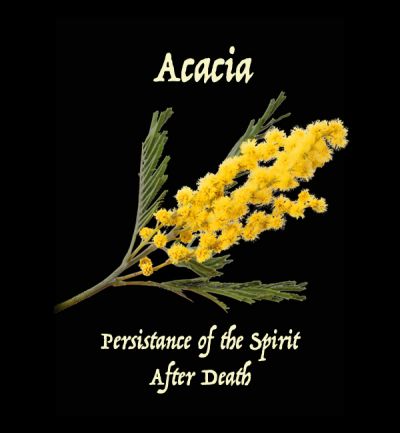
The Acacia is a symbol the afterlife and of the persistence of the spirit after death. In Freemasonry it symbolizes the Immortality of the Soul and is employed in funerary services, and in traditional Judaism it is the custom to plant an Acacia on the grave of a loved one. Acacia wood, which is quite resistant to decay, is also mentioned in the Bible as the wood from which both Aaron's rod and the Ark of the Covenant were made. Branches of blooming Acacia make a sturdy bouquet for the bereaved; but some people sneeze when Acacia is in bloom.
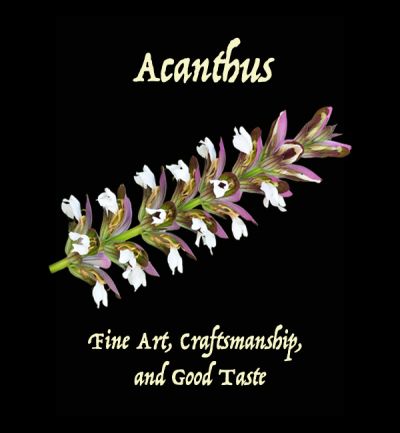
Acanthus, also called Bear's Breeches, is a Mediterranean genus whose best-known species is Acanthus mollis, a large evergreen perennial with shiny leaves that sends up conspicuous flower spikes bearing dozens of purple-hooded white blossoms. Acanthus gained fame as the model for the leafy scroll-work on the capitals of ancient Greek Corinthian columns and it has persisted as a motif in art, architecture, and furniture ever since. Due to its multi-millennia-long use in decoration, the Acanthus symbolizes Fine Art, Craftsmanship, and Good Taste.

Aloe Vera is a member of the Lily family. The thick gelatinous juice found within its succulent green leaves has a long history of use in natural medicine, particularly for treating sunburn, skin irritations, and superficial scrapes. Because it supports the repair of damaged skin, it is associated with Health and Beauty, and its gracefully arrayed leaves symbolize Spiritual Well-Being and Resilience. Aloe is considered a lucky house plant in Chinese Feng Shui, and is said to eliminate negative energies if grown in the East or North of your home or work space.

The Althaea is a symbol of spiritual and therapeutic healing, and of emotional compassion. A member of the Mallow and Hibiscus family, its name means "The Healer" and its mucilaginous root has a long history of medical use in the making of poultices for wounds and decoctions for easing sore throat. In trying times, the Althaea calls in beneficial spirits and helpers who soothe tense thoughts and smooth rough speech. When Althaeas are presented in a bouquet, the meaning is one of caring and amelioration of difficulties, for help is at hand.
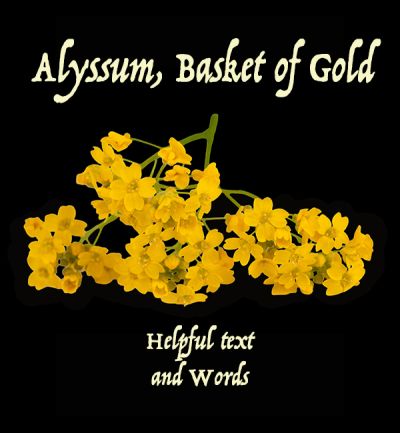
Basket of Gold Alyssum, also known as Yellow Alyssum, Golden Alyssum, Gold-Dust Alyssum, Golden-Tuft Alyssum, Golden-Tuft Madwort, Rock Madwort, and Aurinia saxatilis, is a low-growing evergreen perennial in the Mustard family, native to Europe, Asia, and North Africa. In Greek, Alyssum means "Without Madness," and the plant was once prescribed to treat mental illness, hence the name "Madwort." The flowers are worked into nosegays and tussy-mussies, where they symbolize A Positive Disposition and Happy Thoughts.

The Amaryllis is a sturdy member of the Lily family. As a symbol of strength, determination, and success it may be given to commemorate a hard-won achievement. It also carries the meanings of beauty and love. Its name is Greek and means "to shine or sparkle." The ancient Greeks said Amaryllis was a young woman who loved a shepherd named Alteo. The Oracle of Delphi told her to stand in front of Alteo’s house for thirty nights piercing her bosom with a golden arrow. On the thirtieth night, a beautiful flower grew from her blood and Alteo gave her his love.
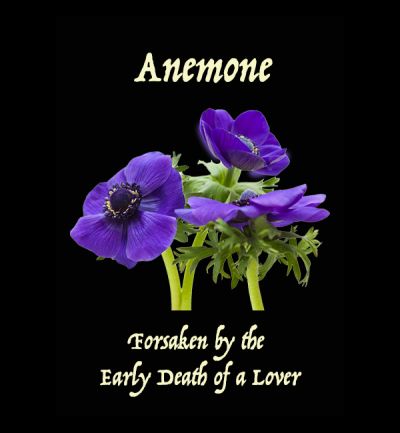
The name Anemone means "Daughter of the Wind" in Greek, hence members of the Anemone genus are known as Windflowers. The Roman writer Ovid said that the goddess Aphrodite created the Anemone by sprinkling nectar on the blood of her lover Adonis, who had been gored to death by a wild Boar. The fragility of the Anemone's petals, easily detached by spring breezes, suggests how suddenly a beautiful young life may be ended by the winds of fate. Thus, the Anemone carries the symbolism of one who is Forsaken by the Early Death of a Lover.

Angelica, also known as Holy Ghost Root, Archangel Root, and Dong Quai, is a member of the Celery or Carrot family with strong stalks, a deep root, and white flowers. It derives its name from the Greek word "arkangelos," which means a messenger from God. Used medically in women's health matters and also to flavour wine, it is widely thought to be a powerful guardian and healer, and to provide strength to women. When Angelica is presented as a bouquet, the meanings it conveys are Heavenly Inspiration, Peace in the Home, and Marital Fidelity.
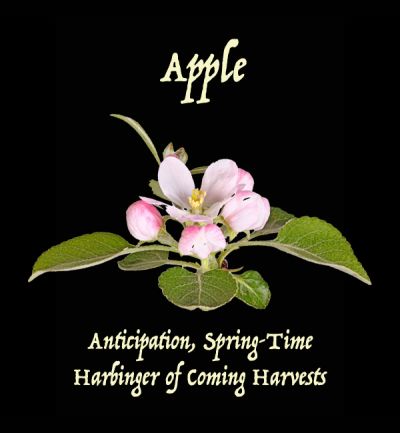
The Apple Blossom symbolizes anticipation, for it is a Spring-time harbinger of coming harvests. Like other members of the Rose family, it has five petals, so the flowers look like tiny Roses. It is an English custom to go into the Apple orchard on January 6th and sing to the oldest bearing tree, encouraging it to flower and bring in a bountiful crop: "Hats full! Caps full! Bushel, bushel, sacks full! And my pockets full too! Hurrah!" Christians relate the Apple to the temptation of Adam and Eve in the Garden of Eden; it thus appears in The Lovers tarot card.
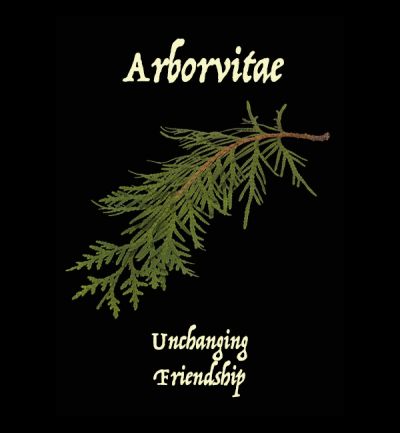
Arborvitae or Thuja is a genus of evergreen coniferous trees with flattened branches in the Cypress family, native to Asia and North America. Confusingly, Arborvitae in our Eastern states is called Whitecedar, and Arborvitae in our Western states is called Redcedar, but neither is a member of the Cedar genus of the Pine family, so collectively they are also known as New World False Cedars. Arborvitae is a Latin name meaning "Tree of Life." When added to a floral bouquet or grown near a home, Arborvitae represents Unchanging Friendship.
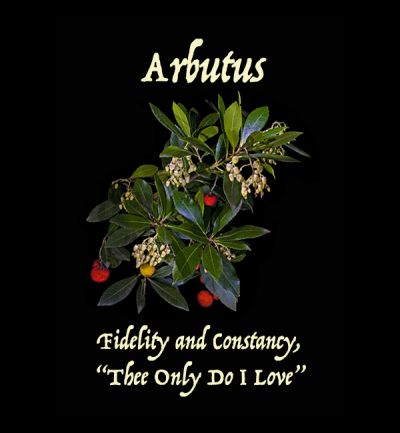
The Arbutus is a shrub or small tree native to the Mediterranean, Europe, the Canary Islands, and North America, where it is also known as Madrone or Strawberry Tree. It flowers with a bunch of inconspicuous white, Heather-like cups, which identify it as a member of the Heath family. Because its edible berries take so long to ripen, the fruits of the previous season always accompany the current season's flowers. This brings to mind thoughts of fidelity and constancy, and thus a sprig of flowering and fruiting Arbutus proclaims, "Thee Only Do I Love."

The Purple Aster is a leading member of the large and prolific Daisy or Aster family. In the Victorian Language of Flowers it is symbol of hope, love, and faith. The name Aster means "Star" and this star-like flower is therefore related to the tarot card known as The Star, which also stands for hope. Asters come in many hues, including white, pink, peach, lilac, and mauve; because purple is a colour of royalty, the Purple Aster, when presented in a bouquet means that the giver admires in the recipient the qualities of wisdom, leadership, optimism, and noble character.
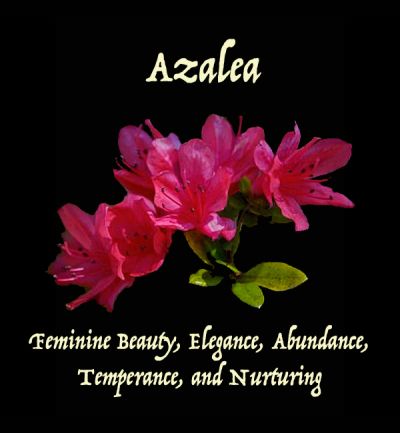
The Azalea is a symbol of feminine beauty, elegance, abundance, temperance, and nurturing. It exemplifies love and gentleness, and its long life and cheerful annual flowers signify enduring Beauty and Commitment when planted in the garden. Dark pink Azalea blossoms are a symbol of Romance and Passion. Because it is a woody shrub and its flowers fade quickly when cut, it is rarely presented in a bouquet, so its charms, and its meaning in the Language of Flowers is best enjoyed out-of-doors while strolling hand in hand with the one you love.

The Barberry or Holy Thorn, also known as Mountain Grape, Oregon Grape, or Yerba de la Sangre ("Herb of the Blood") is a symbol to some of the crucifixion of Jesus, and his crown of thorns. However, its magical and medical attributions are not always religious, for it is used in hoodoo spells to "bar the way" or stop named people from entering a location. Additionally it is a well known folk remedy that reduces fevers and acts as an antiseptic throat wash, and also has mild laxative qualities. Given in a bouquet, either in flower or in fruit, its spikes are highly protective.

Basil is a symbol of good wishes, domestic happiness, and a loving marriage. Because it is an herb with inconspicuous flowers, it is rarely given in a bouquet, but it is often presented to newlyweds as a potted plant during a housewarming party. Like many other members of the large Mint or Lamiaceae family, Basil has plentiful uses as a culinary and medicinal herb, and it can also be employed in spells of magic. It is sacred to the Hindu god Vishnu and his consort Tulasi, and in European occultism, it is said to be ruled by the Planet Mars in Scorpio.
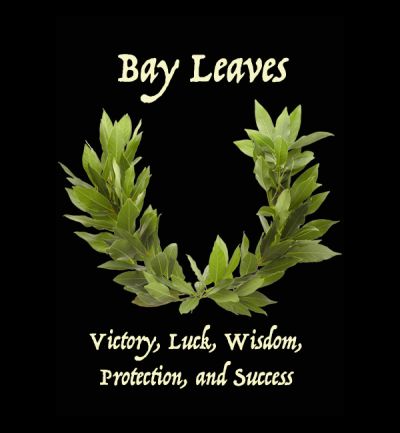
Bay, also known as Bay Laurel, Sweet Bay, or Laurus nobilis, is an evergreen Mediterranean tree. Its aromatic leaves add flavour to sauces, soups, and stews; they also contain antioxidant and preservative oils which help keep foods fresh. Since ancient times Bay leaves have symbolized Victory, Luck, Wisdom, Protection, and Success in military and academic pursuits. As Laurel wreaths they appear on eight tarot cards: The Fool, The Empress, The Chariot, The World, the Two of Cups, the Seven of Cups, the Six of Wands, and the King of Pentacles.

The Begonia, a tender tropical flower, comes in many hues, with varied petal forms and spectacularly diverse leaf-shapes. It is a popular potted plant, but in the Language of Flowers, the gift of a Begonia conveys a powerful warning, for it means "Beware!" and alerts the recipient to danger, false friends, untrustworthy family members, a straying spouse, or coming financial ruin. The nature of the trouble is deciphered by the colour of the blossom. For instance, the Yellow Begonia warns of a jealous rival, while the Red Begonia tells of a deceitful lover.
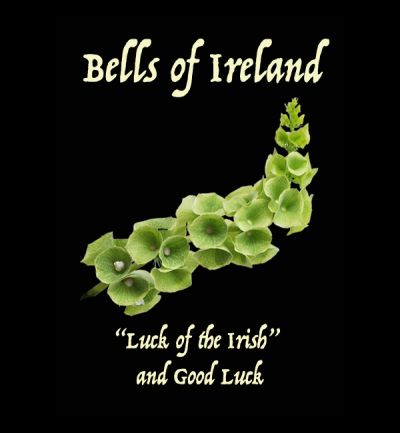
Bells of Ireland, also known as Shell Flower, is a plant of unusual form. You would not think to look at it, but each of its flowers is a tiny, white blossom surrounded by a net-veined Apple-green calyx or outer husk. Even more unexpectedly, Bells of Ireland is a member of the Mint family, along with its cousins, Savoury, Sage, Rosemary, and Thyme. Native to Turkey, Syria, and the Caucasus, it is a popular annual garden novelty in Europe and America, where its bright green colour brings associations with "The Luck of the Irish" and hence Good Luck in general.

Bindweed, also known as Field Bindweed or Wild Morning Glory, is a perennial member of the Convolvulus family with twining, vine-like stems and rows of swirled flowerx. Native to Europe and Eurasia, it has spread widely throughout the world and is considered invasive in agricultural lands of the Western United States. Some strains have white flowers, others are pale pink. Like several of its relatives, Bindweed contains psychoactive chemicals. In keeping with its twisting and far-reaching habit of low growth, it symbolizes Humble, Lowly Entwining and Binding.
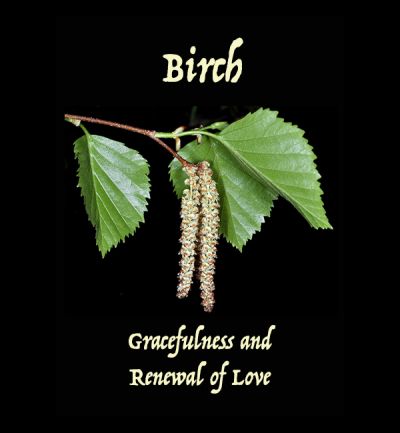
Many species of Birch trees can be found world-wide in the Northern Hemisphere. In Celtic mythology, the deciduous Birch tree, bursting into leaf and flower each Spring, symbolizes New Beginnings. Its name is Beithe, and it is the first letter of the Irish Ogham tree alphabet, representing the letter B. In North America, the crafting of Birch Bark canoes by Woodland Native Americans is still practiced to this day. A bouquet of Birch tree flowers, known as catkins, shows admiration for the recipient's Gracefulness and a wish for Renewal of Love.

The Black-Eyed Susan, a member of the large Daisy family, is a symbol of justice, and also represents encouragement and motivation to persist in what is right. It is a hardy native of North America that adapts well to many regions and is the state flower of Maryland. Like other members of its family, the Black-Eyed Susan has a place in herbal medicine, where it provides support to the immune system and is used to treat sores and mild infections. When a bouquet of Black-Eyed Susan is presented as a gift, the message conveyed is one of social and political support.
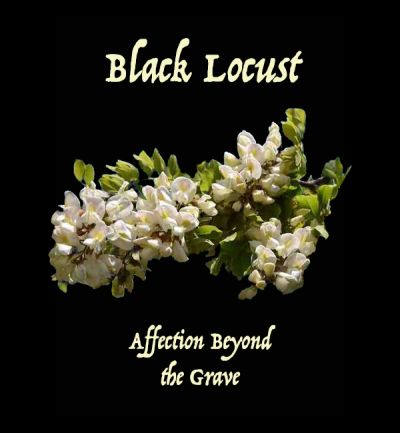
The Black Locust, a deciduous tree that bears cascades of attractive white flowers, is a member of the Fabaceae or Leguminosae family, and thus a relative of Peas, Beans, Clover, Acacia, and Wistaria. Although its leaves and bark are toxic, the flowers are not, and they are used in medicinal teas and fried in fritters. The Black Locust's taxonomic name, Robinia pseudoacacia, and its alternative common name, False Acacia, point out its affinity to the Acacia, a funerary tree symbolizing immortality, and thus its meaning is, unsurprisingly, Affection Beyond the Grave.

The Bleeding Heart, also known as Lady's Locket and Lady's Heart, symbolizes passionate love so deep that its loss would be tragic, the pain of unrequited or lost love, and a compassionate love so strong that one's heart figuratively bleeds for the sorrows of another. Its gracefully arched, 3-foot stems are festooned with dangling pink, red, or white flower hearts, but despite its delicate, exotic appearance, it is actually a hardy plant that endures for decades if its basic needs are met. Perhaps there is a lesson to be learned there about the true nature of love.

Borage, sometimes called Star Flower is an annual Mediterranean plant, now naturalized throughout Europe and North America. Its bright blue flowers are used to decorate salads and deserts, or are frozen in ice cubes to add colour to drinks. The hairy leaves have the scent of cucumber and can be cooked, although excess consumption is a liver toxin. Greeks and Romans steeped Borage in wine for Forgetfulness; in England, Borage honey and flower syrup brought Joy and cured melancholy. Borage flowers also represent Bluntness and Direct Speech.

Broom is a common name that refers to three related species, Scotch Broom (Cytisus scoparius), French Broom (Genista monspessulana), and Dyer's Broom (Genista tinctoria). All three are shrubby, yellow-flowered members of the Pea and Bean family, native to Europe. Introduced to North America as ornamentals, they soon naturalized and are now considered invasive species. Despite the name "Broom," they are not related to Broom Corn, which belongs to the Grass family. In the Language of Flowers, a sprig of Broom means Modestry and Humility.
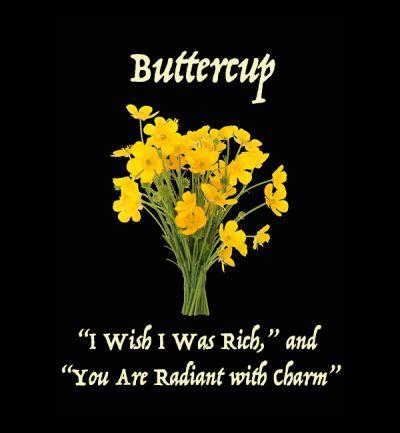
The Buttercup, also known as the King Cup or Water Crow-Foot, is in the Ranunculus genus, which contains a phenomenal 1,750 species, most of which bear crowns of golden-yellow or white five-petalled flowers. Buttercups are toxic to most animals, but are a food source for the Hebrew Character Moth. This moth has a mark like the Hebrew letter "nun" ("fish") on each wing; both the letter and the word protect against the evil eye. The meaning of the Buttercup in old books is "I Wish I Was Rich," but modern writers say it means, "You are Radiant with Charm."

Butterfly Bush, also known as Buddleia, is a genus of 140 species, most of them perennial shrubs with long spires of small four-petaled flowers in shades of blue, lavender, pink, and white. Its habit of growth and bloom-time has led to it being dubbed Summer Lilac, but the two plants are not related. Not only do Buddleias attract Butterflies, they provide nectar for Moths and Bees, making them a great garden choice. Because they readily come back from severe damage and need little care, they symbolize Regeneration and Transformation in Difficult Places.

The Cabbage is a vegetable in the Mustard or Brassica family, related to Broccoli, Kale, Brussels Sprouts, and Cauliflower. Its meanings are quite varied. To call someone a Cabbage-Head is to say they are Stupid and Doltish, but Cabbage is also another word for Paper Currency, and to some folks Cabbage Leaves resemble labiae, so the old blues lyric, "He boiled my first cabbage, he really made it hot, but when he put in the bacon, it overflowed the pot," refers to a sex act, with the Cabbage represents the woman's genitalia and the bacon symbolizes the man's.

The Cactus family is large and varied, but taken as a whole, the cacti are known for their sharp thorns and extreme drought tolerance. It is no surprise, then, that the Cactus is a symbol of endurance under difficult conditions, persistence in times of poverty, and self-reliance in an inhospitable location. Because of its thorns, the cactus is never given in a bouquet, but the gift of a potted cactus signifies non-aggressive self-protection and emotional feelings under heavy armour. In the Language of Flowers it may also mean, "Touch me at your own risk."

The Calendula, known in England as the Marigold, is a member of the large and colourful Daisy or Aster family. The "Mary" in its English name refers to the Virgin Mary, and its bright yellow flowers symbolize the Sun. Its American name, Calendula, is Latin for "Little Calendar" or "Little Clock," and refers to its circular form. In hoodoo, the Calendula is one of several yellow Daisies that represent golden coins. It brings good luck in money matters, especially in games of chance, through lucky dreams, and in court-case magic, where a financial settlement will be of benefit.

The Calla Lily, native to Africa, is now a garden plant in warm climates everywhere. Introduced in diverse places, its symbolism became scattered and incoherent. Like other Arum Lilies, its form suggests Sexuality, Fertility, and Birth. Its soft, powdery pollen has charmed generations of little girls, who use it as "make-up," associating the Calla Lily with Beauty. Huge fields of Callas were once grown in Southern California for the "Easter Lily" trade, and although it is not a true Lily, to Christians it has acquired the meanings of Purity, Holiness, and Death.
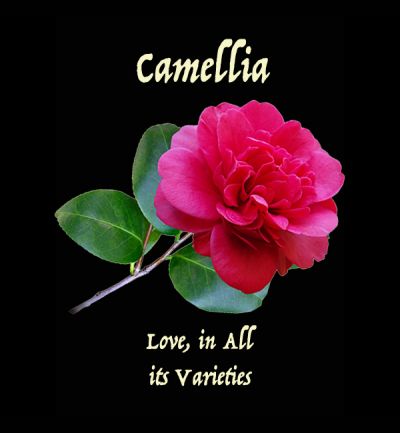
The Camellia, like many flowers that come in a range of white, pink, and red blossoms, is associated with Love; the white for a crush or New Love, the pink for Romantic and Devoted Love, and the red for Sexual and Marital love. The Camellia is a not a little garden bloom; it can grow to be a sturdy 20 to 30 foot tall tree. In addition, because the Tea plant is a species of Camellia, the Camellia, when floated in a low glass bowl with its leaves, evokes the notion of Alertness and Vivacity. Just think, every time you read the tea leaves, you are reading a Camellia!

Candytuft is a darling, low-growing woody sub-shrub with white, lilac, or purple blossoms that attract butterflies and bees. It loves to grow in full sunlight and in warm climates it remains evergreen all Winter long. Because of its diminutive habit of stiff, shrubby growth, it is not found in bouquets, but according to the Victorian Language of Flowers. if you are given a little branch of Candytuft in bloom, the meaning it conveys is Indifference and Detachment -- quite an unexpected load of negativity to attribute to this sweetly-named and charming miniature plant.
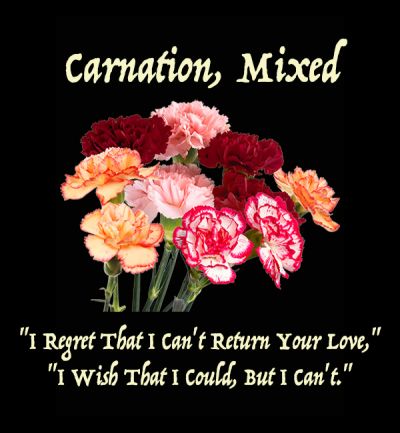
A mixed bouquet of Carnations can carry three possible messages. In addition to the symbolism of each colour -- a White Carnation for pure love, a Pink Carnation for friendship leading to romance, and so forth -- there are meanings given to mixed colour bouquets. If all the Carnations are solid colours, "The Answer is Yes." If all are striped and variegated, the meanings are "Fickleness," "No," or "I Refuse." But if the bouquet contains both solid and variegated Carnations, the message is, "I Regret That I Can't Return Your Love," "I Wish That I Could, But I Can't."

The Pink Carnation, also known as the Clove-Pink because of its spicy, Clove-like fragrance, has long been a popular flower for men to wear as a boutonniere on formal occasions because it tells of Friendship leading to Romance. In 1957, the country singer Marty Robbins wrote a sad song that touched ironically on the flower's reputation: "A white sport coat and a Pink Carnation, I'm all dressed up for the dance; a white sport coat and a Pink Carnation, I'm all alone in romance." A bouquet of long-stemmed Pink Carnations tells the recipient, "I’ll never forget you."
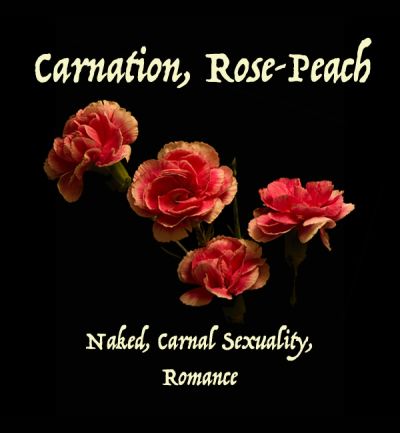
The Carnation is also known as Clove-Pink or Clove-Gillyflower; the word "Clove" alludes to its fragrance, resembling Clove spice. The Carnation symbolizes Love and Fascination, but each of its many colours and tints has a subtly different meaning. Pink Carnations signify friendship and romance, Red Carnations indicate deep heart-felt love, and striped, variegated, and multi-hued Carnations warn of fickle love. These rosy-peach Carnations carry all of these ideas and convey a desire for Naked, Carnal Sexuality with a romantic and loving tinge.

The Carnation is a symbol of love and fascination, but each of its many colours carries a slightly different message. White Carnations signify new and hopeful love. In the Language of Flowers, when given in bouquet, they symbolize the thought that the recipient is Sweet and Lovely. Like most white flowers, they are representative of Innocence or Pure Love, without sexual connotations. When given by one woman to another they convey the meaning of "A Women’s Good Luck Gift," a wish to cheer the receiving woman on to fortune and success.

Catnip has an intoxicating effect on Cats, who react to it as to a love-drug, rolling in it and biting the leaves. It is a member of the Mint family, along with Rosemary, Sage, Lavender, Oregano, Dittany of Crete, and Thyme. It is an aphrodesiac gift bestowed on Cats, and also "Intoxicating in Matters of Love and Sex" for human beings. Seasoning food with Catnip and Dittany of Crete is said to entice a lover, and a well-known nine-day Love Herb Bath is made with a tea blended from Catnip, Rose Buds, Damiana, Lovage, Red Clover, Lavender, and Ginger.

The Cattail or Reed Mace is a symbol of sheltered peace and prosperity ensured by noble patronage. The stalks are tall and thus Cattails are rarely found in small bouquets, but a bunch of these aquatic reeds in a large vase makes a powerful statement when placed on display at the opening of a new shop or business. or in a hotel lobby The messages conveyed are those of financial security and charitable provision for the local community, and of power and strength that supports all those who seek safety and aid under the majesty of a true leader.

Cedar, also called Cedrus, is a genus of evergreen coniferous trees with aromatic wood, in the Pine family. Some are native to the Himalayas, some to Turkey, Cyprus, Syria, and the Eastern Mediterranean, and some to Morocco and Algeria in North Africa. The Cedar of Lebanon is the national emblem of Lebanon and it has special value to those who grow plants mentioned in the Bible, for the Temple of King Solomon was built from Cedar of Lebanon. When a branch of Cedar is included in a bouquet or grown in a garden, its meaning is "Spiritual Strength."

Coxcomb Celosia, also called Crested or Cristate Celosia, is a tropical flower in the Amaranth family, with culinary and medical uses and colourful unfading flowers when dried. Celosias have remarkably differing flower forms, and until recently botanists were confused about their genetic relatedness. Coxcomb Celosia was formerly Celosia cristata, but is now called Celosia argentea, var. cristata. Its flower heads, which look like rooster combs, symbolize Bravery, Foppery, and Bold Affection.
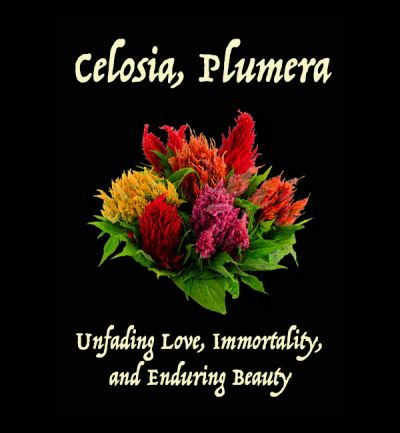
Plumed Celosia is, like Coxcomb, a tropical member of the Amaranth family. The two used to be cousins, back when Plumed Celosia was Celosia plumosa and Coxcomb was Celosia cristata, but modern genetic testing has revealed them to be siblings, and both are now Celosia argentea, with Plumed Celosaia known as var. plumosa. The brilliant, feathery flowers preserve their hues, so either fresh or dried, Plumed Celosia represents Unfading Love, Immortality, and Enduring Beauty.

The Chamomile is a small white flower with with a strong, sweet fragrance. It is a medical remedy that brings restful sleep and good health for children. Magically, because of the flower's golden-yellow centers, Chamomile is also found in spells of money-luck. Finally, like several members of the Daisy or Aster family, Chamomile is widely used to predict love futures by young women, who pull the white petals off one by one, while reciting, "He loves me ... he loves me not," and hoping for a truthful outcome when the final petal is plucked.
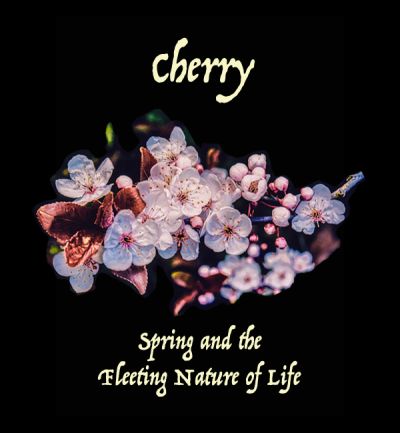
The Cherry blossom is a lovely symbol of Spring, and thus of nature's annual renewal. Its bloom-time is brief, and after about two weeks, the petals fall in drifts, like snow, so they also symbolize the fleeting nature of life, and encourage us to embrace a serene consciousness of time's passage. In China Cherry Blossoms signify love, feminine beauty and female sexuality. In Japan families and friends get together every Spring for the centuries-old tradition of hanami or Cherry blossom-viewing, and to meditate on this lovely expression of life, death and renewal.

The Chive is a small and mild member of the Onion family, whose fresh leaves and flowers are used in cookery, most often as a garnish. This accords with its symbolic meaning in the Victorian Language of Flowers, where the significance of a Chive flower is Usefulness, Practicality, Fitness, and Effectiveness. Due to the distinctive food-like scent of Chives, they are rarely presented in a bouquet, but a pot of growing Chives makes a lovely house-gift for a cook, as useful as it is pretty. If treated well, it reproduces by division and from seed.
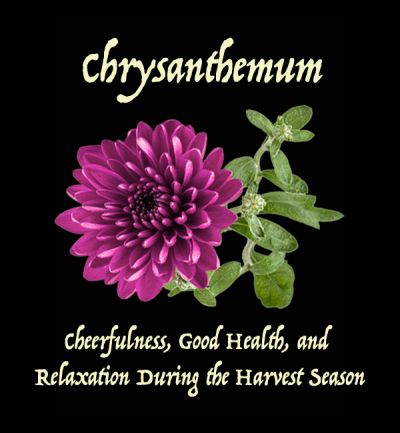
The Chrysanthemum is a perennial in the Daisy or Aster family that blooms from Summer through Fall. It comes in many colours, from yellow and orange through bronze and purple. In the Victorian Language of Flowers, Purple "Mums" convey cheerfulness, good health, and relaxation during the harvest season. When given in a bouquet or as a potted plant, they tell the recipient, "You're a Wonderful Friend." In Asia, the Chrysanthemum likewise represents Health and Happiness, but it may also symbolize Nobility, for it is the national flower of Japan.

The Red Chrysanthemum is usually a brick- or purplish-red, its hue situated somewhere between Crimson and Fuchsia on Nature's great wheel of colour. Like all of the "Mums," it blooms from late Summer through Fall, depending on the variety. This means that just at the time when more traditional love flowers, such as the Rose, have bloomed out, the Chrysanthemum appears in the florists' shops in bouquets or as blooming potted plants in foil-wrapped containers to tell the recipient "I Love You" and convey a wish for Good Health and Good Cheer.

The Chrysanthemum is one of the best-known members of the Daisy family. Whether given in a bouquet or as a potted plant, it generally communicates a friendly feeling of cheerfulness and a wish for good health to the recipient. The White Chrysanthemum bears the additional symbolic meanings of Truthfulness, Honesty, and a Pure Heart. Because it blooms in Autumn, it has come to be used used as a table decoration during harvest festivals and family feasts. As the national flower of Japan, the White Chrysanthemum may also symbolize Nobility of Spirit.

The Chrysanthemum is generally a symbol of good cheer, but in the Victorian Language of Flowers, the Yellow Chrysanthemum carries the sad connotation of "Slighted Love," and when presented in a bouquet it is anything but encouraging. The recipient may ask, "Have i slighted the gift-giver, or is the gift-giver slighting me?" Other flowers in the bouquet will help to interpret the meaning of the message. The Chrysanthemum comes in many beautiful colours and shapes. It is a member of the large Daisy or Aster family and is also known as the national flower of Japan.
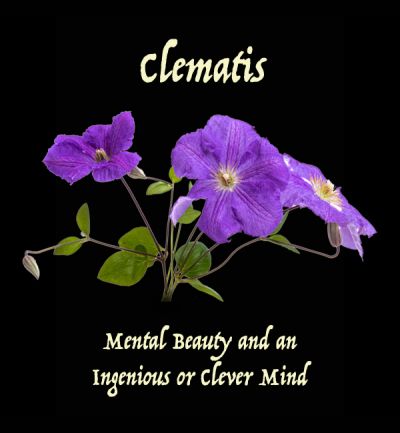
The Clematis, known to many as “The Queen of the Vines,” is a beautiful, sun-loving climbing plant with spectacular blossoms. It represents mental beauty and an ingenious or clever mind. It comes in a variety of colours, from the purity of white to the softness of lilac and the harshness of magenta, and including the flashy mentality of pink stripes — but the most beloved form is the Purple Clematis, which takes the idea of intellectuality to the highest reaches and associates the twining, climbing flower with aspiration, exaltation, and the crown of success.
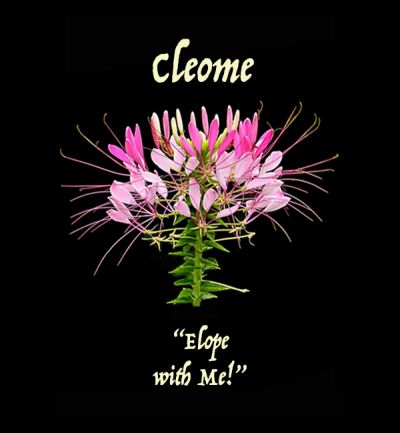
Cleome, also known as Spider Flower, is a popular garden annual which bears a cluster of purple, pink, or white four-petalled blossoms on a tall stem. It is often planted as a backdrop in large garden beds, where it blooms from late Spring to early Fall. Cleomes are distant cousins of Mustard and Broccoli, and at least one of the more than 200 species in the genus is cultivated as a vegetable, but only Cleome houtteana, a native of Argentina, Paraguay, Uruguay, and Brazil, is an ornamental. In the Language of Flowers, Cleome's message is "Elope With Me!"

The Clover is known for having three leaves -- in fact, its genus name is Trifolium, which is Latin for "Three Leaves." However, one of Nature's wonders is the rare mutation which, every once in a while, produces a Four-Leaf Clover. This is not a different species, but a Shamrock with four leaves. It symbolizes good luck, or, as some say, while counting the leaves, "Health, Wealth, Love, and Luck." Clovers are perennial, so if you find a Four-Leaf Clover clump, pick and press a few, but do not over-harvest it. Tend it well, and you will have good luck for years.

The Red Clover (which is actually pink) is a symbol of abundance and love. Clover of any kind is a wonderfully nutritious forage for livestock, and its growth enriches the soil, so all Clovers represent good fortune and good health. Red Clover is also used in love-magic to ensure a fortunate romance, a prosperous marriage, and conjugal felicity. A well-known hoodoo Love Herb Bath is made by mixing Red Clover Flowers, Lavender, Rosebuds, Damiana, Lovage, Catnip, and Ginger and bathing in it for nine days, then calling the name of the desired partner.
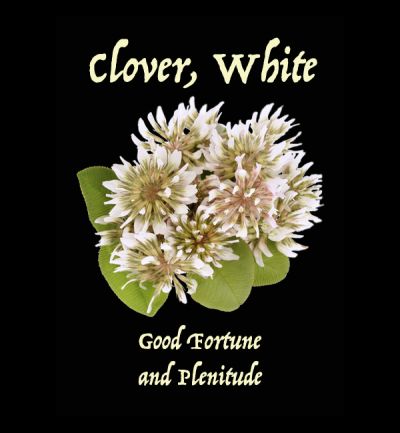
The White Clover or Shamrock is a symbol of good fortune and plenitude and is connected to the lore and history of Ireland. The rare Clovers that bear four leaves instead of the usual three are especially lucky, and people often press Four-Leaf Clovers in books as keepsakes. In the Victorian Language of Flowers, the White Clover also carries the additional meaning, "Think of Me," and in African-American hoodoo folk magic, it is used in spells and carried in mojo hands both for luck and for protection from evil and crossed conditions.
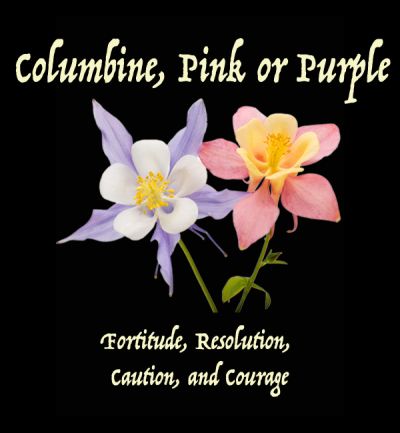
The lovely, perennial Columbine is ruled by Venus. It grows wild in rugged mountain regions -- it is the state flower of Colorado -- and so it represents Resolution, Caution, and Courage, while it warns against haste or folly, for in the mountains the paths are narrow and a foolish misstep may prove fatal. Columbines come in several colours, subtly affecting their meanings when given as a gift. The Purplish-Blue Columbine symbolizes Fortitude, Ascension, and Rugged Endurance. The Pink Columbine symbolizes Fortitude, Temperance, and Prudence.
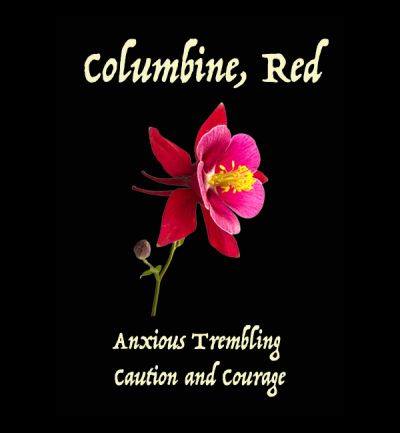
The Columbine is a delicate, mountain-loving, wild perennial flower associated with the love-promoting planet Venus. There are many types of Columbines, and all are symbols of Resolution, Courage, and Caution. The Red Columbine is different than pink or purple varieties, though, because it represents Anxious, Trembling Caution and Courage. If presented in a bouquet, the Red Columbine tells the recipient that the one who gave it is unsure of the reception his or her thoughts and intentions will receive, but is brave enough to proceed anyway.

The Coreopsis is a symbol of happiness, and when presented in a bouquet, its meaning is "Always Cheerful." Like other yellow members of the Daisy or Aster family, it is associated with the Sun's life-giving solar energy, which warms and stimulates us, Furthermore, because it resembles a golden con, it also symbolizes wealth and prosperity. In the end, whether your joy comes from the ornamental beauty of nature's golden light, or the prospect of holding many coins, the Coreopsis conveys an sunny mood and foretells a brighter day to come.

Coriander is a culinary herb related to Parsley, and is therefore also known as Chinese Parsley. It has aromatic seeds and unusually fragrant leaves, the latter also known as Cilantro. Due to genetic variation, some people find the scent of fresh Coriander leaves compellingly attractive, while to a minority it "tastes like soap." Because those who dislike it are vocal in their distaste, some American Chinese and Mexican restaurants have replaced Cilantro with Parsley in their recipes, rendering their food both bland and bitter. Coriander symbolizes "Hidden Worth or Merit."

Corn, also known as Maize, native to the Americas, is now a food crop grown world-wide. A member of the Grass family, it bears starchy seeds, called kernels, on stout stalks called cobs. It can be cooked fresh, as Corn on the cob or cut Corn. When dried, the kernels can be ground to cornmeal or powdered into cornstarch. The germ of the kernel contains oil, which can be extracted and used in cooking. With all of these uses, Corn symbolizes Abundance, Prosperity, and Riches, and Cornbread is eaten on New Year's Eve for Wealth in the coming year.
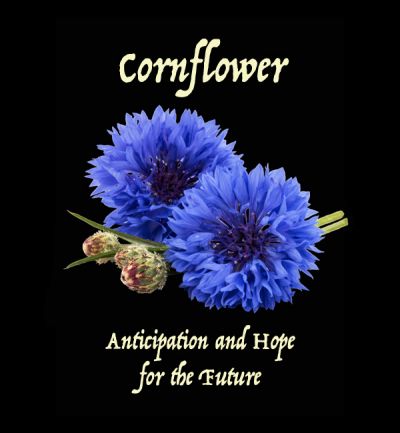
The blue Cornflower or Bachelor's Button looks upward to see the blue sky, and thus it symbolizes anticipation and hope for the future. It is a member of the large Daisy or Aster family, and it lends a charming rustic quality to a bouquet of wildflowers given by an unmarried man to the one he favours in romance. As a blue flower, the Bachelor's Button is also one of many similarly-hued blossoms that represent a peaceful and modest home where contentment reigns — which is exactly what the bachelor wants when it comes time to marry and settle down.
- Cosmos.jpg
The word "Cosmos" does not mean, as many think, "the universe." Rather it is the ancient Greek word for "order" or "arrangement." Therefore, to refer to our solar system, galaxy, or the universe as a "cosmos" is to imply strongly that it not a chaotic array of objects, but an inherently orderly one. Thus it is with the Cosmos flower, a member of the large Aster or Daisy Family, known for its strong, wiry, upward-thrusting stems, each topped with eight perfect petals arrayed around a central yellow disk, symbolizing Order, Peace, Harmony, and Love.

The Cowslip is a yellow-flowered perennial Primrose that blooms in the fields, meadows, and coastal dunes of Europe. The leaves are edible in salads or as cooked greens and the flowers are used to make Cowslip wine. The ancient Celts believed that Cowslips point the way to hidden fairy gold. The plant's drooping flower-heads resemble a bunch of keys, so in the Middle Ages the Cowslip became known as Saint Peter's Herb, after the Christian Keeper of the Keys. In Floriography, the Cowslip symbolizes Native Grace, Fairy Gifts, and Youthful Joy.
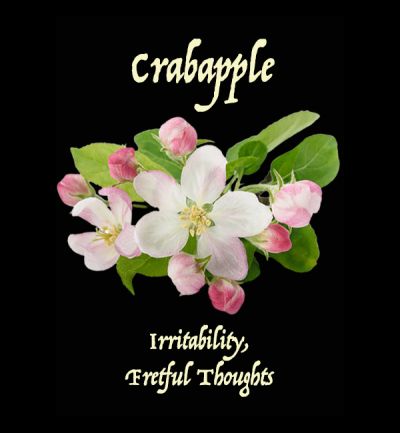
Crabapples are small, stiffly-branched members of the Apple genus in the Rose family, and thus cousins to the Peaches, Apricots, Cherries, Plums, and Almonds. They bloom lavishly in Spring, with pink or white flowers, but although they produce large crops of apples, their small or crabbed fruits, less than 2 inches in diameter, are disappointingly sour. Crabapples are great for making preserves and cider, but they can't be eaten out of hand, so while Apple blossoms symbolize anticipation, Crabapple flowers represent Crabby, Irritable, or Fretful Thoughts.
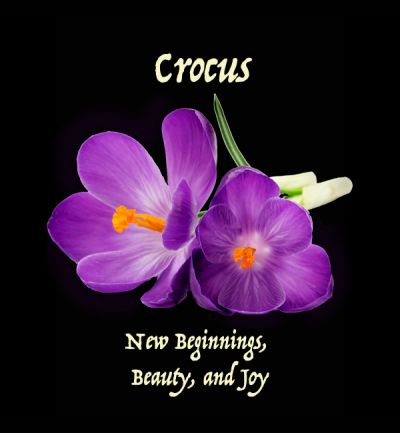
The Spring Crocus is represents new beginnings, beauty, and joy — but there are many species of Crocus, and among them is one that blooms out of step with the others. This is the magical Autumn or Saffron Crocus, which is cultivated for the three tiny thread-like stigmas within each blossom. When plucked and dried, these are the rare and costly seasoning called saffron, which imparts a golden hue and subtle scent to cooked rice. To serve a man saffron rice is a classical seduction spell, and saffron threads are also found in the best love oils used in magic.

The Cyclamen is a peculiar flower. Emerging from a lush bed of patterned and veined green leaves, the tall floral stems bend down to face the earth, but the five petals reflex up and backwards toward the sky, resembling a flock of butterflies. It grows from a plump tuber, but is too fragile for bouquets, so it is given as a potted plant, Associated with the planet Venus, its white, pink, or magenta flowers imply romantic love but, according to the Language of Flowers, when presented to a loved one, its reversed petals convey Resignation, Diffidence, and Farewell.

To most people the Daffodil symbolizes rebirth, new beginnings, and the coming of Spring because it is among the first hardy perennials to bloom after the cold of Winter. However, its name in Greek and Latin is Narcissus, and it was named for Narcissus, the beautiful but foolish son of a river god. It is said that one day Narcissus bent down to look in the water, saw his own lovely reflection, and drowned trying to embrace it. The nodding head of the Narcissus flower represents his downward gaze, and the word "narcissistic" describes his self-absorption.
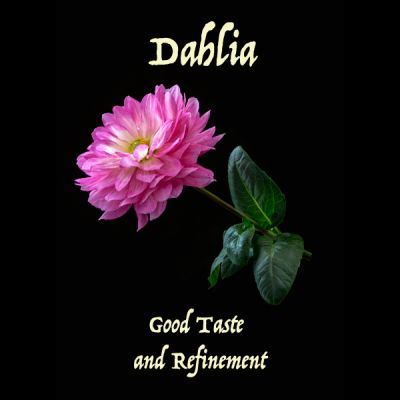
The Dahlia, a tuberous perennial native to Central America, was named to honour the Swedish botanist Anders Dahl (1751-1789). There are forty-nine species in the genus, and their forms and colourations are so varied that Dahlia breeeders sort them into appearance groups such as single, ball, pom-pom, collarette, Anemone-flowered, Waterlily-flowered, Cactus-flowered, and so forth. Presenting a bouquet of Dahlias pays a compliment, for it signifies that the gift-giver considers the recipient to be a person of good taste, aesthetic refinement, and elegant culture.

The White Daisy is a symbol of Innocence, Purity, and Loyal Love. When it is presented in a bouquet, it assures the recipient of the giver's circumspection, discretion, and willingness to keep a secret, for its meaning in the Victorian Language of Flowers is "I'll never tell." The White Daisy is also famous as one of the flowers used in a folkloric divination called "He loves me, he loves me not," in which petals are pulled off the flower one at a time, and the final petal gives the answer to the question of whether a person of interest loves or does not love you.

The Yellow Daisy, like the White Daisy, is used in the folkloric fortune-telling ritual that young girls and women employ to find out if their beloved truly loves them in return. They pull the Daisy petals one by one, alternating between "He loves me" and "He loves me not." The last petal pulled tells the truth of the matter. Yellow Daisies are symbolic of a surreptitious affair, for as the saying goes, "Daisies Don't Tell." However, unlike the circumspect White Daisy, the Yellow Daisy expresses the cheerful belief that "A Secret Love Will Be Declared at Last."

The Dandelion, with its sunny yellow flowers, is a symbol of optimism and hope, even in times of negativity or low energy, for just as the dandelion plant, often considered a worthless weed, breaks through barriers and spreads its happiness, so does human courage grow in the waste places of life. Blowing the fluffy, plumed seeds of a Dandelion to the winds is a way of sending your wishes into the world to be fulfilled. Dandelion root tea is said to enhance physic abilities; when used in laundering bed sheets and pillow cases, it brings psychic dreams.

The Daylily has acquired its name because each flower on the stalk, no matter how radiantly beautiful, lasts only one day, from morning to night, then withers and falls away, as another bud prepares to take its place next day. Its taxonomic name, Hemerocallis fulva, translates to "Tawny-Red-Yellow Day-Beauty" -- which describes it perfectly. Because Daylily flowers are so fleeting and their crumpled fall is so swift, to present them to a woman in a bouquet is a bit of an insult, with the meanings of "Coquetry," "Idle Flirtation," and "You Were Lovely for a Single Day."

In Victorian manuals of Floriography, symbolic meanings are included for quite a few botanical subjects that are not considered flowers, but which may appear in bouquets -- among them herbs, twigs, leaves, berries, and nuts. Given this variety of possibilities, and the urge to present floral tributes at all seasons of the year, a well-arranged bouquet of Dead Leaves is a gift whose message conveys Sadness and Depression, and can also be used to signify Acquiescence or reluctant acknowledgement of the withered ending of a once-blooming relationship.

Deadly Nightshade or Belladonna ("Pretty Woman") is a toxic member of the Solanaceae family, which includes vegetables such as Tomatoes, Potatoes, Tomatillos, Peppers, and Eggplants, and toxic plants such as Tobacco, Angel's Trumpet, Henbane, Datura, and Mandrake. Not to be confused with the Belladonna Lily or Naked Ladies, Atropa belladonna contains the lethal poisons atropine and scopolamine. Eating it leads to paralysis of the involuntary muscles of the body, including the heart. When given in a bouquet, it conveys a threat: "Silence ... or Death."

Many people think of Dill merely as a flavouring for pickles, but like others in the Apiaceae or Umbelliferae family -- including Angelica, Asafoetida, Anise, Carrot, Celery, Coriander, Cumin, Fennel, Lovage, Masterwort, Parsley, Parsnip, and Sea Holly -- it is aromatic and has medicinal, magical, and culinary properties related to love and psychic abilities. Its umbrella-like flower head provides a platform and a shelter for insects, and thus its messages are: "My love is strong," "My love will strengthen you," "I will protect you," and "I am powerful against evil."

The Dogwood flower, due to having four petals, has long been a symbol of the cross of Christianity, with ascriptions such as purity and affection. Some even go so far at to identify it with rebirth and resurrection. On the other hand, long before the advent of Christianity, the Cherokees believed that Dogwoods were home to small brownie-like Dogwood People who protected babies from harm. The Dogwood tree blooms profusely in early Spring under the canopy of larger deciduous trees, and thus it is also associated with reliability, durability, and strength.
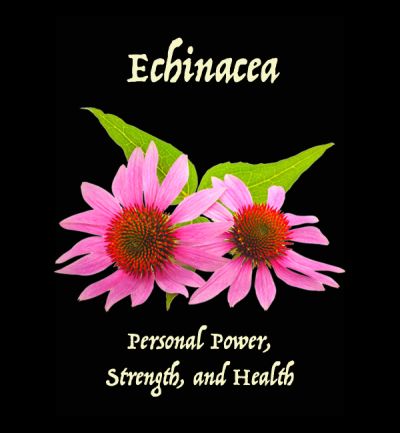
Sampson Snake Root, also known as Purple Cone Flower or Echinacea, is a symbol of personal power, strength, and health. The roots are carried as a curio in mojo hands for mastery and vigour. In herbal healing, the entire plant is made into a tea that works to fight off colds, influenzas, sore throats, and respiratory infections, as well as cystitis and vaginitis. The medical principles in Sampson Snake Root have been proven effective against bacterial Staphylococcus and Streptococcus infections, as well as fungal yeast infections caused by Candida.

The Edelweiss is a small, Alpine perennial flower in the large Aster or Daisy family. Its German name means "Noble White," a reference to its high altitude habitat. Its Latin taxonomic name, Leontopodium, means "Lion's Paw," and refers to the soft, furry bracts which surround its tiny yellow flowers. The Edelweiss is a symbol of courage and devotion. It is rarely found in fresh bouquets, but in times past it was often encountered as a pressed flower, given as a souvenir of a mountain climb, especially by a climber to his or her beloved.

The Elder, also known as Elderflower, is a shrub with pithy stems, heavy clusters of small white blossoms, and bountiful crops of black fruit called Elderberries. Its stems are used to make Elder whistles, its flowers and berries to make magical wines. Sitting beneath an Elder on Halloween is said to bring visions of the Fairy realms, for good or ill. In a vase, its flowers symbolize Endings, Rebirth, and Compassion. In magic spells, the dried flowers, berries, leaves, or roots of Elder are used for Protection and to ward off both natural and unnatural illness.
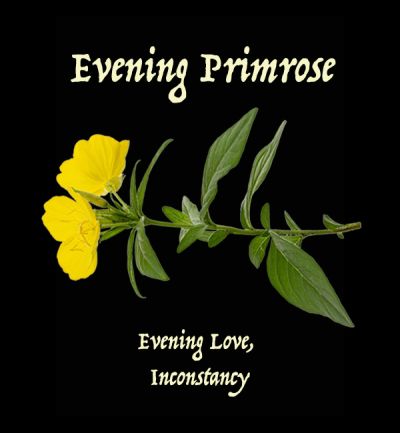
The biennial Evening Primrose or Oenethera is native to the Americas, and is not actually a Primrose or Primula at all. Native Americans prescribed it for skin diseases and it was introduced to Europe under the name King's Cure-All. Its long bloom time makes it a crucial source of nectar and pollen for moths, butterflies, and hummingbirds. Because it blooms at dusk, it is a symbol of silent love and Love at the Evening of Life. Because so many moths visit it, some say that it represents "Inconstancy," as though its popularity was somehow a fault.

Fennel root, known as Finocchio, is a beloved Italian vegetable, and Fennel seeds are used to flavour Finocchiona sausage, but like others in the Apiaceae or Umbelliferae family -- including Angelica, Asafoetida, Anise, Carrot, Celery, Coriander, Cumin, Dill, Lovage, Masterwort, Parsley, Parsnip, and Sea Holly - Fennel also has strong magical associations. Its yellow flowers symbolize Flattery; its seeds are used in spells of Protection from snakes, the police, immigration officers, and tax assessors; and in folk medicine it treats depression and headaches.
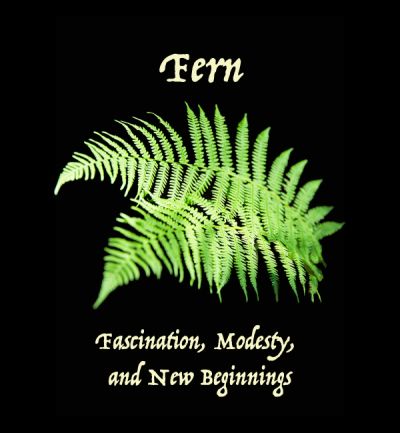
Although the Fern is not a flower, it appears in many bouquets as a symbol of Magical Fascination, Humility, Modest Confidence, Safe Shelter, Sincerity, the Secret Bonds of Love, New Life, and New Beginnings. Because it reproduces by spores and bears neither flowers nor seeds, the Fern is associated with the gender-non-binary planet Mercury and the element of Air. Depending on the species, a living Fern may be planted atop a spell-packet for conjugal love. For protection and safety, dried fern leaves may be scattered about or carried in a mojo bag.

The Maidenhair Fern, with its wiry hair-like stems and graceful leaves, holds a special place in the realm of magical herbology. It is sacred to the goddess Venus, and has long been used as a test of virginity due to the belief that only a virgin can hold a branch of Maidenhair Fern without causing its leaves to shake. Those leaves have the remarkable power of causing rain drops to bead up and fall off, a trait noted in its taxonomic name, Adiantum capillaris-veneris, which means "unwettable hair of Venus." In a bouquet it represents the Secret Bonds of Love.

The Fir is a coniferous evergreen tree in the genus Abies, which is part of the larger Pine family, the Pinaceae. Fir trees tend to be conical, with a single trunk and downward-drooping branches and needles when young, but as they age they may develop flattened crowns and increasing asymmetry due to environmental factors. Firs often grow in mountainous areas, where their shape helps them shed the weight of Winter snow. Their lumber is widely used in construction, and they are said to symbolize Strength, Constancy, Time, and Immortality.

The Flax flower is a symbol of domesticity, a happy home life, female wisdom, and womanly virtue. This is because the strong fibers derived from Flax stalks are used in spinning and weaving, which was at one time the home occupation of many women. The Flax flower, as well as the act of spinning, is associated with the Norse goddess Freya, who is generally shown spinning Flax fibers into linen threads. Like other blue flowers, Flax carries the connotation of a peaceful home, female dignity, devotion to family, marital commitment, and social maturity.

The Forget-Me-Not, with its tiny scorpionic racemes of blue flowers and its soft, velcro-like seed-pods, is so symbolic of Remembrance and Fidelity that its very name reflects its magical qualities. The pink buds of romantic and devoted love open to sweet blue blossoms with yellow centers, representing Honesty, Clarity, and Loyalty -- but if you have ever walked through a patch of these darling, shade-loving biennials when the seed-pods are ready to separate from the stems and latch onto your socks or your dog's fur, you truly will never forget them!
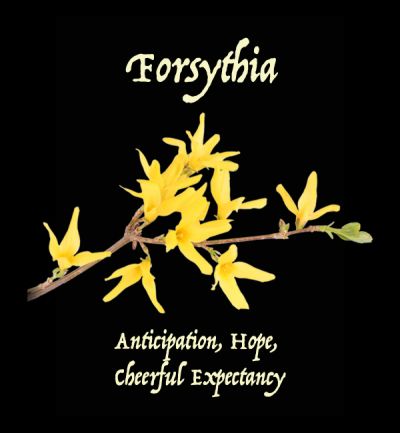
Not only is the Forsythia one of the earliest shrubs to blossom in the Spring, it is so eager to bloom that it covers its bare, woody branches with golden flowers well before its green leaves appear. For this reason the Forsythia symbolizes Anticipation, Hope, and Cheerful Expectancy of wonderful future things to come. To give a bouquet of Forsythia branches cut from your own garden is a traditional way to share the joys of Spring, and to bring a living Forsythia plant to new home owners and plant it in their garden is to wish them many years of happiness in that home.

The Foxglove is a tall plant in the Snapdragon family that bears spires of bell-shaped flowers, small enough for foxes to wear as gloves. It is a popular flower, despite the fact that it is highly toxic if eaten. Pharmacists say, "The dose makes the poison," and Foxglove is usually given as an example of this because in small doses its deadly toxin, digitalis, is a valuable heart medicine. Foxglove thus symbolizes both healing and harm. Its meanings are similarly dualistic: Immortality and Insincerity. Foxgloves in a vase mean, "I am not ambitious for myself, but for you."

The Yellow Freesia is a member of the Iridaceae or Iris family, first described as a genus in 1866 by the Danish botanical collector and apothecary Christian Friedrich Ecklon (1795 1868), and named by him to honour his friend and colleague, the German botanist and medical doctor, Friedrich Freese (1795–1876). Yellow Freesia flowers represent Lasting Friendship, Trust, Happiness, and Optimism. Their uplifting, citrusy fragrance is used to scent perfumes, lotions, shampoos, and candles, and they are said to symbolize the 7th wedding anniversary.
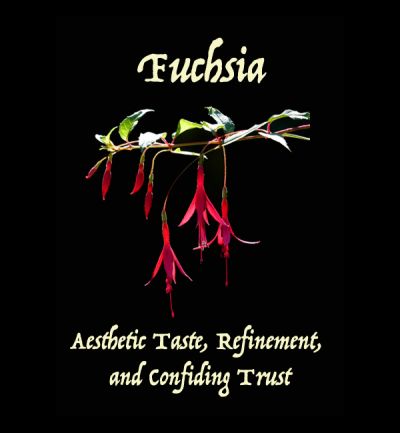
The Fuchsia, also known as Lady's Ear-Drops, is a symbol of fine aesthetic taste and refinement as well as confiding trust and love. The gracefully pendant blossoms have a unique two-part structure, and the inner cup of petals is generally a very different colour than the encircling parts. A bouquet of Fuchsia flowers may resemble a group of ballerinas dancing en pointe across a stage. Their alternative name, Lady's Ear-Drops, is an old term for earrings, and jewelers have indeed made lovely earrings in the form of Fuchsia flowers, often enamelled in bright colours.

The Double Fuchsia is a wonderfully plump variation on the Lady's Ear-Drops or Single Fuchsia. Instead of the blossoms resembling a group of ballerinas dancing en pointe across a stage, a cluster of these bulging beauties looks like the tutu-wearing Hippos in Walt Disney's "Fantasia." When they are almost ready to open, the buds can be gently popped with a light squeeze, and they neatly burst along their seams, revealing the pretty petals. Despite being popped, they open flawlessly and dance gracefully, expressing Delicate Balance, with a Dash of Fun.
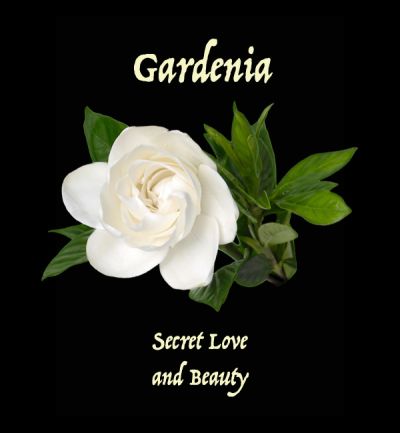
The Gardenia is a symbol of secret love. Its white colour implies a relationship that is gentle and pure in nature. The plant is, unexpectedly, a member of the Coffee family, and thus the flower is also energizing. Because its large flowers are sweetly scented and long-lasting when cut, the Gardenia is frequently worn as a hair ornament, boutonnière, or corsage. When presented to someone to wear on an evening date, the Gardenia conveys a compliment to the one who receives it, for in the Language of Flowers, it says, "You are lovely, my dear."

Garlic is a symbol of courage, strength, and protection. It wards off the evil eye, werewolves, vampires, and harmful witchcraft. Braided and hung by the back door or kept in open sight in the kitchen, it protects the home from hexes, curses, and crossed conditions. Added to food as a seasoning, it has medical value, providing antioxidants that support the body's protective mechanisms, reducing blood pressure, helping to lower high cholesterol, strengthening the immune system, and functioning as an antibiotic to assist in the fight against inflammation and disease.
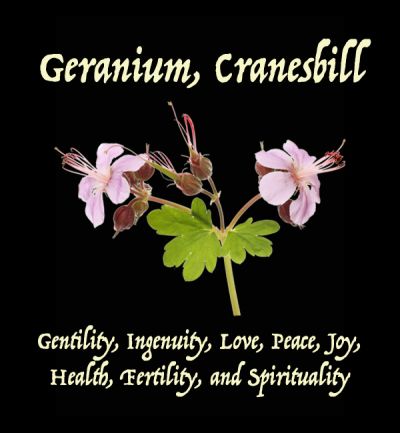
The seed pods of the wild Cranesbill Geranium resemble a Crane’s beak, and thus arose the flower's common name. Both the Geraniums and their more showy relatives, the Pelargoniums, are associated with the zodiacal water sign of Cancer the Crab because they bloom in summer when the Sun is in Cancer and Cranes live in marshes and eat Crabs. The Cranesbill is not a flower often given in a bouquet, but when encountered in nature, its meanings are many, varied, and delightful: Gentility, Ingenuity, Love, Peace, Joy, Health, Fertility, and Spirituality.

In 1789 botanists divided the Geranium genus into Geranium ("Crane") and Pelargonium ("Stork"). Gardeners, already confused about Storks versus Cranes, rebelled, and they still call Pelargoniums Geraniums. Pelargoniums, more beautiful but less cold-hardy than Geraniums, are often grown in pots and bedded out for Summer. The amount of care they need led to the signification of Folly and Stupidity. However, this Ivy-Leafed Pelargonium also conveys the Ivy's message of Friendship and Favour. It's your dear dim-witted pal who can't tell a Stork from a Crane.

The Gladiolus, whose name means "Little Sword" in Latin, has sword-shaped leaves. It is a symbol of male energy and love, and is a proper offering from a gladiator to his beloved, for its flowers are receptively feminine in shape. As a sword-flower, it is associated with the nobler qualities of the warrior planet Mars, such as strength of character and faithful bravery. A member of the colourful Iris family, it comes in a wide array of hues -- white for purity, pink for romance, red for passion, orange for change, yellow for cheerfulness, and purple for nobility.

Globe Amaranth or Gomphrena globosa ("Globe of Nails") is member of the Amaranth ("inexhaustible, immortal") genus. Amaranths, variously cultivated as leafy vegetables, pseudocereals, and ornamental flowers, are so diverse in form that they set a pretty problem for taxonomists, who have undertaken molecular genetic studies to sort things out. Globe Amaranth retains its colour and shape after drying, making it suitable for garlands and altar offerings. Its message is "Hope in Misery" and it symbolizes Resilience, Inner Strength, and Immortality.
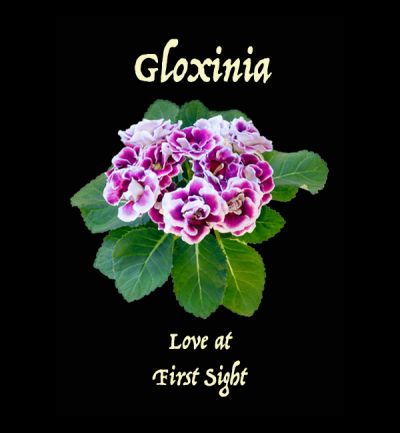
The Gloxinia is a tuberous perennial native to tropical Brazil and now found world-wide as a Summer garden flower or year-round house plant. After flowering, the tubers are put in a cool, dark area to go dormant; when replanted, they will bloom again. Because it is only 6 to 12 inches tall, the gorgeous Gloxinia is not used in bouquets, but with its massive, colourful flower heads, it makes a splendid potted plant. Ever since the Victorian era, the gift of a potted Gloxinia has been a token of love, and when presented to a crush, its meaning is "Love at First Sight."

Goldenrod is a name applied to about 120 species in the Solidago genus, which is a member of the Daisy family, the Asteraceae. Most are native to North and Central America. They bear elongated flower heads comprised of dozens of small, yellow, Daisy-like florets. Important plants in terms of ecosystem support, Goldenrod species provide food for more than 100 species of butterflies and moths and almost 50 species of wasps. Their flowers produce a natural yellow dye for fibers. In Floriography, they symbolize Encouragement and Good fortune.
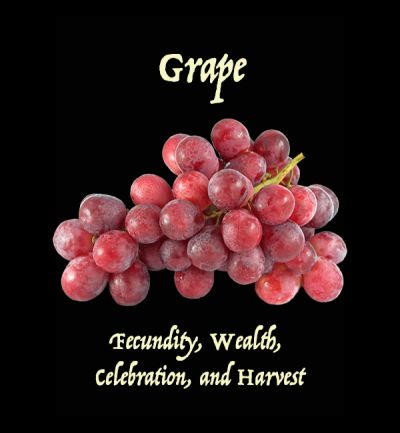
Grapes grow in clusters and are easy to share, so they symbolize Charity. Because they are abundantly fruitful, they also signify Fertility. Women who wish to get pregnant eat Grapes -- but not seedless ones -- as an act of faith, and a gift of grapes indicates a desire for children. Grapes also make wine, and thus are sacred to Dionysus and Bacchus, the Greek and Roman gods of Intoxication. The Grapes in the 7, 9 10, and King of Pentacles of the tarot stand for Fecundity and Wealth; those in the 3 of Cups and 4 of Wands mean Celebration and Harvest.

Grass is a name applied to more than 11,500 species in the Poaceae family of flowering plants. They are monocotyledons, so their leaves are marked by parallel veins, and they are usually pollinated by the wind. The family includes cereals grown for grain, turfs grown for forage, and ornamentals used in landscaping. Because grass is regularly trampled and eaten by herbivores, it symbolizes Submission and Renewal. It is rarely given as a floral tribute, but a growing container of grass is a splendid gift for a house-cat, to whom it brings Health and Vitality.

The Harebell is in the Campanula or Bell Flower genus, making it a cousin to the Bluebell, and it is known by some as Scottish Bluebell, although the two flowers are not similar. The name Harebell may come from old Scottish lore that where Harebells grow, Hares can be found, but another tale is that Scottish witches used a poultice or potion of Harebells to transform into Hares. It is a symbol of Clan MacDonald and also of Saint Dominic, the patron of astronomers, who introduced the rosary to Catholics. In a bouquet it means Faithful Expectation and Hope.
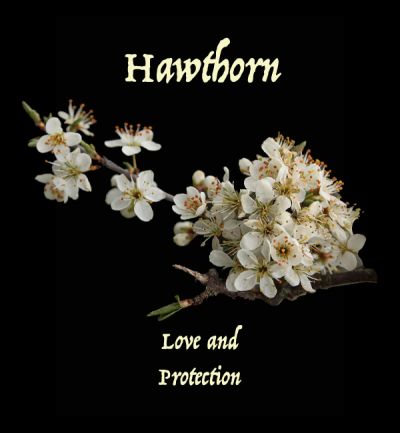
The White Hawthorn flower is a symbol of love, and the bush's thorns also bring protection. In the Victorian Language of Flowers, it symbolizes hope, happiness, and faith. It is considered by many to be the flower that represents the month of May, and on May Day, also known as Beltane, it is the custom to wear sprigs of Hawthorn in the hair. Blooming branchlets are also carried in bridal bouquets. Among the ancient Celts, the Hawthorn was a sacred plant, sometimes called the Fairy Tree. It was said to house ghosts, and to cut down a Hawthorn was a sacrilege.

The Heather is a flower of good fortune, much prized in Scotland. A bunch of Purple, Pink, or Lavender Heather conveys admiration, but can also represent the solitude that comes to those who live apart from the crowd. White Heather, on the other hand, conveys good luck and safety. It is said to grow only on land where no blood has been shed, so Scottish soldiers used to wear small sprigs of White Heather into battle. Its meaning in the Victorian Language of Flowers is, "Your Wishes Will Come True," and for this reason, it is found in wedding bouquets.
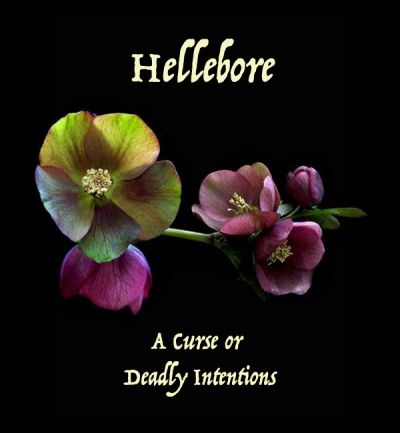
The Hellebore is a lovely but poisonous flower that blooms in the Winter and symbolizes a curse or deadly intentions; its very name means "it kills when eaten." Hellebore is associated with the planets Mars and Saturn in malefic conjunction and, on the theory that a small amount of a toxin can effect a cure, it was said in ancient times to be used by skilled physicians for the remission of mental illness and seizures. If someone gives you a Hellebore in a bouquet, there may be an evil wish attached to it, and if the one who presents the bouquet tells you to take a bite of it, beware!

Hen and Chicks is the common name given to a number of small succulent species in the Crassulaceae or Stone Crop family. The name is appearance-based, and refers to low, circular, evergreen plants such as the European Sempervivum ("Always Living") genus, and the American Echeveria genus, both of which reproduce by seeds, but more noticeably, by offsets from the base of the stem. People see the central rosette as the Hen, and the little offsets as her Chicks. The meaning of a gardener's gift of a living Hen and Chicks plant is "I will Care for You."

The Hibiscus is a warm-climate flower that comes in several colours in the yellow, orange, peach, pink, red, magenta, and purple range, The softer shades of Hibiscus symbolize delicate beauty, romantic love, friendship, hospitality, femininity, and youth, while the brighter shades of Hibiscus represent passion, glory, success, and joy. Closely related to Mallow, Althaea, Rose-of-Sharon, Hollyhock, and Okra, the Hibiscus blooms fleetingly, and is usually kept as a garden flower, but it is so dramatic that it may be worn as an ornament in the hair.

The Holly, with its prickly evergreen leaves and its cheerful red berries, is a plant of contradictions. Of course the stickery leaves stand for defense against physical intrusion and spiritual attacks -- but a sprig of Holly leaves and berries against a field of snow is heart-warming and a Holly planted by the front door signifies domestic happiness within. The Holly King is the ruler of the Pagan season of Yule, and although Holly is not often given in a bouquet, it is the custom to "deck the halls with boughs of Holly" to celebrate the turn of the year and the joy of the holidays.

The Hollyhock or Alcea is a close relative of the Marshmallow or Althaea in the great Mallow or Malva family. Its other plant-cousins include Rose-of-Sharon, Hibiscus, Okra, Cotton, Cacao, and the Linden or Tillia tree. What visually distinguishes the Hollyhock from the Marshmallow -- Alcea from Althaea -- is the Hollyhock's upward form of growth and showier blossoms. Hollyhocks are generally the tallest flowers in any garden, and a group of them in bloom is a grand sight indeed. Their height has earned them the floriographic meanings of Ambition and Aspiration.

The Honeysuckle is a vining shrub that bears long, tube-like flowers. In some species the flowers change from virginal white to yellow-gold as they mature and fade; other are two-toned in pink and yellow. The nectar within the flower tubes is sweet to the taste and so copious that people suck it out as a treat, which is why the plant is called "Honeysuckle." Due to its twining growth and delectable nectar, the Honeysuckle symbolizes the sweet bonds of love. Additionally, it is a favourite food-flower of Hummingbirds, which are themselves a symbol of honest and true love.

The Hop is a perennial climbing plant in the Cannabis family. Like its relatives, is it psychooactive; in this case mildly sedative, with anti-testosteronic qualities. The golden-green Hops flowers, also known as cones, burrs, or strobiles, are highly aromatic and may be brewed into a soothing tea or extracted in alcohol, such as beer. The male plants have no commercial value, so the female Hops are propagated by rhizomes. A bouquet of flowering Hops is a gift of Calm Relaxation, Healing, and Sleep, as well as Luck, Prosperity, Fertility, and Opposition to Injustice.
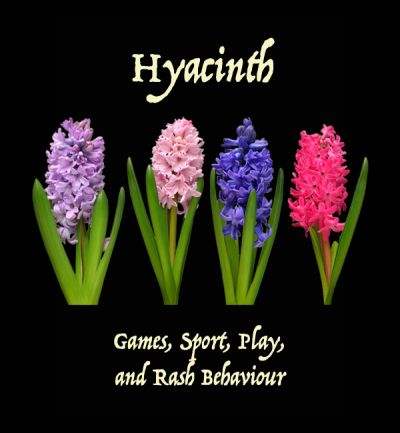
The Hyacinth symbolizes games, sports, play, rash behaviour, and same-sex love. It was named for the Spartan prince Hyacinthus, a man of unusual beauty and athletic ability who was a lover of the Greek Sun god Apollo, the deity of music, poetry, art, archery, and healing. Pink Hyacinth brings romance to games and play; Red Hyacinth indicates sexual playfulness; Yellow Hyacinth tells of jealousy masquerading as play; Blue Hyacinth is emblematic of constant love; White Hyacinth declares, "I'll Pray for You;" and Purple Hyacinth says, "I am sorry, please forgive me."

The Hydrangea is expressive of many moods. This is due to a unique property of the shrub itself, for its inflorescences are so sensitive to the acidity of the soil that their colour shifts from blue in acid soil to lavender in neutral soil and pink in basic soil. Gardeners exploit this trait by amending the soil to produce a trio of Hydrangea colours in a single garden. The Blue Hydrangea conveys apologies, regrets, and peace offerings. The lavender Hydrangea is neutral, expectant, and patient. The Pink Hydrangea symbolizes love, affection, and sentimentality.

Hyssop is a famous member of the large, varied, and aromatic Mint family. In the Biblical Book of Exodus, the enslaved Israelites were instructed to use it as a brush to paint their door lintels with the blood of a sacrificed lamb, to mark their homes for protection when the Lord sent the Angel of Death to kill the first-born children of the Egyptians. Additionally, as Psalms 51 tells us, a tea made from Hyssop leaves is used to cleanse oneself from sin. In the language of Flowers Hyssop represents Cleansing, Purification, Sacrifice, and Healing.
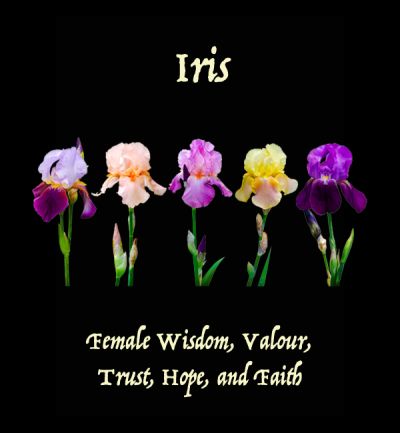
The Iris symbolizes a Message of Female Wisdom, Valour, Trust, Hope, and Faith. Its name means "rainbow," because it comes in many colours. Iris was a messenger goddess of the Greeks who ran down the rainbow to deliver news. The Yellow Iris appears in the tarot card of Temperance; the rainbow is found in the 10 of Cups. The Iris flower resembles female genitalia, and its fragrant rhizome, called Orris Root or Queen Elizabeth Root, is a power curio of women. In Victorian Floriography, the message in a bouquet of Iris is, "Your friendship means a great deal to me."

The Yellow Iris, like all Irises, conveys Friendship when offered in a bouquet, but additionally it signifies Passion. In the Temperance tarot card, a healing angel stands with one foot on land and one foot in a shallow creek that cuts across a narrow path leading to the horizon. Yellow Iris flowers bloom beside the angel, who pours water from one goblet to another, like a ministering pharmacist. This indicates the Healing Power of the Iris Root, which has antioxidant properties and is used to treat wounds, inflammations, and bacterial and viral infections.

The Ivy symbolizes clinging love and friendship. It festoons gracefully on a brick building, but smothers trees on which it casts its weight. Juvenile Ivy rambles over the ground, but once it gets its suckers into a tree, it matures, changes the shape of its leaves, then flowers and puts forth toxic blue berries. So different is the young Ivy from the mature tree-smotherer, that the adult form is called The Vine, and was long thought to be a different species from the Ivy. In love, clinging affection is charming, but if carried too far, dependency becomes destructive.

The Jasmine is a symbol of psychic visions, pure love, and meaningful dreams. Because it blooms at night with an intoxicating perfume, it represents astral travel and dream-visitations from a loved one or family member. In the tarot cards, Jasmine is associated with the 6 of Cups, "The Psychic Children." In past times, people planted Jasmine vines outside their bedroom windows so that, for the few weeks it is in bloom, they could sleep with the windows open, inhale its magical scent, and dream true dreams. If the Moon was full at the time, so much the better.

The Johnny-Jump-Up is a species of Violet, but unlike the Purple Violet, which stands for watchfulness, modesty, and faithfulness, the Johnny-Jump-Up, which suddenly bursts into flower at Winter's, symbolizes male phallic energy, ready to spring into action. All Violets and Pansies have the alternate name of Heart's-Ease, but only the Johnny-Jump-Up represents the victory of masculine kindliness accompanied by visible charisma and good will. The Johnny-Jump-Up is associated with High John the Conquerer Root, another symbol of the victorious man.
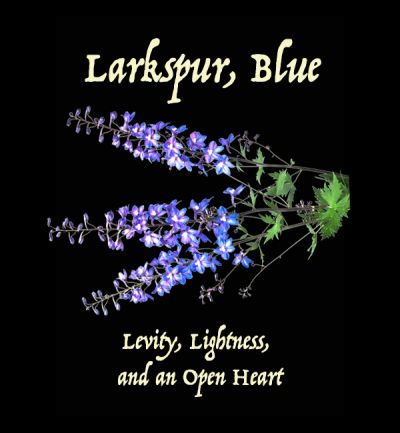
The blue Larkspur is not a single species, but all blue Larkspurs are charming wildflowers that grow in forested woods and mountain habitats. There are annual, biennial, and perennial species of Larkspur within the larger Delphinium genus. The Blue Larkspur carries its blossoms high above its leaves on strong, thin stalks, where they seem to almost float or dance in the air. This aetherial appearance has given rise to the association of the Larkspur with the qualities of levity, lightness, and an open heart -- but be cautious, for every part of the plant is toxic.
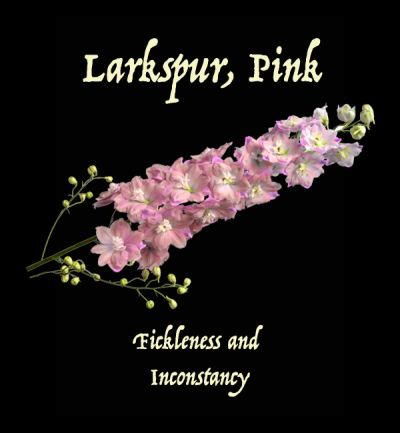
The pink Larkspur is a member of the large Delphinium genus. It is a gentle-looking wildflower, rarely grown in the garden and only carefully offered in a bouquet because it is toxic in all its parts. The meaning it conveys is that of fickleness and inconstancy, for its graceful, carefree growth seems like a fantasy of beauty that will never be available to hold and touch. Mingled with its cousin, the blue Larkspur, which symbolizes levity, lightness, and an open heart, it makes a beautiful mixed bouquet that says, "Your charm is sweet, but you only play at love."
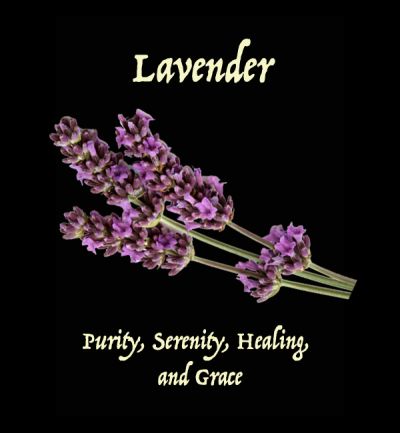
The Lavender flower is a symbol of purity, serenity, grace, and healing. It is said to have a calming or soothing influence upon the one to whom it is presented in a bouquet. Its light purple colour gives it royal associations, and so it represents noble love and loyalty. It is ruled by the planet Mercury, which is associated with young masculinity and the element of Air, and is thus also a sign of same-sex love and devotion. Lavender is stuffed into pillows as an aid to sleep, is used to scent soaps and perfumes, and has great popularity as a domestic, rustic fragrance.
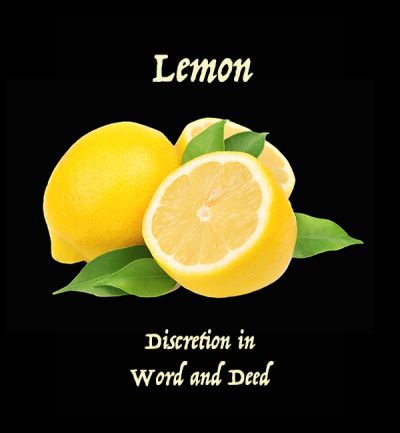
The Lemon belongs to the Citrus family, along with Rue and Oranges. It bears citrus-scented flowers and sour fruit. In the Language of Flowers it symbolizes Discretion, not revealing all one knows. Its uses in folk magic echo both its form and taste. The Lemon is shaped like an eye and contains liquid, like an eye, and so it will ward off the evil eye. It is also very sour, so when cut in half, it can be packed with Red Pepper and an enemy's name to sour that person's life. Sugar, water, and Lemon juice create a summer treat, ice cold lemonade, turning stress to pleasure.
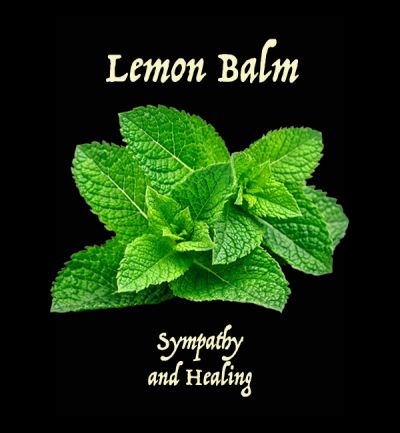
Lemon Balm is not a member of the Lemon, Orange, Rue or Citrus family, nor is it related to Balm of Gilead, the bud of a Poplar tree. It is in fact a Mint Family member, related to Spearmint, Peppermint, and Catnip. Most Mints are aromatic, and this one, Melissa officinalis, has a lemony scent and finds uses in herbal medicine (hence the name officinalis). Sedative and calming in cases of anxiety, stress, insomnia, and indigestion, it also reduces viral inflammations, such as cold sores. When given as a potted plant, it symbolizes Sympathy and Healing.

Lettuce, a plant in the Aster family, is grown to eat fresh in salads. There are many varieties, some bitter, some mild, some bright green, some whitish, and some tipped with maroon on the edges. From Wild Lettuce, which resembles a Dandelion, to Loose-Leaf, Oak-Leaf, Romaine, and Bronze-Leaf Lettuce, all forms of Lettuce are chilled to use in salads. The one variety most Americans are familiar with is the pale, compact ball of the nearly flavourless Iceberg Lettuce. To serve your suitor Iceberg Lettuce as a salad is to call the recipient Insipid and Cold-Hearted.

The Lilac is a hardy, fragrant Spring-flowering shrub native to Europe and Eurasia. In the Victorian Language of Flowers, it symbolizes the first emotions of love; however, it also holds the meaning of an old love or a lost love and for that reason it was once considered a flower appropriate for widows to grow in the front yard and bring into the home as a cut flower. Its fragrance is strong, beautiful, and inspirational to most people, so a large bunch of home-grown lilacs, while not a dainty bouquet, is a magnificent gift when calling on a friend for a day's visit.

The Tiger Lily is a magnificent flower, borne aloft on a strong stem, its petals reflexed to reveal dramatic black spots on glowing orange, reminiscent of a wild feline. Associated with women of high status, exotic tastes, and imperious bravery, it makes a stunning gift bouquet that requires a large, tall vase of the type that only those accustomed to floral tributes are likely to possess. As a flower of outsized opulence, the Tiger Lily compliments the one who receives it for having Courage, Wealth, and Pride akin to that of the Tiger from which it takes its name.

The Lily, with its six-pointed star of petals, comes in several colours, from orange and yellow to pure white. It is the white Lily -- emblematic of maidenly charms, virginity, purity, chastity, innocence, and heavenly blessings -- that appears several times in the tarot, where it is always accompanied by Red Roses. Look for the White Lily on the Ace of Pentacles, Two of Wands, Magician, and Hierophant, and on the card backs of the "Original Rider Waite Tarot Pack," where Roses and Lilies alternate to form a pattern linking worldly magic to mystical spirituality.

The Yellow Lily, unlike its better-known sister, the virginal, innocent White Lily, carries with its colouring a sunshiny optimism and a sense of carefree abandon. In the Victorian Language of Flowers, a bouquet of lovely Yellow Lilies conveys three differing, and slightly contradictory, sentiments "I am Happy and Gay," "I am Walking on Air" and, as a caution, "False Gaiety," as exemplified in the old Carter Family song lyrics: "When the flattering ones come around me, they'll think my heart is light; though my heart may break tomorrow, I'll be all smiles tonight."

Lily of the Valley is a spring-flowering woodland plant that spreads by underground rhizomes to form large colonies. As one time classified among the Lilies, it is now considered a member of the Asparagus family. It is highly toxic and its wonderfully scented flowers cannot be distilled into an essential oil, so all perfumes labelled Lily of the Valley or Muguet are combinations of other floral fragrances, made in emulation of the elusive original. Its meanings are Sweetness, Return to Happiness, Humility, "You've Made My Life Complete," and Tears of the Virgin Mary.

The Magnolia is a symbol of faithful, married love. Many species of Magnolia trees are grown as garden subjects. Their flowers range in colour from white to pink. Some are deciduous and some are evergreen. The evergreen Magnolia Grandiflora, also known as the Large-Flowered Magnolia or Southern Tree Magnolia, is the biggest and boldest of the lot. It bears enormous white flowers on a huge, long-lived tree. In hoodoo magic, the leaves of the Magnolia Grandiflora are placed between the box springs and mattress of the bed to ensure conjugal fidelity.

There are many species of Maple trees, almost all of them native to the Northern hemisphere. Most are deciduous and among the most prized species are those whose palmate leaves turn bright colours in Autumn. While hardy Maple Trees stand as a symbols of Strength and Endurance, the Sugar Maple Leaf on the flag, military regalia, and bullion coinage of Canada represents Unity and National Pride. In the Victorian Language of Flowers, to present a small bouquet of colourful Maple Leaves to a friend is a sign that you have Hidden Thoughts Held in Reserve.

The Mexican Marigold or Tagetes is a member of the large Daisy or Aster family. Not to be confused with the Calendula or European Marigold, this is a New World species. It is used in folk-medicine to treat poor appetite, stomach pain, colic, intestinal worms, coughs, colds, and sore eyes. Extracts of the plant ward off garden pests, especially aphids and planthoppers. This repellant action parallels the Marigold's meaning in the Language of Flowers, where it symbolizes cruelty, grief, and jealousy. Like the Calendula, the Tagetes is associated with the Sun.
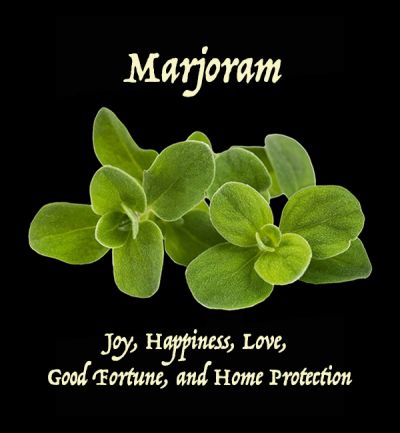
Marjoram is a member of the prolific and magical Mint family. It has a fine reputation in culinary use, being one of the five ingredients in the famous Italian Seasoning blend, which consists of Marjoram and its Mint family cousins Oregano, Basil, Rosemary, and Thyme. In ancient Greece and Rome, Marjoram was used in love spells and twined into wedding wreaths to bless and protect the marriage. As a potted housewarming gift or a fragrant sprig worn in a buttonhole, its message is one of Joy, Happiness, Love, Good Fortune, and Protection of the Home.

Mint is a fragrant herb with a sharp, clean scent. Although its flowers are inconspicuous and it is rarely presented in a bouquet, in the Victorian Language of Flowers it represents Virtue. Mint finds wide use as a fresh culinary herb that lends piquancy to teas and salads. In herbal medicine, Mint is known to ease nausea, calm anxiety, and help clear up coughs, and it is used to flavour less-appealing herbal remedies. In folk-magic it is used for cleansing and protection. There are many species of Mint, and Mint is the type genus of the large Lamiaceaea or Mint family.
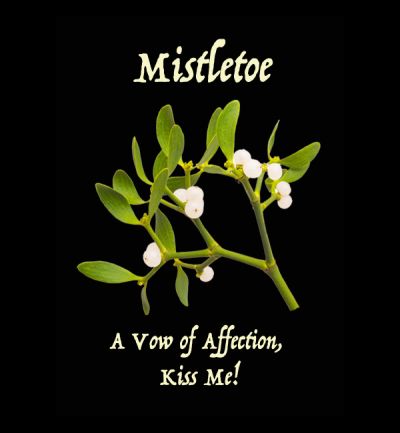
Mistletoe is a semiparasitic plant that inhabits deciduous trees. Well-known as a sacred medicinal herb of the Druids, it can be found in deep forests but is more common in sunny, open areas where birds can spread its seeds. The Norse associated it with the goddess Frigga, and it was with an arrow of Mistletoe that the traitor-god Loki killed Frigga's son, Balder. Rural folks harvest Mistletoe by shooting it out of trees to sell at Christmas-time. Loaded with white winter berries and hung in a doorway, it says, "Kiss Me!" and represents a vow of affection.
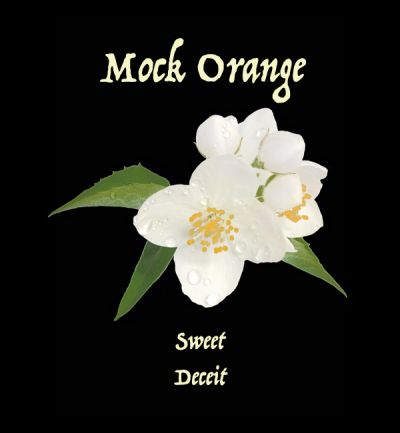
Mock Orange is a large shrub covered in Spring with thousands of white flowers which smell like Orange Blossoms. Because Orange Blossoms symbolize marriage, but Oranges do not grow in cold climates, the Mock Orange takes the Orange Blossom's place in bridal bouquets, and thus its meaning is "Sweet Deceit." This is not treacherous deception, but fragrant emulation, for the Mock Orange is actually in the Hydrangea family! Its Latin name, Philadelphus coronavirus, identifies it as the that crowned the Egyptian king, Ptolemy Philadelphus (285-246 BCE).

Monkshood gets its name from the appearance of the flowers, which resemble the hoods worn by Catholic monks in Europe during the Middle Ages. It is one of several members of the Aconitum genus, many of them interchangeably referred to as Aconite. All species, no matter where in the world they originate, contain a deadly toxin, aconitine, which can paralyze the heart, lungs, muscles, and nerves, resulting in rapid death. Even touching it can bring numbness to the fingers. Therefore, a bouquet of Monkshood tells the recipient, “Beware, a deadly foe is near.”

The Morning Glory is a symbol of mortality, in that it blooms gloriously in the morning, but each blossom lasts only a day, and fades away at night; it also represents love in vain or unrequited love and as a twining plant, it represents the power to bind. The seeds are psychedelic, although they carry rough side-effects. A species closely related to the Morning Glory is the white Moonflower, which blooms only at night and is symbolic of psychism. Both flowers are also related to High John the Conqueror, a famed hoodoo root carried for male power and vitality.
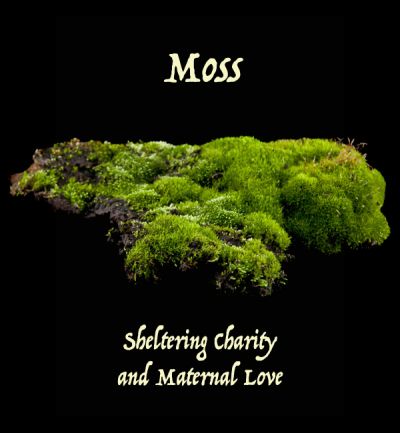
Humble, moisture-loving Moss, which covers stones and clings to the shady sides of trees, represents sheltering charity and maternal love. It spreads itself quietly along life's path, softening our way, and if given rain, it surprises our senses with a glowing carpet of vibrant green. When summer comes and the weather is dry, it quietly yellows, dries, and patiently waits. When given water, it renews itself and grows again. Moss is not given in bouquets, but it is often tucked around the bases of potted flowering plants, and there it symbolizes Loving Care.

Motherwort (which means Mother-Root in Old English) is a symbol of strong maternal love and protection, and it is found in hoodoo spells that aid women and children. A member of the Mint family, it is used medically to stop bleeding, treat heart conditions, allay menstrual irregularity and ease menopause. Its taxonomic name is Leonurus cardiaca ("Lion-Tail for the Heart") and thus it is associated with the zodiacal sign Leo and the tarot cards of Strength, the lady who tames a Lion, and the Queen of Wands, the woman seated on a Lion throne with herbs in her crown.

Mushrooms -- the fruit of various fungi -- are not often thought to be a gift in contemporary urban areas, but they do have symbolic meanings, nonetheless, based in part upon their species. At the height of the Victorian craze for floriography, when a prospective male suitor came to call, if a woman did not wish to welcome him in, the gift of a basket of edible mushrooms conveyed a distinct meaning to the recipient: "Away! Go home and cry about it!" Presumably the rejected suitor had the comfort of cooking up the mushrooms, perhaps in a nice omelet.
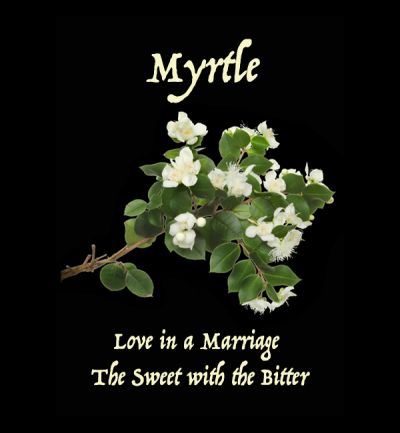
"The Myrtle so bright, with its emerald hue" is a flower of contradictions. Its fragrant white blossoms and deep green leaves smell sweet, but its taste is very bitter. Under the Hebrew name Hadassah, it is the emblem of the Biblical Queen Esther, who hid her true name and ethnicity, displayed her sweetness and grace to the King of Persia, became his wife, and was thus able to bitterly destroy Haman, who had sought to commit genocide against the Jews. In the Victorian Language of Flowers, Myrtle is called Love in a Marriage, the Sweet with the Bitter.
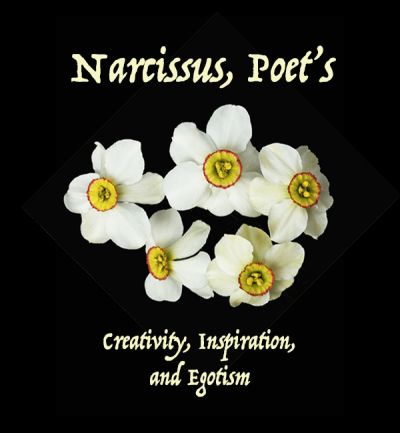
The Poet's Narcissus has been revered since classical times as an emblem of Creativity and Inspiration. It is related to the Daffodil, but instead of a "trumpet," the inner part of the flower is flat, with unique red banding on its rim. It was named for Narcissus, a man so smitten with his own good looks that he tried to embrace his reflection in a river, fell in, and drowned. As the word "narcissist" implies, it also signifies Egotism. It is said to have been the flower that the goddess Persephone was picking when the god Hades abducted her to the underworld.
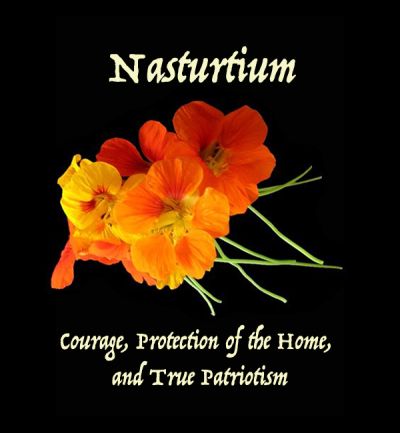
The Nasturtium is a symbol of courage, protection of the home, victory in battle, war, conquest, and true patriotism, perhaps because its bright orange flowers look like bombs exploding and its leaves resemble shields arrayed against the attack of a foe. The name Nasturtium is Latin and it means "twisted nose," for although the flower's the nectar is very sweet, the plant itself has an indescribably odd odor. For all of that, Nasturtium flowers are delightfully spicy in salads, and the buds, when pickled, make a very good home-made substitute for Capers.
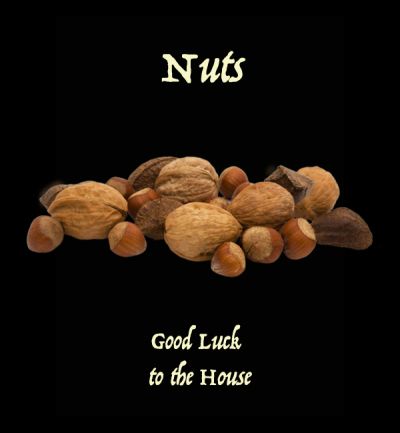
Walnuts, Hazelnuts, Pecans, Hickory Nuts, Butternuts, Almonds, Chestnuts, Pistachios, Brazil Nuts, and Macadamias are united by form, not species. They are edible seeds inside hard shells and grow on trees. Some seeds called Nuts, like Peanuts, Soy Nuts, and Pine Nuts, do not fit that definition, and Acorns are excluded because they are inedible until processed. A bowl of mixed nuts, a nut cracker, and a set of nut dishes is a traditional Winter gift meaning "Good Luck to the House." Nuts also symbolize hard-headed people with fixed ideas; they are "just plain nuts."
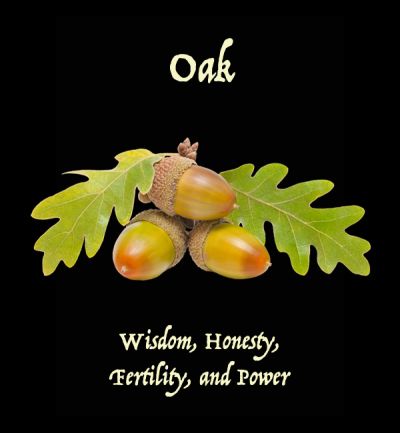
The Oak Tree is a symbol of stability, endurance, attainment, justice, robust health, and longevity. The Oak Leaf is a symbol of wisdom and honesty, while the Oak Acorn is a symbol of fertility and the steady growth and unfoldment of wealth, and dignified social position. Venerated by the ancient Greeks as a tree of the great god Zeus and by the ancient Druids as a kingly, sacred tree, the Oak also appears in silhouette on several tarot cards, including the Knight of Pentacles and Knight of Cups. Lightning-struck Oak wood is used in folk magic as a symbol of power.

The Oleander is a lovely ornamental shrub with abundant summer blooms in several colourful varieties, ranging from white, through pink and peach, to crimson. Every part of the Oleander plant is highly toxic, so it is no wonder that its meaning in the Victorian Language of Flowers is "Warning! Caution! Danger!" Even drinking the water left in a vase that held Oleander flowers as a bouquet can bring on symptoms of poisoning, so beware. When planted around the homestead, the Oleander brings joy to the eye, but as a gift, it conveys an ominous message.

The Orange is a member of the large Citrus and Rue family, the Rutaceae. Its healthful fruit is eaten out of hand, squeezed to make juice, made into Orange marmalade, and used to flavour everything from tea to chocolate. The fragrant, white Orange Blossom which heralds this fruit is recognized as a symbol of Innocence, Purity, Eternal Love, Faithful Marriage, and Fruitfulness. It is traditionally worn by brides in wedding crowns, and its scent, called Neroli, is a prized ingredient in "white flower" perfumes, as well as in citrus-scented eau de cologne.
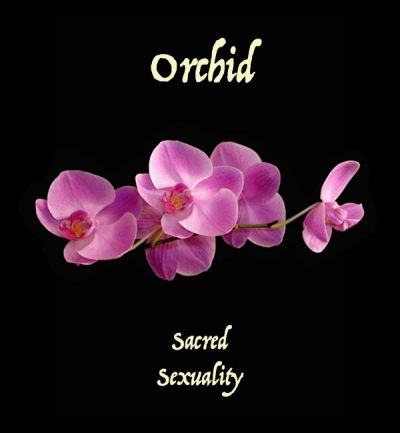
The Orchid is a symbol of sacred sexuality. Its graceful flowers come in numerous shapes and colours, but all of them, in one way or another, evoke the image of a female vulva. Interestingly, the Orchid's tuberous roots derive their name from the same Greek word that denotes the male testicles. The gift of a Orchid corsage from a man to a women therefore carries an immediate message of sexual desire and its fulfillment. When a woman wears the Orchid corsage she has been given, the meaning is clear to all; she has a lover — or at least a date for the night.
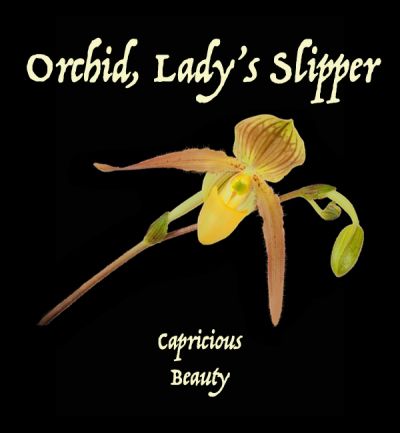
The Lady's Slipper Orchid has a little structure at the front which resembles a woman's slip-on shoe. It takes its name from veneration of the Blessed Virgin Mary, after whom many other "Lady" flowers have been named. However, the meaning of the Lady's Slipper in the Language of Flowers anything but holy, for it is a symbol of Capricious Beauty. In African-American hoodoo, a Lady's Slipper flower used to be worn by women in the left shoe when looking for love — but it is now a rare plant, so modern conjure doctors use a Violet leaf or flower instead.

Oregano is a Mediterranean culinary herb, well known as a flavouring in Italian cookery. It is not grown for its flowers, but for its fragrant leaves, which are also antiseptic. It is said to ward off law officers and false witnesses, and thus is used in court case spells. A potted Oregano plant given as a gift conveys "Substance" "Good Placement" and "Protection." As a Mint family member Oregano is closely related to Dittany of Crete and Marjoram, and its botanical cousins include Savory, Sage, Rosemary, and Thyme, not to mention Lavender, Catnip, and Basil.

The Date Palm frond is a symbol of victory, success, and eternal life. To Jews, it represents kingly rulership, and the phallic tree with its testicular fruits demonstrate male energy and potency in the tarot card of the High Priestess. To Catholics, the Palm represents victory mingled with sacrifice, for as King Jesus entered Jerusalem, Palm fronds were laid down for his donkey to walk upon, but within days he hung upon the cross to atone for the sins of the world. For this reason, Catholic saints who died defending their faith hold the Palm of triumphant martyrdom.

The Pansy is a flower whose very name means "thought." As such, it is a symbol of fond memories, kindly sympathy, introspection, and reverie. The pensive Pansy is also the symbol of the Freethought Movement, whose members have declared its meaning to be "memories, loving thoughts, and souvenirs." A member of the often-shy Violet family, the robust Pansy holds its flowers up for all to see. The cute markings on the flowers resemble a monkey's face, and many a pretty Pansy has been kept in a book of poems as a pressed flower, a memento of a happy day.

Parsley (from Greek "Petros Selinon" or "Rock Celery") grows on rocky ground and is in the Celery family. The Greeks said it sprang from the blood of Death's son Archemorus ("Herald of Death"), who was eaten by Snakes. At the Nemean Games, founded in his honor, the victors wore crowns of Parsley. The Romans used Parsley to decorate tombs. Jews say a blessing over Parsley at Passover, dip it in salt water to symbolize the tears of slavery, and eat it to celebrate new beginnings. Christians use Parsley to ward off evil; garnishing food with it kills poisons.
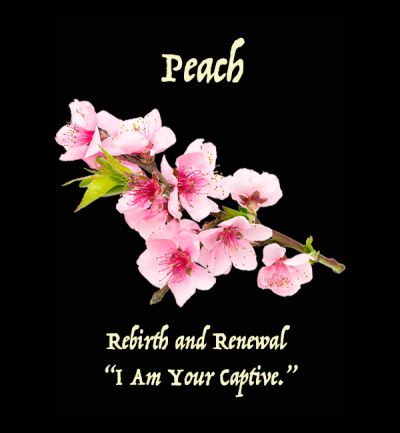
Peach Blossoms, the pink flowers of the Peach tree, are a beautiful harbinger of Spring and remind us of nature's yearly Rebirth and Renewal. Peach leaves are used in magic spells for children's academic success, while Peach fruits symbolize longevity, good health in old age, and protection from evil spirits. As for the flowers of the Peach, in Japan, they mark the holiday of Hinamatsuri or Girls' Day, on March 3rd, and in the Victorian Language of Flowers, to give a blooming branch of Peach Blossoms to one's beloved is to secretly say, "I Am Your Captive."

The Peony is a hardy shrub which produces yearly crops of showy, multi-petalled flowers. The blossoms are mildly fragrant, carrying hints of Rose, Citrus, Carnation, or Jasmine, depending on the variety -- but the fragrance is evanescent and we instead admire the longevity of the Peony plant, reliably blooming year after year, with a lifespan longer than most human beings. This combination of large flowers and hardiness has given the Peony the symbolism of a Long, Healthy, and Joyous Life, albeit, in the case of the Pink Peony, with a hint of Sexual Scandal.
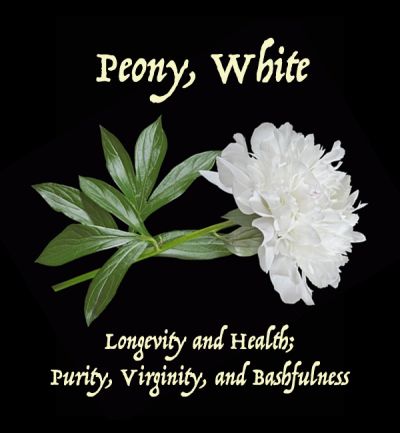
The Peony is among the longest-lived flowering plants in the garden. Native to the Northern Temperate zones, and reliably hardy in much of North America, it requires a period of Winter chilling in order to bloom. Various species of Peony have come to us from Asia, Europe, and the Western United States, and the flower's cultural importance in Asia certainly influenced the Victorian Language of Flowers, for with its long lifespan the Peony symbolizes Longevity and Health, and the White Peony additionally connotes Purity, Virginity, and Bashfulness.

Periwinkle leaves and flowers have long been reputed to enhance conjugal felicity, pleasure, and happiness among married couples and those who share a home. This belief seems to have been based on the way that the Periwinkle twines and clings to walls in a loving, tender way and displays its leaves in perfect pairs, all the way along the stem. The blue flowers of the Periwinkle are also said to be symbolic of spiritual peace and harmony, and to improve marital relations, ensure fidelity, put an end to domestic disputes, and soothe away all family troubles.

The Petunia is a symbol of petulance. Short-stemmed and spreading, it is available in solid, striped, and spotted varieties. It comes in a wide range of colours, and each of these hues has a well-known symbolic meaning that modifies the basic message. Being a low-grower, the Petunia is not presented in bouquets, but it may be given to a friend in the form of a potted plant in full bloom. According to the Victorian Language of Flowers, the meaning of the potted Petunia is "I Feel Resentment and Anger -- But Your Presence Soothes Me."
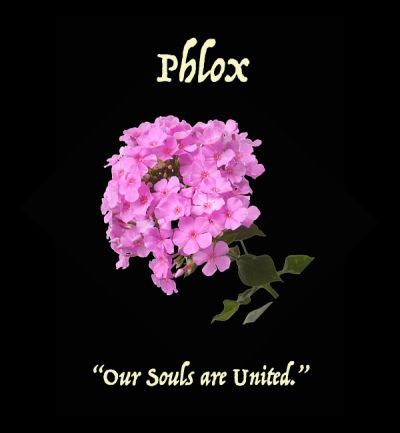
The name Phlox refers to a large genus of North American wildflowers. Some are tall and bushy, others are short and creeping, but they all bear the name Phlox, which derives from the Greek word for "flame," a reference to their bright globes of intensely vivid pink, magenta, lilac, blue, or white flowers. While all species of Phlox can be found in the wild, one particularly showy species, Phlox paniculata has entered into domestication, and it is known as the Garden Phlox. Its message to the one who receives it in a bouquet is, "Our Souls are United."
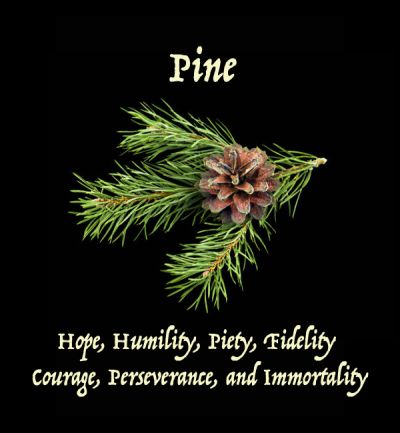
The Pine, a tall, evergreen tree, represents Hope, Humility, Piety, Fidelity, Courage, Perseverance, and Immortality. In Europe and North America, Pines and other evergreens are displayed at Yule or Christmas. In China, the Pine is an image of strength in the face of hardship; in Japan it is a New Year symbol of renewal and a bright future. To the Iroquois, the White Pine symbolizes the Great Peace that united their separate nations into a League. Twin Pines is used as a emblem of buyer and consumer cooperatives, credit unions, and community gardens.
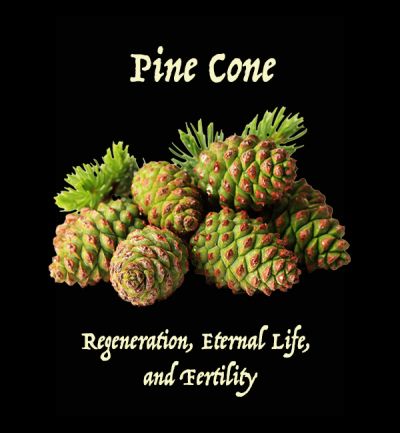
The Pine Cone is the nut-bearing organ of the Pine tree. In ancient Egypt the Pine Cone represented Regeneration or Eternal Life. In Greece and Rome, it was a Fertility symbol linked to the Greek god Dionysus and the Roman god Bacchus, both of whom were patrons of the Grapevine and wine making. Those who venerated Dionysus carried a phallic Pine-Cone-tipped wand. Pines were also associated with the Greek goddess Pitthea. If you pine for someone, you desperately want to see them, or as the saying goes, "I Pine for You and Balsam (bawl some)."

The Pineapple is a tropical plant native to South America whose fragrant and flavourful fruit became an emblem of Hospitality during the era of British colonialism. Wealthy North Americans imported Pineapples as an adjunct to the Caribbean slave trade, while the British devised coal-fired hot-houses to coax the plants into fruit. When a host presented a Pineapple for dessert it was a show of Welcome; when a weekend guest came bearing a Pineapple in a basket it signified Generosity. In modern times, the Pineapple has become an icon for IVF Fertility Treatments.

The Plumeria, also known as Frangipani, is a symbol of budding romance, passionate love, new beginnings, and birth. Its meaning is positive, optimistic, and hopeful. The fragrant flowers grow on a shrub, which contains a toxic, milky sap so bitter and irritating to the mouth that apparently there is no record of anyone ingesting enough if it to suffer major ill effects. Hawaiian Plumeria flowers are used to make perfume, floated in the bath to scent it, or strung into garlands called leis that are given as gifts of affection and enjoyed for their sweet and fruity scent.

The California Poppy is a brilliant and showy wildflower and the official State Flower of The Golden State. In Spring its four-petalled flowers can cover acres of land, especially on sunny hillsides. California is famous for the Gold Rush of 1849, and the California Poppy symbolizes the golden riches that the Forty-Niners brought forth from the earth. It signifies Wealth and Success, but it is not given in bouquets because it is not long-lasting as a cut flower. The best way to enjoy it is to seed it around the home or travel to see a mass of the flowers in bloom.

The blood-red Poppy is a symbol of peaceful sleep, quietude, consolation, and death. It is associated with these things because the plant is a source of the sedative narcotic drug opium, which is used for pain relief, as a cough suppressant, and, in larger doses, to bring on a fatal coma. The red colour of the flowers is also reminiscent of blood, another symbol of death. Poppies grow wild in much of Europe, and their association with the battlefields of the First World War has led to the Poppy becoming associated with disabled veterans and fallen soldiers.
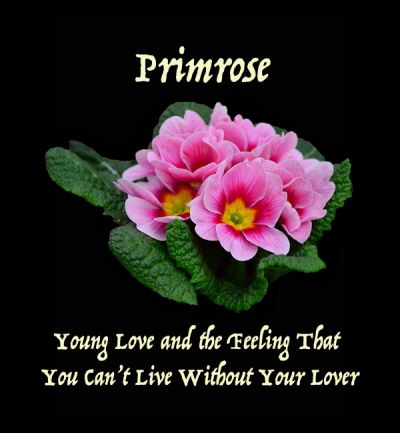
The Primrose is a symbol of young love and of the feeling that you can't live without your lover. The name comes from the Latin word Primus, meaning "first," because it blooms in early Spring. All Primroses have a yellow center that looks like an eye or a star, while the colour of the outer petals can be yellow, blue, white, pink, red, or purple. White is for new love, yellow for happiness, blue for serenity, red for sexual passion, purple for noble thoughts, and the pink-and-lilac coloured Primrose signifies womanly confidence in the outcome of one's desire for love.

The Pussy Willow has soft, fuzzy grey male flowers, called catkins, which appear before its leaves do every year. Willows are associated with the Moon and have medical healing powers as analgesics, while Cats are also considered to be Lunar in nature and to have the power to heal so the healing power of Pussy Willow makes great metaphysical sense. When presented as cut branches in bloom, the Pussy Willow represents a sure sign of the return of Spring, recovery from illness, renewal of growth, and the gentle softness of protective motherhood.

Queen Anne's Lace is the American name for Wild Carrot, the same species as the domestic Carrot, but with a woodier root. Named in honour of Britain's Queen Anne (1665 - 1714), its umbelliferous head of tiny white flowers does resemble fancy lace, and each lacy grouping bears one red flower, called the ruby, which represents a drop of blood that fell when Queen Anne pricked herself with a needle. Woven into wreaths and garlands it symbolizes Safety and Sanctuary; presented as a bouquet it offers praise to the recipient's Elegance and Purity.
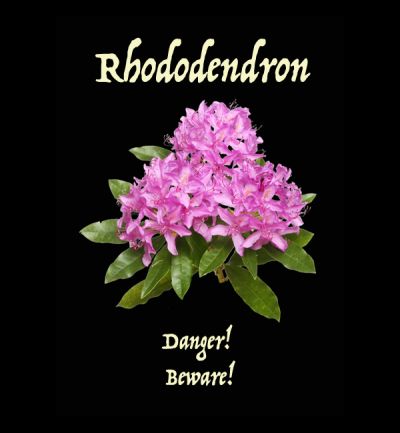
The Rhododendron is an evergreen shrub with large leaves and glorious heads of trumpet-like flowers in shades of white, cream, pink, rose, scarlet, lavender, lilac, orchid, and purple, often with speckles, stripes, and ruffled edges. Its name, from the Greek, means "Rose Tree," but it is neither a Rose nor a tree, being in fact a relative of the Azalea. All parts of the Rhododendron are toxic and can cause serious cardiac symptoms, including low blood pressure, atrial fibrillation, and brachycardia -- so it is no surprise that its meaning is "Danger! Beware!"
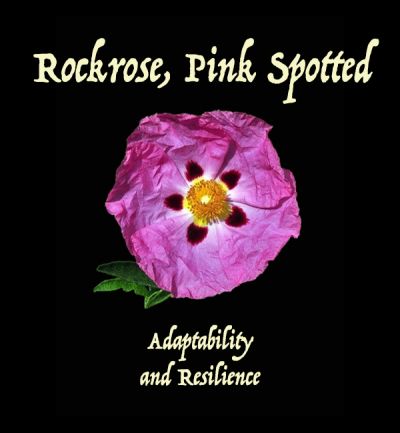
The Pink Spotted Rockrose is a cross between the White Spotted Rockrose (Cistus ladanifer, native to Spain, Portugal and North Africa) and the Pink Rockrose (Cistus creticus, native to Crete and Israel). Glandular hairs on the leaf surfaces exude a fragrant resin called labdanum. Many believe it to be the "Balm of Gilead" in the Bible, for Cistus grows in the ancient territory of Gilead. It may also have been an ingredient in ketoret, the sacred Jewish temple incense. The symbolism of the Pink-Spotted Rockrose is Adaptability and Resilience.

The Banksia or Yellow Lady Banks Rose is, like other Roses, a symbol of love, but it differs from other Roses in many ways. First, it is virtually thornless, with very soft petals, representing the gentlest of love. Second, it blooms all along its lengthy canes, not at the tips. Third, it does not smell like a Rose, but has the fragrance of Violets, giving it the soothing qualities of Pansy or Heart's Ease. Fourth, it blooms a full month ahead of any other Rose. And fifth, it is tender-hearted, a native of Southern China that only thrives in regions with the lightest of Winter frosts.

Budded Roses signify new or upwelling love, and the Pink Rose Bud, halfway between the innocent girlhood of the White Rose Bud and the eager sexual desires of the Red Rose Bud, is emblematic of Youth, Beauty, and a Heartfelt New Romance. Pink Rose Buds convey a desire to awaken romance, but not to seduce or kindle passion. A lover's subtle shift from sending White Rose Buds, then Pink Rose Buds, and finally Red Rose Buds, is mirrored in a common hoodoo spell in which the lover burns three candles in succession, white, pink, and red.

The Rose Bud is a symbol of new or budding love and the Red Rose is a symbol of intense Sexual Passion, so the Red Rose Bud carries the doubled meaning of an expectation of sexual union with a New Love. It is for this reason that men are known to present women they desire with Red Rose Buds as dating gifts. The Rose is associated with the female planet Venus, while the colour red is linked with the male planet Mars, hence the Red Rose Bud also symbolizes the sexually-charged astrological conjunction of feminine Venus and masculine Mars.

The White Rose, when in bud, is said to be a symbol of girlhood. As it opens, it becomes representative of Innocent Love, Pure Love, New Love, or heavenly love. When fully in bloom it tells of secret love, and also conveys the sentiment, "I am worthy of your love." The white rose appears on the Tarot card of The Fool, and is the emblem that he carries as, accompanied by a white dog, he steps off a cliff. In this case his innocence may be seen as a folly, but he proceeds on despite the warnings he may receive, especially in matters of new love.

The Rose is a symbol of love and affection, associated with the planet Venus. The "Chicago Peace Rose" is a highly coloured sport of the well-known and paler "Peace Rose," which was introduced in 1945 to commemorate the end of World War Two. By the time that the vividly-tinted "Chicago Peace" was found in a garden in Chicago and introduced to the public in 1962, America had put the War behind and was ready for the hot-hued Swinging Sixties. In more recent years, "Chicago Peace" has come to symbolize hope for an end to gun violence in the Windy City.

Whereas a single Red Rose Bud conveys a message of New Love, a bouquet of One Dozen Red Roses symbolizes a vow that the coming twelve months are being set aside as a promise of One Year of Love and Devotion. This is a gift for special annual occasions: Valentine's Day, February 14th, the holiday of love and romantic sexuality; the recipient's birthday, with the promise of twelve more months of dedicated passion and affection; and a couple's wedding anniversary, to renew the bonds of matrimony for one more year of fidelity, pleasure, and union.

The five-petalled Wild Rose, when given in a bouquet, is a symbol of spontaneous and free love. Rose Hips, the edible apple-like fruits of the Rose which ripen in Fall, make eccentric bouquets which are emblematic of good health and a cheerful disposition. They come in many colours, just like Apples do, from red and orange through yellow and green, and some are even black. High in natural Vitamin C, Rose Hips, when taken as a tea or made into jam, support the growth and repair of all body tissues, and uplift the immune system.

The Rose is a symbol of love and sexual passion. It is associated with the planet Venus and appears in the tarot cards for the Queen of Pentacles, The Magician, The Hierophant, the Two of Wands, The Fool, and others. The White Rose is for new love, the Pink for romance, and the Red for passion. Most unusual is the large peach-coloured rose "Just Joey." The man who hybridized it wanted to give it the full name of his wife, but she asked for it to be given her nickname, and so it became "Just Joey," a symbol of great beauty that cloaks itself in humility.
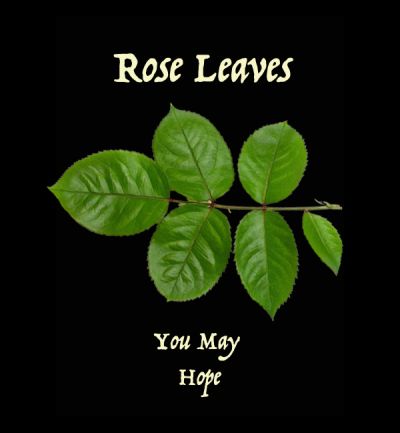
Everyone loves Roses -- their colourful furled buds, their generous open blossoms, their wide range of heady floral scents, and their healthful hips. But what about the green Rose Leaves? Do they have a traditional meaning in the Language of Flowers? Yes, they do. The compound leaves, with matched pairs of leaflets bearing a distinctive pattern of veins, may or may not be included in a rose bouquet. If they are, and if the leaves are free from blemishes, disease, or insect bites, they convey the message, "You May Hope" for a reply to your offer of love.

The Red Rose symbolizes passionate love and the White Rose speaks of purity and fidelity. Together they call to mind the English Wars of the Roses (1455–1487), which pitted the White Rose of the House of York against the Red Rose of the House of Lancaster, and ended when Henry VII of England married Elizabeth of York, symbolically uniting the White Rose and Red Rose. Thus, a bouquet of mingled Red Roses and White Roses coneys a message of unity, collaboration, and partnership, an end to hostilities, and a future of cooperative love and peace.

Imagine that you dated a charming woman and sent her a bouquet of long-stemmed, budded Roses in a florist's box tied with ribbon -- and then heard nothing from her. No message of gratitude or interest would be sent in return, and the silence would extend to a week. Then, a messenger would appear on your doorstep with a florist's box tied with ribbon. You would open the box and find, untouched, the bouquet of roses, now withered, the symbol of Rejected Love. Yes, those Victorians knew how to ghost someone after a first date too!

The Yellow Rose is traditionally said to represent the emotion of envy or jealousy, although in modern times florists have tried to replace that meaning with the comforting idea that it stands for friendship and joy. "The Yellow Rose of Texas" is a famous song about a beautiful mixed-race woman who played a part in the War of Texas Independence in the 1830s, and for this reason, the Yellow Rose is also a highly positive symbol to those who are not members of upper-class White society, but whose radiant beauty has become the envy of others.
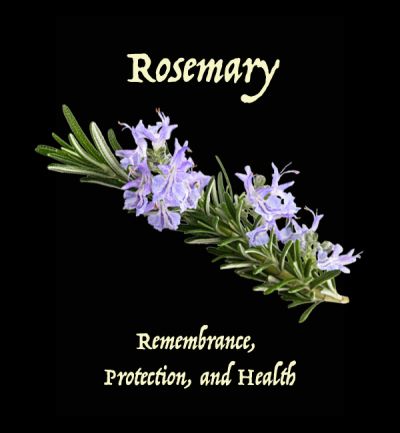
Rosemary is called the symbol of remembrance, and it is known for fostering a strong memory, and strengthening loving bonds of fidelity and peace in the home. A bush of Rosemary planted by the door is said to give women power in the home, and Rosemary tea is a well-loved hair rinse. A tender perennial member of the Mint family, Rosemary is distinguished by its pine-needle-like leaves, floral-Minty fragrance, and lovely pale blue flowers, which resemble those of its botanical cousins, Lavender, Sage, Catnip, Oregano, Basil, and Dittany of Crete.
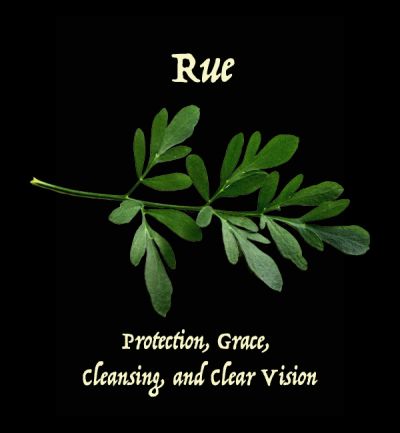
Rue is a member of the Citrus family, which includes Oranges and Lemons, but not many people are aware that the entire family, the Rutaceae, is named after this humble herb. Like all Citrus plants, Rue has the power to physically and spiritually clean people and places. In the Language of Flowers, the meaning of Rue is Protection, Grace, Cleansing, and Clear Vision. Silver charms called Cimaruta ("Sprig of Rue") ward off the evil eye of jealousy, while bathing in warm Rue tea removes the damage caused by malevolent or envious glances.
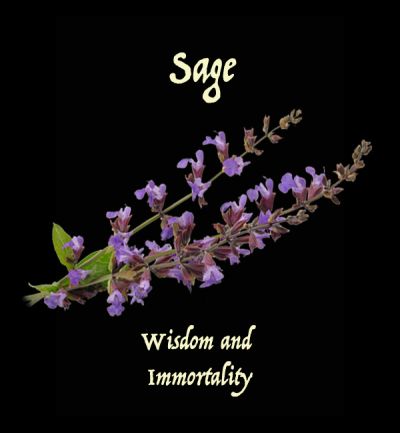
The Sage or Salvia is a symbol of wisdom and immortality, and is associated with the planet Jupiter and his day, Thursday. The lavender-blue Sage seen here has the additional meaning of "I think of You." Sage is also a popular incense for energy-cleansing, although some people are allergic to its fumes. Botanists and herbalists know that Sage is a member of the aromatic Mint family, which also includes its cousins Rosemary, Lavender, Catnip, Oregano, Dittany of Crete, Thyme, and many other fragrant culinary, medical, and magical plants.
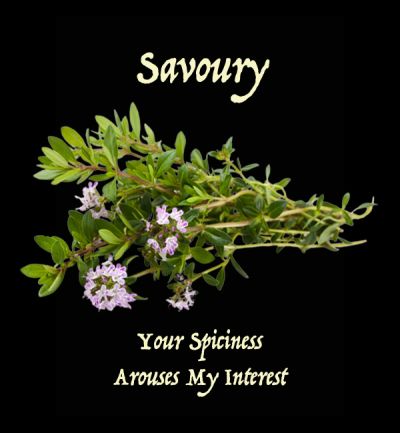
Savoury is a member of the prolific and aromatic Mint family, and its botanical links to its fragrant cousins are commemorated in the famous 18th century English ballad, "Scarborough Fair," with the mnemonic refrain of "Savoury, Sage, Rosemary, and Thyme." The word "savoury" refers to foods that are salty or spicy rather than sweet, and has the secondary meaning of "appetizing," so it is no surprise that this tasty culinary herb, used to flavour meats and sauces, conveys the floriographic message that "Your Spiciness Arouses My Interest."

The Snapdragon is a plant of contradictory meanings. On the one hand it represents a Gracious Lady -- and on the other it symbolizes deception by means of concealed intentions as it protects against witches and wicked people. The flowers are squeezed to open their "dragon mouths" and released to snap them shut, and their dry seed pods resemble a miniature skull, adding to their magical reputation. Snapdragons come in many bright colours, each with a meaning: for example, yellow is for optimism, orange for changes, and pink for romance.

The early-flowering Snowdrop bears a single white bell-shaped flower with six petals. As the birth flower for January, Snowdrops symbolize Hope and Renewal. They are also associated with the February 2nd festival of Candlemas, the 40th day after Christmas, when the Virgin Mary took Jesus to the Temple for his blessing. Parishioners process around the church on this day, carrying candles to be blessed and taken home, and Snowdrops picked at this time are known as Candlemas Bells. In floriography Snowdrops mean "I Am Not a Summer Friend."

Pink Sorrel, also called Wood-Sorrel due to its preference for shady areas, is often confused with Pink Clover, because both plants have heart-shaped trifoliate leaves. However, unlike Clovers, Sorrel plants fold their leaves closed at night and open them in daylight, and their flowers -- in shades of white, yellow, or lavender -- have five veined petals each. Living in moist, forested areas, and forming humble, low beds on the ground, the Pink Wood-Sorrel, with its startlingly bright flowers, conveys the meaning of Quiet Affection That Proves to Be Passionate.

Yellow Sorrel, also known as Cape Sorrel, Sheep Sorrel, Sour Trefoil, Sheep's Clover, Bermuda Buttercup, Yellow Oxalis, and Sour Grass, is not a Trefoil or Clover, despite its heart-shaped leaves; not a Buttercup, despite its yellow flowers; and not a Grass, despite its long stalk. Instead, it is an Oxalis, known for the high levels of oxalic acid in its cells. Because its leaves resemble Four-Leafed Clover, it symbolizes Luck, Healing, and Protection; and if two people share a single Sour Grass stalk, the ordeal brings them Never-Ending Love and Friendship.

Southernwood's grey-green, fern-like leaves emit a sweet, lemony-camphor aroma when crushed. It is an Artemisia, related to Wormwood and Mugwort, in the Daisy or Aster family. Like other Artemisias, it contains thujone, a compound that eliminates pinworms, roundworms and tapeworms but, if taken to excess, is neurotoxic, convulsant, and hallucinogenic. In the past, Southernwood was considered an antidote to poisons as well as to spider, scorpion, and snake bites. When grown in the yard it symbolizes Protection, Love, and Marital Constancy.
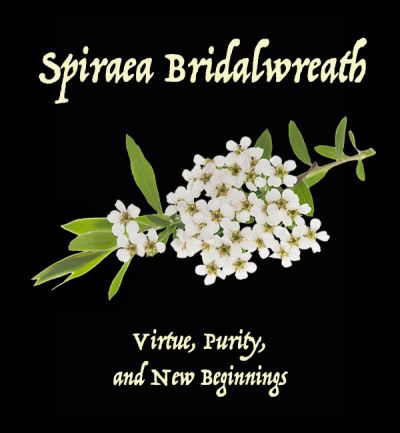
Spiraea is the name of a genus of deciduous shrubs in the Rose family grown for their large clusters of tightly-packed flowers. The name Spiraea is derived from the Greek word "speira," which means "wreath," "coil," or "spire” -- terms that describe the various forms taken by the showy flower clusters they bear in mid-Spring. White-flowered Spiraeas of various species and cultivars are commonly called Bridalwreath Spiraeas because their delicate white blooms are traditionally carried in bridal bouquets to symbolize Virtue, Purity and New Beginnings.
- Spiraea-Meadowsweet.jpg
There are everal species of Pink Spiraea, variously known by the common names Meadowsweet, Rose Meadowsweet, or Rosy Spiraea. These graceful members of the Rose family are popular in garden landscapes due to their shrubby growth and dense spires of vivid, five-petalled blossoms. In a bouquet, Pink Meadowsweet symbolizes Prosperity, Wealth, Success, Victory over Hardship, and Creative Expansion. Like Willows in the genus Salix, Spiraeas contain pain-killing salicylate compounds, and the name Aspirin is derived from Spiraea.
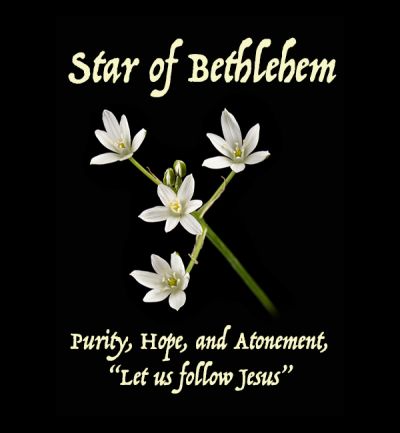
Star of Bethlehem is a small white flower in the Asparagus family. Its taxonomic name, Ornithogalum, means Bird's Milk, which is not as romantic as it sounds, for its bulbs are a sub-toxic famine food, known in 2 Kings 6:25 as Dove's Dung -- and both names refer to the white excrement of birds. The flowers open around noon, but close on cloudy days and at night, giving rise to other names, such as Sleepy Dick, Eleven O'Clock Ladies, and Nap-At-Noon. Star of Bethlehem symbolizes Purity, Hope, Atonement and, among Christians, "Let Us Follow Jesus."

Stephanotis is a genus of woody, evergreen tropical vines which bear clusters of beautifully scented tubular white flowers. Native to Africa, Madagascar, and the Middle-East, they easily reach ten feet in length, but when grown domestically, they are trained onto wire hoops to limit their size. Some call them Madagascar Jasmine, but they are actually members of the Dogbane family. Stephanotis means "suitable to wear as a crown" and an alternate name, Bridal Veil, tells of their symbolism: Happiness in Marriage, Desire to Travel, and a Honeymoon Abroad.
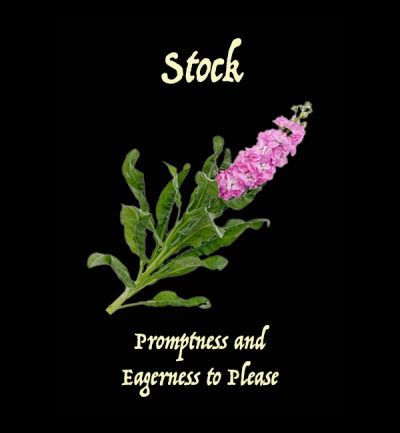
The Stock, also known as Brompton Stock, Matthiola, or Ten-Week Stock, is an old-fashioned bienniel much loved for its rich fragrance, with hints of Vanilla, Rose, and Cloves; its generous assortment of pink, cream, magenta, lavender, or purple flowers; and the rapidity with which each plant develops. These qualities more than make up for its rather messy leaves and relatively short blooming season. Naturally, the Stock's characteristic of speedy growth has given rise to its symbolism, for it conveys the meaning of Promptness and Eagerness to Please.

The Sunflower is a symbol of Optimism, Hope, and Renewal of Health, for it always turns its face to the Sun. A member of the Daisy or Aster family, it is notable for its tall habit of growth, golden flowers, and nutritious oil-bearing seeds, which are arrayed in a sacred whirling pattern known as the Fibonacci spiral. The Sunflower is the emblem of the National Spiritualist Association of Churches. Among the tarot cards, it is the flower held as a scepter by the powerful Queen of Wands, and also the flower that grows and blooms in the happy card of The Sun.
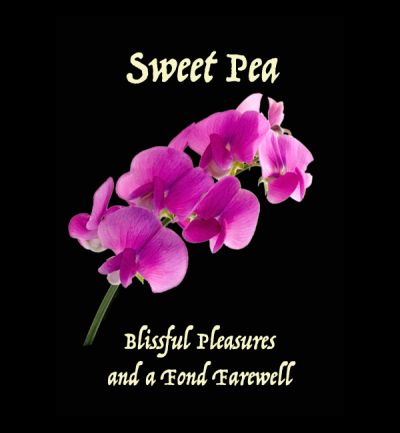
The tall and fragrant Sweet Pea, which comes in a rich array of hues, from white and ivory through peach, pink, magenta, and purple, is a close relative of the Garden Pea and the Wistaria. Taken on its own, it is a symbol of Blissful Pleasures, but if it is presented in a bouquet, it also conveys the meaning of a Fond Farewell. Thus, when a hostess cuts bunches of freshly blooming Sweet Peas from her garden, in all their many colours, and gives them to her departing guests, she is effectively saying, "Good-bye and thank you for a lovely time."

Sweet Woodruff, also known as Master of the Woods, Galium odoratum, or Asperula odorata, is an unlikely member of the Coffee family or Rubiaceae, related to both Gardenia and Cinchona or Quinine Bark. Even more unlikely, this fragrant plant, with its attractive whorls of green leaves and white flowers, seems barely able to lift itself from the ground, which conveys the meaning of Humility -- but under the name Master of the Woods, it represents Strength, Rulership, and Control, and it aids athletes by increasing their energy while relieving aches and pains.

The Tansy, a pretty yellow button-shaped flower in the Daisy family, is a symbol of hostile thoughts and declarations of war. This is likely due to the fact that although the Tansy is associated with Venus, the planet of love, and with Gemini, the zodiacal sign of communication, it also contains a toxic load of Thujone, a natural botanical chemical that, when ingested, can cause death in livestock and human beings. In fact, one old household remedy to keep ants and fleas away from the home consists of planting Tansy flowers all around the perimeter of the house.

Tarragon, also known as Estragon or Dragon Plant, is an unusual culinary herb because it is a member of the Aster or Daisy family, unlike the Mint-family herbs such as Basil, or the Celery-family herbs like Dill found in many recipes. Its unique aromatic scent marks it as a member of the Artemisia genus, related to Wormwood and Mugwort. The use of Tarragon as seasoning is widespread in France and Italy, where it flavours vinegar and appears in salads. Its meaning in floriography is "Lasting Interest," which is appropriate, as it is a perennial garden plant.

The symbolism of the prickly Thistle varies by region. In Scotland it exemplifies bravery, courage, and loyalty in the face of treachery, and its purple blossom signifies royalty and noble character. In Romania it brings luck. Where the Thistle invades pastures, it represents aggressiveness and pain. In the Bible Thistles symbolize desolate lands. The Blessed Thistle has healing powers and supports breastfeeding; Medieval Benedictine monks used it to combat the bubonic plague, and in African American hoodoo it is found in protective teas and floor washes.

Thyme is a low-growing member of the aromatic Mint family, and like its cousins Rosemary, Basil, and Oregano, it finds uses in cookery as well as magic. Although it is of humble stature, Thyme is tough, rugged, long-lived, and wildly fragrant, so it symbolizes Courage and Strength. It is also associated with prosperity magic, and to keep Thyme in the garden or in a pot, with a lucky coin beneath its roots, is said to make your money grow. Medically, Thyme helps fight off bacterial infections and relieves coughs. As the saying goes, "Thyme is on your side!"

Toadflax is probably the flower with the most common names of all. It is also known as Brideweed, Bridewort, Butter and Eggs, Bacon and Eggs, Bread and Butter, Butter Haycocks, Bunny Haycocks, Bunny Mouths, Lion Mouths, Dragon Bush, Dead Men's Bones, Devil's Flower, Devil's Flax, False Flax, Wild Flax, Flaxweed, Fluellen, Gallweed, Gallwort, Impudent Lawyer, Jacob's Ladder, and Ransted. The Celts called it Fae Flower and said it grows on Hidden Treasure. Picking it for a bouquet is fine, but digging up the plant invites the Wrath of the Little People.

The Tulip is a symbol of a perfect lover. They come in many colours and each one has a meaning, so a bouquet of assorted Tulips can be "read" like a letter. The Yellow Tulip conveys good cheer: "There's Sunshine in your smile." The Red Tulip signifies passion or a declaration of love: "Believe me." The Pink Tulip implies friendship: "You are sweet." The Burgundy Tulip stands for respect: "I admire you." The Purple Tulip tells of fame and honour: "You rule my heart." The variegated Tulip expresses fascination: "I am lost in the gaze of your beautiful eyes."

Valerian gets its name and meaning from the Latin verb valere: to be strong, healthy, and ready, which evokes related words like valour, value, valedictorian, and valid. The Roman Emperor Valerian (199 - 260 CE) oppressed Christians and died as a captive of the Persians. Valerian root, also known as Vandal Root, wards off envy and affects cats much like catnip, while its sweetly scented flowers attract butterflies, moths, and flies. Ruled by Mercury, Valerian is a folk remedy for insomnia, and may be boiled with Licorice, Raisins, and Anise Seed to relieve coughs.

Vanilla flowers are not as well known as Vanilla Beans, the fruit-pods of the Vanilla Orchid, but both emit a heavenly fragrance that is associated with love. Vanilla extract is used extensively in cookery as an aromatic addition to sweet cookies, cakes, and chocolates. Far from being merely symbolic of love, Vanilla is a powerful relaxant and an erotic arouser that works especially well on men. As the old commercial goes, "Nothin' says lovin' like something from the oven," and baked delicacies warm with the musky-floral aroma of Vanilla are a wonderful invitation to romance.
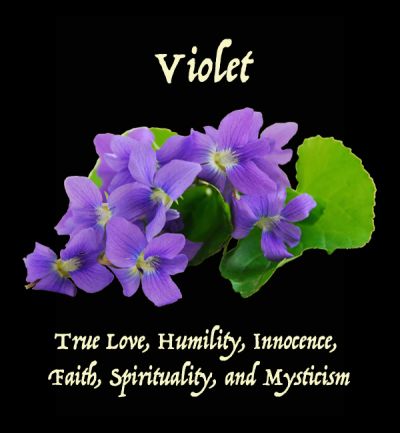
The Violet, which hides its flowers close to the ground under heart-shaped leaves, is a symbol of true love, modesty, humility, innocence, faith, spirituality, and mysticism. Because the Violet is closely related to the Pansy, it is also a symbol of thoughtful remembrance. The fragrance of the Violet is very lovely and persistent, and wearing a cluster of violets pinned to the bosom is a way of surrounding yourself with rare, exotic perfume. The Violet is associated with the months of February and March, the zodiacal sign of Pisces, and the planet Jupiter.

The Virginia Creeper is equally at ease running along the ground or climbing walls and draping downward. It is capable of sprouting roots at every joint, so when the hanging vines touch earth, they creep onward until they can climb again. Unlike the evergreen Ivy, the five-leafed Virginia Creeper is spectacularly deciduous: bright green in Spring, it suddenly shades to yellow, orange, flame red, pink, and purple in Fall, then drops all its leaves at once for Winter. When given in a bouquet, it symbolizes Rising Above Obstacles, and Tenacious Enthusiasm.

Viscaria, also known as Sticky Catchfly or Wild Pink, is a member of the Campion or Carnaton family, the Caryophyllaceae. Two beloved species are Viscaria vulgaris, also known as Lychnis viscaria, and Viscaria alpina, also known as Silene suecicae. Viscarias bear whorled spikes of bright pink flowers and they have sticky or viscid patches on their stems, below each leaf-joint. The beautiful way they dance in the wind, and their slightly sticky adherence, has given rise to their symbolism, for when presented in a bouquet, they say, "Will you dance with me?"

The White Water Lily is a symbol of Purity, Hope, Birth, Wellness, Enlightenment, and Peace. Cultures all around the world associate Water Lilies with gods, goddesses, meditation, and spirituality. Another name for the White Water Lily is the White Lotus, and this aquatic plant's habit of growth, rooted on the bottom of ponds, but sending its fresh green leaves and ethereal white flowers aloft to reach the light of the Sun, gives rise to the saying, "Out of the mud springs the Lotus," which is another way of saying that Spirit is free from earthly encumbrances.

The Pink Water Lily, also known as the Pink Lotus, is a symbol of Tranquility, Meditation, and Noble Birth. It is similar to the White Lotus in terms of its spiritual significance, but the delicate pink blush of its petals gives it a distinctly feminine touch and in Hindu iconography it is closely associated with the goddess Lakshmi, the bringer of wealth, who stands upon a Pink Lotus and showers golden coins on her devotees. The Pink Water Lily also appears in the tarot cards for the Ace of Cups as a symbol of Tranquility, and in the Page of Cups as a sign of Noble Birth.

The Willow, especially the Weeping Willow, if given in a bouquet, is a symbol of the sadness and the sorrow of unrequited love. When planted by a grave, it represents the hope that the deceased will be remembered with regret, for as an old song goes, "Bury me beneath the Willow, under the Weeping Willow Tree, so he may know where I am sleeping, and perhaps he will weep for me." Yet, in a strange inversion, this Lunar tree, which conveys so much grief, is also symbolic of the eventual ease of pain, for Willows are medical analgesics, and have the power to heal.

The Wistaria, a long-lived vine that can grow to 30 or more feet in length, is a symbol of longevity and sensuality, of lives entwined in strong love. The abundance of its pea-shaped flowers, followed by long pea-like pods, is associated with female fecundity and fertility. Over time, the trunks of the Wistaria vine, if well-supported, grow into sturdy, brown tree-forms, but the new growth is always expressed as gentle, green tendrils. Purple Wistaria is sexually seductive and white Wistaria is virginally chaste, but both are more powerful than they first appear.

Witch Hazel is a North American shrub that flowers from Autumn through snow-fall, for which reason it is also known as Winterbloom. The seeds take a year to mature, so their capsules and twisty yellow flowers are seen at the same time, until the pods expel their seeds as explosively as bullets from a gun. Native Americans use a decoction of the bark for dressing wounds and Scots-Irish Appalachians use its branches for water-witching or finding treasure. A branch of flowering and fruiting Witch Hazel means that you are Casting a Spell for Love or Money.

Common White Yarrow or Milfoil, a member of the Aster family, has been given the Latin name Achillea millefolium, the "thousand-leaved" flower of the ancient Greek war hero Achilles. Each leaf is so finely divided that the plant bears thousands of leaflets and its association with Achilles is born out by its medical use as a battlefield vulnary, for which reason it is also known as Soldier's Wound-Wort. Thus Yarrow symbolizes courage, bravery, and endurance. In Chinese folk magic a bundle of 50 Yarrow stalks is used to cast fortunes with the I Ching or Book of Changes.

The name Zinnia refers to a genus of closely-related flowers in the Daisy family, native from the American Southwest to South America, and most diverse in Mexico. Their flower forms range from single and semi-double to fully double, and their colours include chartreuse, cream, yellow, orange, red, pink, and purple. These frost-sensitive annuals are often planted from seed as mixed varieties to produce vibrant multi-coloured bouquets which, in the Victorian Language of Flowers, convey "Thoughts of an Absent Friend," "Lasting Affection," and "Daily Remembrance."

Because Zinnias are annuals that grow from seed to full flower in about two months and do not live over the winter, they are prolific bloomers. Covered with blossoms from Summer until the first hard frost, they attract butterflies and other pollinators to the landscape garden and make vivid cut-flower bouquets. The Red Zinnia is not purely red, but displays a variety of shaded hues from scarlet, conveying the sentiment of "Constancy," to magenta, representing "Lasting Affection" -- which is strange, considering that they bloom for only one season.


How the Floral Oracle Has Grown
In January 2021 i started a catherine yronwode Instagram account. I has been onlne offering my reading services since 2009, but in November 2021 i decided to go live on HoodooPsychics.com twice a week, and also to redesign the Floral Oracle flower photos to fit the squarish Instagram format. The vertical Facebook images were reconfigured, and some new flower texts and images were added. As it has turned out, Instagram hasn't done much for me -- 90% of my followers and friends find me through Facebook, the Lucky Mojo Forum, and our weekly podcast, the Lucky Mojo Hoodoo Rootwork Hour on YouTube The only good thing about IG is that cute little squarish layout, like an endless run of nine-patch quilt blocks.
By September 2022, we had more than 90 flowers and their meanings completed. It was while working on the latest week's text that i suddenly had the desire to publish the whole lot as a stand-alone project. I realized that if i took the HoodooPsychics.com advertisement material off the image and simply ran the name of the flower and a few keywords, followed by the informative text, i would have produced a teaching tool and fortune telling device in one item. We released these text and image blocks via my Patreon account in September and November 2022 in four weekly installments -- a total of more than 90 different flowers and texts in all.
From September through November 2023, the four Patreon pages were compiled into one page and released to the general public -- with our deepest thanks to the Patrons who made this project financially feasible.
Beginning in October 2023, i increased my office hours at Hoodoo Psychics to include Mondays. My Monday readings were well accepted by my clients, although not every day was advertised with Floral Oracle placards, and you had to go to the Hoodoo Psychics website itself to see if i was on the line.
In February 2024, we reached the goal of 104 flowers -- a pair of colour-matched flowers for every Friday and Saturday for a full year -- and we had gotten 2,000 views of this page. So we started a new series of flowers for Mondays, which allowed us to add a new flower and its meaning every week, and i began reading 7 days a week at HP website.
In June 2024 we had 120 different flowers online and 7,000 views of this page. That's when we got "discovered" by the internet -- because in October 2024, we had 140 flowers in the collection and had received more than 23,000 views, and by December 2024, with 150 flowers, we had received 36,000 views.
In February 2025 we completed 156 flowers, meaning that my Monday reading advertisement sequence was filled for a full year, and our view-count had reached 60,000. We then began adding flowers for Tuesdays.
In February 2026, the Tuesday cycle of 52 flowers was completed, we had 208 flowers online and the page's view-count had surpassed 175,000.
We added flowers sporadically at that point, trying to even out our aesthetic goal of running book-end colour and form matches on Monday-Tuesday and Friday-Saturday in order to make cute Instagram rows of 3, with a different ad between each pair. In June 2026 the view-count for this page reached 200,000.
In July 2026 we serious committed to adding new flowers and their symbolism for Wednesdays and Thursdays, and the view-count was at 286,000 for this page.
How many Floral Oracle flowers will there be? Well, my collection of Victorian Floriography books is extensive, and if we commit to seven flowers per week and multiply that times 52 weeks in a year, the total will be 364 flowers, plus one to make 365 for the full year (and maybe one more, for leap years). God willing, i will still be doing psychic readings and we will get there in 2029 if we fund the remainder of the project only via my callers at Hoodoo Psychics -- however, to speed things along, i may do another dip or two into Patreon funding, to complete the project before my 80th birthday in May of 2027. We shall see.
To Discuss This Patreon Page
This Patreon Bonus Page is part of the series titled "Your Wate and Fate." To discuss it with me and the Patreon community, please visit our Private Patreon Forum at
http://forum.luckymojo.com/your-wate-and-fate-t93995.html
Thank you.
catherine yronwode
curator, historian, and docent
Your Wate and Fate
Special thanks to my dear husband and creative partner nagasiva yronwode for illustrations, scans, and clean-ups.